One Person Company Registration in Bangladesh gives solo entrepreneurs a solid legal foundation to safeguard their assets. This modern business model allows an individual to enjoy corporate perks while retaining full operational control, making it ideal for entrepreneurs aiming to grow without the hurdles of traditional partnerships.
Registering your startup with the Registrar of Joint Stock Companies and Firms (RJSC) grants legal recognition and limited liability. By filing the required documents with the Registrar of Joint Stock Companies and Firms (RJSC), you can complete your company registration while keeping your personal and business documentation properly organized.
Awareness of One Person Company (OPC) Registration in Bangladesh helps business leaders make informed decisions about valuation, dilution, and shareholder rights, while preserving long-term corporate stability and growth potential.
The Registrar of Joint Stock Companies and Firms (RJSC) is the only legal authority in the country for One Person Company (OPC) Registration in Bangladesh. Following RJSC’s clear steps helps you register your OPC efficiently. Proper arrangement helps you avoid common pitfalls and ensures your entity achieves the legal status it deserves.


The RJSC issues legal permission and registration for a wide range of business services, including:
- One Person Company (OPC) Registration
- Company Share Transfer and Share Allotment
- Joint Venture Company Registration and Share Allotment
- Partnership Firm Registration
- Branch Office and Liaison Office Registration
- Foreign Company Registration and Share Transfer
- Society and Trade Organization Registration
- Company Annual Return / Schedule X Submission
- Company Winding Up and Certified Copy Issuance
Our comprehensive guide streamlines the journey to achieving this status. We detail every requirement, from document preparation to final approval. This ensures your path to success is straightforward and easy.
Quick Facts: One Person Company (OPC) Registration in Bangladesh
Governing Law: Companies Act, 1994 (Section 392A–392G, OPC amendment)
Registering Authority: RJSC (Registrar of Joint Stock Companies and Firms)
Eligible Applicant: Bangladeshi citizen or foreign national, natural person, 18+ years old
Shareholders: Exactly 1 (sole shareholder)
Nominee Director: Mandatory (1 nominee required)
Minimum Paid-up Capital: Tk. 25 lakh (2.5 million)
Maximum Paid-up Capital: Tk. 5 crore (50 million)
Annual Turnover Requirement: Between Tk. 1 crore and Tk. 50 crore
Name Clearance Fee: Tk. 600 (approx.)
Name Clearance Validity: 30 days from approval
Company Name Suffix: Must end with “One Person Company” or “OPC”
Conversion Option: Must convert to Private/Public Limited Company if capital or turnover exceeds the limit
Key Takeaways
- Gain limited liability protection for your solo business venture.
- Maintain total control over your daily operations and decision-making.
- Formalize your status through the official government regulatory body.
- Separate personal assets from professional liabilities for better security.
- Follow a streamlined process to achieve legal status quickly.
Understanding the Concept of One Person Company in Bangladesh
The legal recognition of a One Person Company (OPC) is a significant change for solo entrepreneurs in Bangladesh. It allows a single person to establish a corporate entity. This bridges the gap between traditional sole proprietorships and complex private limited companies. Engaging in one person company formation Bangladesh offers a viable option for those wanting a distinct legal identity.
Definition and Purpose of OPC
A One Person Company is a corporate entity with a single subscriber to the memorandum. Unlike traditional companies needing multiple shareholders, it grants full control to one person. This model maintains the benefits of a separate legal entity. Its primary purpose is to enable solo founders to grow their businesses without needing partners.
Choosing this structure offers several advantages:
- Limited liability protection for personal assets.
- Enhanced credibility with banks and financial institutions.
- A clear, professional framework for future business expansion.
Why the Government Introduced OPCs
The government introduced OPCs to encourage the formalization of small-scale enterprises and solo startups. Many entrepreneurs operated informally as sole traders, limiting their access to credit and growth. By simplifying One Person Company Registration in Bangladesh, the authorities aim to bring these businesses into the formal economy.
This change reflects a strategic intent to foster a culture of innovation and entrepreneurship across the country. It provides a secure environment for individuals to test new business ideas while minimizing personal financial risk. This framework serves as a catalyst for economic development by empowering individual business owners to compete on a larger scale.
Key Features and Characteristics of an OPC
Starting a business in Bangladesh as a single person has become easier with the One Person Company (OPC) Registration in Bangladesh structure. This legal setup lets one entrepreneur enjoy corporate benefits while keeping full control. It meets the latest standards set by the RJSC.
Limited Liability Protection
One of the most significant advantages of an OPC is the protection it offers to the owner. Unlike a sole proprietorship, where personal assets are at risk, an OPC creates a distinct legal boundary. Your personal wealth remains separate from business liabilities.
This protection means your personal property is generally safe from business risks. You can take risks without worrying about losing personal savings or family assets.
Single Shareholder Structure
The OPC model is ideal for solo entrepreneurs. You own 100% of the shares, simplifying decision-making. There’s no need to consult with partners or deal with conflicting interests.
Despite having only one shareholder, the entity is seen as a separate legal person. This structure offers professional credibility and efficient management. It’s perfect for solo founders aiming to grow their business.
Perpetual Succession
Another key benefit of an OPC is perpetual succession. This ensures your business continues even if the shareholder’s status changes. Even if the owner dies or becomes incapacitated, the company remains a legal entity.
The business doesn’t end when the founder dies. Instead, a nominee director takes over, ensuring the company’s continuity. This feature offers long-term stability and peace of mind for your business’s future.
Legal Framework Governing OPC Registration in Bangladesh
The introduction of the One Person Company (OPC) structure marks a significant shift in Bangladesh’s corporate landscape. It allows individual entrepreneurs to enjoy corporate benefits while retaining full control. Understanding the legal foundation of this structure is crucial for any business owner in Bangladesh.
The Companies Act 1994 Amendments
The legal basis for establishing an OPC lies in the amendments to the Companies Act 1994. These changes were made to simplify the business environment for solo entrepreneurs. By integrating the OPC model, the government provided a clear pathway for small-scale businesses to transition to formal, registered entities.


These amendments ensure an OPC functions with the same legal legitimacy as a private limited company. It grants the business a distinct legal personality, separate from its owner’s personal identity.
Regulatory Oversight by the RJSC
The Registrar of Joint Stock Companies and Firms (RJSC) is the primary regulatory body for corporate registrations in Bangladesh. It oversees the compliance and operational integrity of every OPC. Entrepreneurs must interact with the RJSC to ensure their business remains compliant throughout its lifecycle.
The RJSC maintains a rigorous process for verifying documentation and ensuring statutory requirements are met. By enforcing these standards, the agency protects the interests of stakeholders and maintains transparency in the marketplace. Adhering to the guidelines set forth by the RJSC is a mandatory requirement for any individual seeking to maintain a valid and compliant business registration.
Comparing OPC with Other Business Structures in Bangladesh
Choosing the right legal structure is crucial for your business’s success. In Bangladesh, entrepreneurs compare various entities before deciding. Knowing the differences helps match your business goals with the best legal protection.
OPC vs Sole Proprietorship
A sole proprietorship is straightforward but lacks legal separation. You’re personally liable for all debts and legal issues. This puts your personal assets at risk if the business faces financial or legal troubles.
An OPC, on the other hand, offers limited liability protection. Your personal wealth is safe from business obligations. While starting a sole proprietorship is easy, an OPC provides a more secure and professional environment for growth.
OPC vs Private Limited Company
A private limited company is strong but needs at least two shareholders. This can be a challenge for solo entrepreneurs wanting full control. The OPC allows a single shareholder to enjoy corporate benefits.
Both structures offer limited liability and continue indefinitely, unlike sole proprietorships. However, the OPC is tailored for solo owners. It reduces administrative tasks and maintains the prestige of a registered company without needing a second shareholder.
| Feature | Sole Proprietorship | One Person Company | Private Limited Company |
|---|---|---|---|
| Liability | Unlimited | Limited | Limited |
| Shareholders | One | One | Minimum Two |
| Legal Status | Not Separate | Separate Entity | Separate Entity |
| Compliance | Minimal | Moderate | High |
Prerequisites for One Person Company (OPC) Registration in Bangladesh
Before starting the one person company (OPC) registration in Bangladesh, you must meet certain legal standards. Knowing these foundational rules ensures a smooth application process. It’s crucial to comply with the Registrar of Joint Stock Companies and Firms (RJSC) rules for all entrepreneurs.
Eligibility Criteria for Shareholders
To qualify for one person company registration in Bangladesh, the applicant must be a natural person. This person must be a citizen of Bangladesh and have the legal capacity to enter into a contract. Age requirements state that the shareholder must be at least 18 years old to hold shares in the company.
Moreover, a person is generally restricted from forming more than one OPC at a time. This rule ensures the focus remains on individual business growth. You must also ensure your proposed business activities comply with the legal framework set by the government.
Minimum Capital Requirements
When considering OPC registration at RJSC, you must meet the financial threshold set by the authorities. Under Section 392C of the Companies Act, the minimum paid-up capital for OPC registration in Bangladesh is Tk. 25 lakh, with a maximum limit of Tk. 5 crore. You must declare the authorized and paid-up capital clearly during the filing process.
Proper capitalization is crucial for your firm’s credibility. It shows your commitment to the business and provides a safety net for potential creditors. Always check the current capital guidelines on the official RJSC portal before submitting your application.
Document Checklist for Applicants
Gathering the correct paperwork is a critical phase of the process. The documents required for OPC registration in Bangladesh include essential items that verify your identity and business intent. Ensure all copies are clear and up to date to avoid unnecessary delays.
- A copy of the National Identity (NID) card of the shareholder.
- A signed copy of the Memorandum and Articles of Association.
- A formal consent letter from the appointed nominee director.
- Proof of the registered office address, such as a utility bill or rent agreement.
- A Tax Identification Number (TIN) certificate for the applicant.
Organizing these documents in advance significantly increases your chances of successful incorporation. Attention to detail during this stage prevents common errors that often lead to application rejection. Once your documentation is complete, you are ready to proceed with the formal registration steps.
RJSC Name Clearance Process for OPC Registration
This initial step ensures that your chosen business identity is unique and does not conflict with existing entities registered in the country. Successfully completing this phase is a mandatory requirement for every entrepreneur starting the OPC name clearance journey in Bangladesh.
Selecting a Unique Business Name
Choosing the right name is vital for your brand’s long-term success. The Registrar of Joint Stock Companies and Firms (RJSC) has specific guidelines to prevent confusion in the marketplace. You should avoid names that are identical or deceptively similar to companies already on the register.
To ensure your application is approved without delay, consider these best practices:
- Perform a thorough search on the RJSC database to check for existing names.
- Avoid using generic terms that lack distinctiveness.
- Ensure the name does not violate any trademark laws or government naming restrictions.
- Include the term “One Person Company” or “OPC” as required by local regulations.
Using the RJSC Online Portal
The government has streamlined the OPC name clearance Bangladesh procedure by moving it entirely online. You must create an account on the official RJSC portal to submit your request digitally. This system allows for real-time tracking of your application status.
Once logged in, you will provide your proposed name and pay the necessary processing fee. The system will then verify the availability of the name against the current database. If the name is unique and compliant, you will receive a digital clearance certificate shortly after submission.
The name clearance application typically requires a processing fee of around Tk. 600, payable through the designated bank.
Validity and Renewal of Name Clearance
It is important to note that name clearance is not a permanent approval. Once granted, the name is reserved for a specific period, typically 30 days. You must complete your company registration within this timeframe to secure the name permanently.
If you fail to finalize the registration before the expiration date, the name will be released back into the public pool. In such cases, you will need to apply for a fresh name clearance. Proactive planning is essential to avoid unnecessary delays in your business setup.
Drafting the Memorandum and Articles of Association
The Memorandum of Association (MoA) and Articles of Association (AoA) are the legal backbone of your new business entity. These documents act as the constitution of your One Person Company. They define how the business operates and its relationship with the outside world. Preparing these papers with precision is essential for a smooth registration process with the Registrar of Joint Stock Companies and Firms (RJSC).
Defining the Scope of Business
Clearly outlining your business objectives is a vital part of the drafting process. You must specify the primary activities your company intends to undertake, as well as any secondary goals. This clarity helps the RJSC understand the nature of your enterprise. It ensures that your operations remain focused on your stated mission.
When defining these objectives, avoid overly broad language that might lead to regulatory confusion. Instead, use specific terms that accurately describe your industry and services. A well-defined scope protects your company from future legal disputes. It helps maintain operational transparency.
Standard Clauses for OPCs
Every One Person Company must include specific mandatory clauses to meet the regulatory requirements set by the government. These clauses cover essential aspects such as the company name, the registered office address, and the liability of the shareholder. Including these standard provisions ensures that your documentation aligns with the Companies Act 1994.
Beyond the basics, your Articles of Association should detail the internal management rules of the company. This includes procedures for decision-making, the appointment of a nominee, and the handling of company shares. By incorporating these standardized legal frameworks, you establish a professional foundation. This supports the long-term growth and stability of your business.
Appointing a Nominee Director for Your OPC
Choosing a nominee director is crucial for your OPC in Bangladesh. This person ensures your business runs smoothly, even if you’re not around. It’s a way to safeguard your assets and keep your company’s reputation intact.
Legal Requirements for a Nominee
When picking a nominee director in OPC Bangladesh, you must follow strict rules. The nominee must be a Bangladeshi citizen, of legal age, and a natural person. Also, they can’t serve as a nominee for more than one OPC at once.
Consent and Documentation
The nominee’s appointment needs a formal consent letter. This must be given to the Registrar of Joint Stock Companies and Firms (RJSC) when registering your OPC.
Proper documentation proves the nominee is ready to take over if needed.
Role and Responsibilities of the Nominee
The nominee’s main job is to take over the company in certain situations. They become the new owner and manager, preventing the company from being dissolved. This nominee director setup gives creditors and stakeholders confidence that the company will continue operating.
| Requirement Category | Eligibility Criteria | Primary Duty |
|---|---|---|
| Legal Status | Natural Person | Succession Planning |
| Citizenship | Bangladeshi | Business Continuity |
| Age Limit | 18 Years or Older | Regulatory Compliance |
| Capacity | Sound Mind | Management Oversight |
Step-by-Step One Person Company Registration Process in Bangladesh
Formalizing your business entity requires precise digital interactions with the Registrar of Joint Stock Companies and Firms (RJSC). Understanding the OPC registration process at RJSC is crucial for entrepreneurs aiming to establish a legal presence in the country. A structured approach ensures your application moves smoothly through the regulatory system, avoiding unnecessary delays.
Creating an Account on the RJSC Website
Start by visiting the official RJSC portal to set up your user account. This digital identity is your primary gateway for all future filings and correspondence. Accuracy during this initial setup is vital, as your contact details will be linked to all official documentation regarding your business.
With an active account, you can access the dashboard to initiate the request for how to register OPC in Bangladesh. Ensure you have a valid email address and a secure password to protect your company’s sensitive information. This account is the foundation for your entire step by step guide for OPC registration.
Submitting Digital Applications
After creating your account, fill out the necessary forms for OPC company registration Bangladesh. Input details about your business name, share capital, and director information with care. Any discrepancy in the data can lead to your application being rejected by the authorities.
The system allows you to upload scanned copies of your required documents directly to the portal. It is highly recommended to verify that all files are clear and legible before submission. This digital submission is the core of the OPC registration process Bangladesh, replacing the traditional paper-based filing methods.
Payment of Registration Fees
After submitting your application, the system will generate a payment slip for the required government fees. You can complete this transaction through authorized banks or digital payment gateways integrated with the RJSC platform. Timely payment is critical to avoid the expiration of your application window.
Keep a digital or physical copy of your payment receipt for your records. This confirmation serves as proof that you have fulfilled your financial obligations to the state. Once the payment is verified, the RJSC will begin the final review of your registration request.
Obtaining the Certificate of Incorporation
The final stage of learning how to register a one person company registration in Bangladesh is receiving your digital Certificate of Incorporation. Once the registrar approves your application, the certificate becomes available for download directly from your user dashboard. This document is the official proof that your business is now a recognized legal entity.
With this certificate in hand, you are legally authorized to conduct business, open corporate bank accounts, and apply for necessary trade licenses. You have successfully navigated the regulatory requirements and are now ready to operate your company.
| Registration Phase | Primary Action | Estimated Outcome |
|---|---|---|
| Account Setup | Register on RJSC Portal | Access to Dashboard |
| Data Submission | Upload Required Forms | Application Pending Review |
| Fee Payment | Process via Bank/Gateway | Payment Verification |
| Final Approval | Download Certificate | OPC Registration Process Step by Step Bangladesh Complete |
Managing RJSC Filing Fees and Capital Requirements
For any entrepreneur planning a new business, understanding the cost of OPC registration in Bangladesh is crucial. Effective financial planning is key to avoid delays or unexpected issues during the registration process.
Understanding the Fee Structure
The government sets specific filing fees based on your company’s authorized capital. These OPC registration fees are paid to the Registrar of Joint Stock Companies and Firms (RJSC).
Additionally, professional service fees may apply if you seek help from consultants or legal experts. It’s important to budget for both government fees and any advisory costs to keep your financial outlook clear.
Methods of Payment
The RJSC has made payment easier through its online portal. You can use digital banking, credit cards, or mobile financial services approved by the government for transactions.
Make sure to get a digital receipt after each payment. This document is your official proof of payment and is essential to complete your application status.
Capitalization Rules
Every One Person Company must set its authorized and paid-up capital during incorporation. Under the Companies Act, 1994, the minimum paid-up capital for an OPC is Tk. 25 lakh, with a maximum limit of Tk. 5 crore. Additionally, the company’s annual turnover must fall between Tk. 1 crore and Tk. 50 crore for the preceding fiscal year.
The authorized capital is the maximum share capital the company can issue. The paid-up capital is the actual amount contributed by the shareholder to the company bank account. If your paid-up capital or turnover exceeds these limits, you will need to convert your OPC into a private or public limited company.
| Expense Category | Description | Estimated Impact |
|---|---|---|
| RJSC Filing Fees | Mandatory government charges | Fixed based on capital |
| Stamp Duty | Legal document verification | Variable by region |
| Professional Fees | Consultancy and drafting | Market-dependent |
| Bank Account Setup | Initial deposit requirements | Company-specific |
Post-Registration Compliance and Annual Returns
After registering your company, maintaining compliance is crucial. In Bangladesh, businesses must follow specific legal requirements to stay recognized by the government. Ignoring these rules can result in penalties or even the loss of your business status.
Maintaining Statutory Registers
Companies must keep accurate statutory registers at their registered office. These records are a permanent record of your company’s internal affairs and ownership. You should log shareholder information, board meetings, and any leadership changes.
Updating these records is not just a formality; it’s a critical safeguard for your business. During inspections, organized registers show your company operates with transparency and integrity.
Filing Annual Returns with the RJSC
Submitting your OPC annual return submission RJSC on time is mandatory for all registered entities. This filing updates the Registrar of Joint Stock Companies and Firms (RJSC) on your business activities and financial health. Avoiding late fees and legal complications is achieved by timely submission.
Ensure all data in these filings is accurate and reflects your current operations. Consistent compliance with the OPC annual return and Schedule X filing process enhances your company’s reputation with regulatory authorities.
Tax Identification Number (TIN) and VAT Registration
Securing a Tax Identification Number (TIN) is vital for managing corporate tax obligations. Registering for VAT is also crucial if your business turnover meets government thresholds. These registrations are essential steps for legitimate commercial transactions in Bangladesh.
Staying proactive with tax and VAT filings ensures full compliance with national fiscal policies. Proper documentation at this stage prevents future audits and ensures smooth financial operations.
Conversion of OPC to Private Limited Company in Bangladesh
Scaling up from a one-person entity to a more extensive corporate structure is a strategic move for many Bangladeshi businesses. As your operations expand, the OPC conversion to private limited company may become essential to unlock new opportunities. This transition enables a more robust organizational structure, crucial for long-term growth.
When to Consider Conversion
Business owners should assess their structure when planning to introduce additional shareholders or seek significant external investment. An opc conversion to private limited company is often necessary to diversify ownership or increase authorized capital beyond a single-person entity’s limits. This change offers the flexibility needed to manage a larger, more complex enterprise effectively.
Legal Procedures for Transition
The legal transition demands strict adherence to the Companies Act. You must first pass a special resolution during a board meeting to authorize the change in the company’s status. Next, the Memorandum and Articles of Association must be amended to reflect the new structure, including the addition of new shareholders and directors.
Updating RJSC Records
After preparing the necessary documentation, you must submit the required forms to the Registrar of Joint Stock Companies and Firms (RJSC). This step ensures your OPC conversion to private limited company is officially recognized by the government. Keeping your records updated is essential to maintain legal compliance and safeguard your business interests.
| Feature | One Person Company | Private Limited Company |
|---|---|---|
| Shareholders | Minimum 1 | Minimum 2 |
| Directors | Minimum 1 | Minimum 2 |
| Capital Growth | Limited | Highly Scalable |
| Compliance | Simplified | Comprehensive |
Common Mistakes to Avoid During OPC Registration
Securing a successful OPC registration in Bangladesh hinges on avoiding common procedural errors. Many entrepreneurs face delays due to overlooking minor administrative details at the start. Vigilance is key to ensure your application progresses smoothly.
Errors in Name Selection
Choosing a business name is crucial, yet many applicants fail to check for existing names. If your name is too close to an existing one, the RJSC will reject it. Always verify your chosen name against the current database to ensure it’s unique and compliant.
Incomplete Documentation
Submitting incomplete or inaccurate paperwork is a major cause of application rejection. You must ensure all forms are signed correctly and that all supporting documents are valid and current. Precision is essential, as even a small typo or missing attachment can force you to restart the entire process for your OPC registration in Bangladesh.
Failure to Appoint a Qualified Nominee
An OPC requires a nominee who meets specific legal criteria. Some applicants fail to secure the necessary consent or choose an ineligible nominee. Properly documenting this appointment is crucial to avoid legal issues later.
| Common Mistake | Potential Impact | Recommended Action |
|---|---|---|
| Duplicate Name | Immediate Rejection | Conduct thorough RJSC search |
| Missing Signatures | Processing Delays | Double-check all forms |
| Invalid Nominee | Legal Non-compliance | Verify nominee eligibility |
| Incorrect Fees | Application Hold | Confirm current fee schedule |
Avoiding these common pitfalls will significantly streamline your OPC registration in Bangladesh experience. Proper preparation saves time and resources in the long run.
Strategic Advantages of Operating as an OPC
By choosing this structure, entrepreneurs gain a formal legal identity that separates their personal assets from business liabilities. Understanding the benefits of registering OPC is essential for any solo founder looking to scale their operations effectively.
Ease of Doing Business
The OPC model is designed to simplify the regulatory burden for individual business owners. It removes the complexities associated with finding multiple partners or shareholders while maintaining a corporate veil. This streamlined approach allows you to focus your energy on growth and innovation rather than administrative hurdles. Key operational advantages include:
- Reduced compliance requirements compared to traditional private limited companies.
- Simplified decision-making processes without the need for board meetings.
- Clear legal status that facilitates smoother interactions with government agencies.
Access to Institutional Credit
One of the most significant benefits of registering an OPC in Bangladesh is the improved ability to secure funding. Banks and financial institutions often view incorporated entities as more stable and reliable than sole proprietorships. This formal status provides a transparent financial history that lenders find attractive when evaluating loan applications.
By maintaining proper financial records, an OPC can build a strong credit profile over time. This access to capital is vital for purchasing equipment, expanding inventory, or entering new markets. Financial stability becomes much easier to achieve when you have the backing of institutional credit facilities.
Credibility in the Marketplace
Establishing your business as an OPC instantly elevates your professional image in the eyes of clients and suppliers. A registered corporate entity signals that you are committed to long-term operations and professional standards. Many vendors and corporate partners prefer working with registered companies because it provides them with a sense of security and accountability.
The benefits of OPC registration in Bangladesh extend beyond internal operations to your external brand perception. When you present your business as a formal entity, you build trust with stakeholders who value transparency. This competitive edge is often the deciding factor in securing high-value contracts and long-term business relationships.
Final Considerations for Successful OPC Management
Building a sustainable business goes beyond initial registration. It demands a focus on internal controls to safeguard assets and ensure operational efficiency. Regularly reviewing your financial records is crucial for maintaining stability as your venture expands.
The regulatory environment in Bangladesh is subject to change. Keeping abreast of updates from the Registrar of Joint Stock Companies and Firms is essential. By actively monitoring these changes, you can avoid legal issues and maintain your business’s reputation.


Strategic planning is vital for long-term success. Regularly assess your market position to spot opportunities for growth. Commitment to compliance and effective management can turn your vision into a profitable venture.
Engage with your professional network to exchange insights on business growth. Seek advice from industry experts when facing complex challenges. Your dedication to excellence will shape the future of your enterprise.
FAQ
What is a One Person Company (OPC) and who is eligible for one person company registration in Bangladesh?
A One Person Company (OPC) is a legal entity with all shares owned by one person. To register an OPC in Bangladesh, the applicant must be a natural person. Introduced by the Companies Act 1994, it allows solo entrepreneurs to enjoy limited liability and perpetual succession. This structure also gives the owner full control over their business.
What are the primary benefits of registering an OPC over a sole proprietorship?
The benefits of registering an OPC include limited liability protection, safeguarding personal assets from business debts. Unlike sole proprietorships, OPCs are recognized as legal entities, enhancing credibility in the marketplace. They also facilitate easier access to institutional credit, as banks generally view registered entities as more stable and creditworthy than unregistered sole proprietorships. Moreover, OPCs in Bangladesh can continue operating even if the shareholder is absent, thanks to a nominee.
What are the document requirements for OPC registration in Bangladesh?
The documents required for OPC registration in Bangladesh include the National ID (NID) of the shareholder and nominee, passport-sized photos, and a valid TIN certificate. You also need to prepare the Memorandum of Association (MoA) and Articles of Association (AoA), along with the nominee director’s consent form. These documents are submitted digitally through the Registrar of Joint Stock Companies and Firms (RJSC) portal.
Can you provide a step by step guide for OPC registration in Bangladesh?
To complete the OPC registration process step by step in Bangladesh, start by obtaining RJSC name clearance. Once the name is approved, draft the MoA and AoA, appoint a nominee director, and create an account on the RJSC online portal. After submitting the digital application and paying the required opc registration fees, the RJSC will review the filing and issue a Certificate of Incorporation.
What is the minimum capital for OPC registration in Bangladesh and the associated costs?
The minimum capital for OPC registration in Bangladesh is 25 Lakh BDT, with a maximum of 5 Crore BDT. The cost of OPC registration in Bangladesh varies based on the authorized capital. This includes RJSC filing fees and stamp duties. Business owners should also budget for professional fees for the OPC registration process.
Who can be a nominee director in an OPC and what is their role?
For an OPC in Bangladesh, the nominee director must be a natural person. The nominee director in an OPC does not manage the business daily but takes over in case of the owner’s death or permanent incapacity. This ensures the perpetual succession of the one person company registration in Bangladesh.
How do I handle the RJSC name clearance for an OPC?
The OPC name clearance in Bangladesh is the first step in the OPC registration process. Log into the RJSC portal and propose a unique name that doesn’t conflict with existing companies. Once approved, the name clearance is valid for a specific period to complete the OPC company registration in Bangladesh.
What are the post-registration compliance requirements for an OPC?
After getting the certificate of incorporation, the OPC registration in Bangladesh requires ongoing compliance. This includes obtaining a Trade License, a Business TIN, and VAT registration. The company must also keep statutory registers and file an OPC annual return with RJSC to maintain legal standing.
Is it possible to perform an OPC conversion to a private limited company?
Yes, converting an OPC to a private limited company is possible. It’s often necessary if the company’s capital or annual turnover exceeds limits or if new shareholders are introduced. The process involves updating the constitution, passing resolutions, and filing changes with the Registrar of Joint Stock Companies and Firms.
What are the common mistakes to avoid during OPC registration in Bangladesh?
Common mistakes in OPC registration in Bangladesh include choosing a name too similar to an existing brand, providing incomplete documentation, or failing to appoint a qualified nominee director. Many overlook specific capitalization rules or fail to clearly define the scope of business in the MoA. These errors can lead to delays or rejection by the RJSC.
-
Foundation Registration in Bangladesh: Easy Guide (2026)
Setting up a non-profit in Bangladesh requires clear planning and a practical understanding of local rules. You’ll face specific administrative steps to ensure your organization operates legally and transparently. Understanding these requirements is the first step to creating lasting social impact. This guide lays out a clear, step-by-step path for Foundation Registration in Bangladesh, covering…
-
Society Registration in Bangladesh | Complete RJSC Registration Guide
If your group works in charity, education, culture, or social welfare, registering as a society gives legal standing and public trust. This guide explains the practical steps, required documents, and fees so founders and organizers can complete the process confidently. Follow the clear steps for society registration in Bangladesh to secure name clearance, prepare your…
-
Company Winding Up in Bangladesh: Complete Legal Guide (2026)
Closing a business entity requires careful navigation of local legal frameworks. Whether you manage a local firm or a foreign enterprise, you must follow the Companies Act of 1994 to ensure a smooth exit. This formal procedure protects your interests while satisfying regulatory obligations. You might wonder how to wind up a company in Bangladesh…
-
Liaison Office Registration in Bangladesh | Representative Office Registration in Bangladesh
Expanding your business into new territories requires a clear strategy and a solid legal foundation. Bangladesh offers a wealth of untapped potential for international firms aiming to grow their global footprint. Establishing a local presence allows you to conduct vital market research and build lasting professional relationships. Navigating the regulatory landscape can feel daunting, but…
-
Branch Office Registration in Bangladesh: Easy Legal Guide
Bangladesh is one of South Asia’s fastest-growing economies — with strong GDP growth and a population exceeding 160 million, it offers substantial opportunity for foreign enterprises. Establishing a local office gives your company closer control over operations and faster access to customers and partners. This guide simplifies Branch Office Registration in Bangladesh: whether you’re evaluating…
-
RJSC Annual Return Filing in Bangladesh | Schedule X Submission in Bangladesh Guide
Running a business demands strict adherence to local corporate laws. If you manage a company, prioritizing RJSC Annual Return Filing in Bangladesh is crucial to maintain your legal status. This ensures your entity remains transparent and trustworthy to stakeholders. Schedule X submission in Bangladesh is a vital part of your yearly obligations. Keeping your director…
-
Company Share Transfer in Bangladesh: Easy RJSC Guide (2026)
Understanding the legal intricacies of corporate ownership changes is crucial. Whether it’s for restructuring or succession, knowing the mandatory steps is essential. This knowledge ensures your actions are in line with local laws. Quick Facts: Company Share Transfer in Bangladesh Every step must comply with the Companies Act and the Registrar of Joint Stock Companies…
-
Partnership Firm Registration in Bangladesh: Easy Steps (2026)
Starting a business with others is a wise choice for many entrepreneurs. It brings together shared resources and expertise, accelerating your venture’s growth. However, it’s crucial to handle the legal aspects correctly from the outset. Completing your partnership firm registration in Bangladesh grants your venture official status. This builds trust with clients and stakeholders. Grasping…
Closing a business entity requires careful navigation of local legal frameworks. Whether you manage a local firm or a foreign enterprise, you must follow the Companies Act of 1994 to ensure a smooth exit. This formal procedure protects your interests while satisfying regulatory obligations.


You might wonder how to wind up a company in Bangladesh effectively. The process involves settling outstanding debts, liquidating assets, and clearing tax liabilities.
Key Takeaways
- Understand the legal framework under the Companies Act of 1994.
- Identify the specific requirements for foreign and joint venture entities.
- Learn the importance of settling financial debts and tax obligations before closure.
- Follow the mandatory RJSC filing procedures to ensure compliance.
- Ensure a clean exit to avoid future legal or financial liabilities.
Understanding the Legal Framework for Company Winding Up in Bangladesh
Considering closing your business? First, grasp the legal framework for the winding up procedure in Bangladesh. The Companies Act, 1994, is the key legislation. Following these laws is crucial for a compliant company winding up process in Bangladesh.
Types of Companies Subject to Winding Up
The dissolution process varies by company type. For a private limited company winding up in Bangladesh, specific shareholder resolutions and audits are required. On the other hand, a public limited company winding up in Bangladesh demands more public disclosures and regulatory checks due to its wider shareholder base.
Identifying your company type correctly is the first step to avoid legal issues. Whether it’s a small family business or a large corporation, the law requires strict adherence to the filing protocols set by the Registrar of Joint Stock Companies and Firms (RJSC).
Distinguishing Between Voluntary and Compulsory Liquidation
Understanding the difference between voluntary and compulsory liquidation is essential. A voluntary winding up process is started by shareholders when the company’s purpose is fulfilled or it’s no longer viable. This method allows for a controlled and orderly asset distribution.
Compulsory liquidation, however, is ordered by the High Court Division. It’s usually due to insolvency or failure to meet statutory obligations. Following the correct Company winding up procedure in Bangladesh is crucial to safeguard your interests and ensure a smooth market exit.
Preparing the Required Legal and Financial Documents
Preparing the necessary legal and financial documents is the cornerstone of your exit strategy. Before you can formally close your business, your paperwork must pass strict regulatory checks. Adhering to these company dissolution steps ensures you meet all Company winding up requirements in Bangladesh efficiently.
Drafting the Board Resolution for Dissolution
The foundation of your legal exit is a formal board resolution. This document is the official record that the directors have agreed to cease business operations. It must clearly state the intent to wind up the company and the appointment of a liquidator.
After drafting, the resolution needs to be signed by the authorized directors. It serves as the primary evidence for the Registrar of Joint Stock Companies and Firms (RJSC) that the decision was made unanimously or by majority vote. Keeping a certified copy of this resolution is crucial for all subsequent filings.
Compiling Statutory Records and Shareholder Registers
Gathering all internal records is essential to provide a clear picture of the company’s history. This includes minute books, share transfer registers, and lists of current shareholders. Having this Company winding up documents in Bangladesh organized will demonstrate transparency to the authorities.
If your records are incomplete, you may face significant hurdles during the audit phase. Ensure that your register of members is up to date and reflects the current shareholding structure. The following table outlines the essential items you need to prepare for a smooth transition.
| Document Category | Specific Item | Purpose of Filing |
|---|---|---|
| Corporate Records | Board Resolution | Official authorization of closure |
| Statutory Registers | Shareholder Register | Verification of ownership |
| Financial Data | Audited Balance Sheet | Assessment of assets and debts |
| Legal Filings | Required documents for company winding up | Compliance with RJSC standards |
Appointing a Liquidator for Your Business
Deciding to wind up your firm marks the beginning of a crucial legal phase. The formal Appointing a Liquidator is your next step. This person takes full control over your company’s affairs. They ensure that the company liquidation in Bangladesh meets all legal standards. By entrusting them with this role, you safeguard your business interests and uphold legal standards during the transition.
Criteria for Selecting a Qualified Liquidator
When starting the liquidator appointment process, focus on candidates well-versed in local corporate laws. A qualified professional should have a background in accounting or law. This expertise is crucial for handling your financial records’ complexities. Experience is vital, as they will navigate Bangladesh’s regulatory landscape.
It’s also essential to ensure the liquidator’s independence. An impartial liquidator ensures fairness in asset distribution. Always review their past performance in similar cases to confirm their capability to manage your situation effectively.
Defining the Liquidator’s Powers and Responsibilities
The liquidator’s primary role is to oversee the company liquidation process in Bangladesh transparently. They have the authority to take control of all assets, verify debts, and manage creditor communications. This power enables them to settle financial obligations legally and orderly.
Moreover, appointing a liquidator in Bangladesh means, entrusting them with preparing final reports for the RJSC. They must document all transactions and ensure compliance with the Companies Act. Their work bridges your active business operations to the entity’s final dissolution.
Filing the Winding-Up Application at RJSC
Filing the Winding-Up Application at RJSC marks the first step in formally notifying the Registrar of your intent to dissolve your business. This action initiates the legal oversight needed to safeguard the interests of all stakeholders. By making this request, you initiate a structured exit from the Bangladeshi market.
Navigating the RJSC Online Portal
The Registrar of Joint Stock Companies and Firms (RJSC) offers a digital platform to simplify the RJSC winding up process. It’s crucial to ensure your user credentials are active and your company profile is up-to-date on the portal. Accessing the right module for dissolution is essential to avoid technical issues with your company winding up application.
Once logged in, specific fields are dedicated to the winding up application to RJSC. It’s vital to upload all supporting documents in the correct file formats to prevent system rejections. Always double-check that the data entered aligns with your internal corporate records before submitting.
Submission Protocols and Requirements
Strict submission protocols are necessary for a successful RJSC company liquidation in Bangladesh. Ensure that every document, from board resolutions to financial statements, is accurate. Adhering to the correct filing procedures at RJSC helps avoid administrative delays that could extend the closure timeline.
The following table outlines the key stages and requirements for your submission:
| Submission Stage | Primary Requirement | Expected Outcome |
|---|---|---|
| Portal Access | Valid User ID & Password | System Entry |
| Data Entry | Company Registration Details | Draft Application Saved |
| Document Upload | Certified Board Resolution | Verification Pending |
| Final Submission | Digital Signature / Payment | Application Acknowledgment |
Meticulous record-keeping during this phase ensures your application meets all regulatory standards. Proper preparation at this stage is crucial for a smooth transition towards full corporate dissolution.
Submitting Required Documents of Company Winding Up to RJSC
After submitting your initial application, the next step is to submit required documents of company winding up RJSC. This phase is crucial for maintaining compliance with local laws. Accuracy is your greatest asset here, as any mistakes can cause significant delays in the dissolution process.
Essential Forms and Supporting Documentation
To ensure smooth Joint stock company liquidation in Bangladesh, you need to gather a detailed set of records. These documents are essential for the Registrar of Joint Stock Companies and Firms (RJSC) to verify that the dissolution is legal and financially viable.

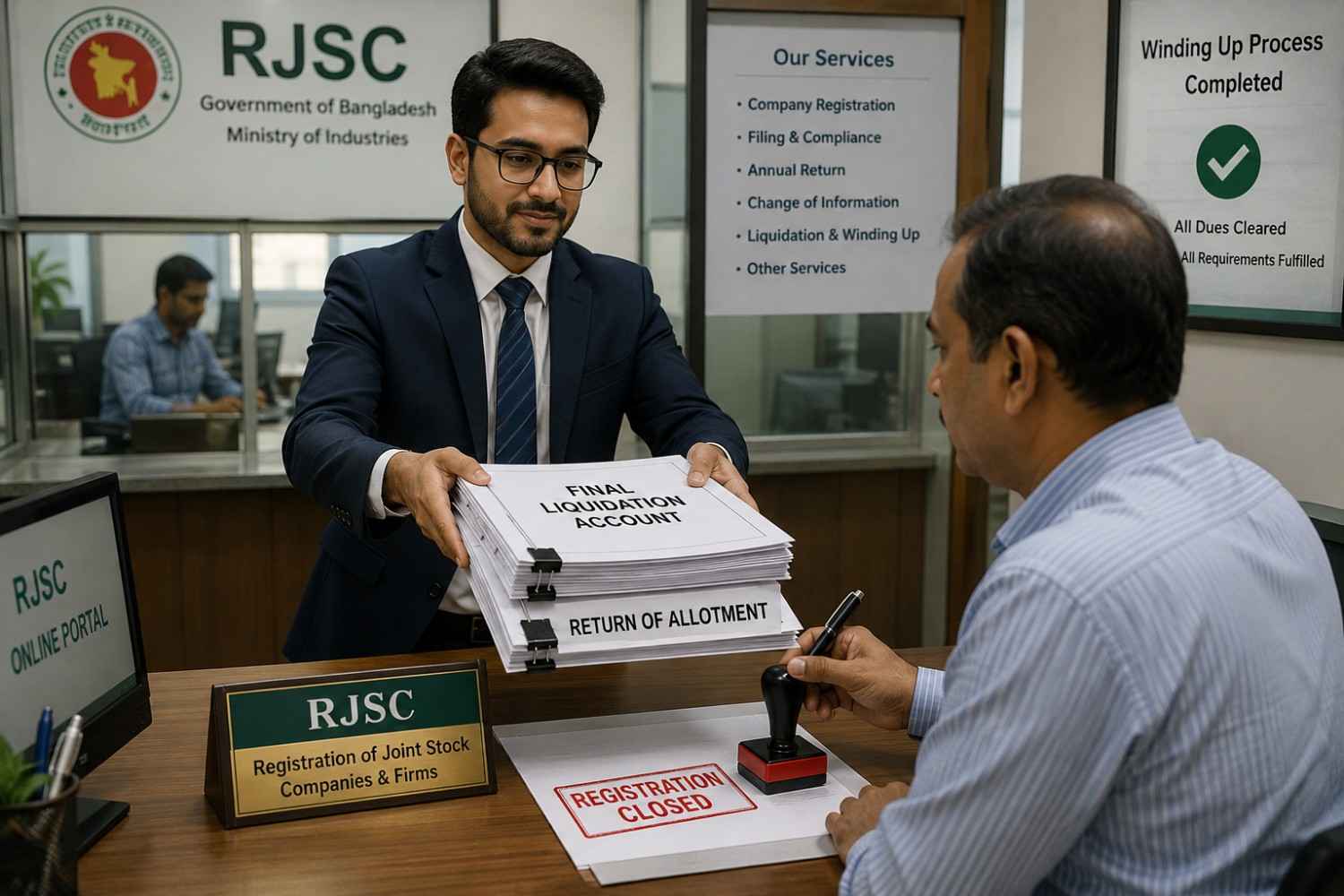
You’ll need to submit a certified copy of the board resolution, proving the decision to close. Also, current financial statements are required, showing the company’s financial health. These documents protect all stakeholders during the liquidation process.
Verification Procedures for Submitted Filings
When you submit Company winding up documents to RJSC, a thorough verification process begins. The agency checks your filings against the Companies Act requirements. They ensure your financial reports align with the board resolutions.
If any discrepancies are found, the RJSC may ask for clarifications. Maintaining clear communication with the regulatory office is key. By ensuring your documents are complete, you expedite the review process and move closer to approval.
| Document Type | Purpose of Submission | Regulatory Requirement |
|---|---|---|
| Board Resolution | Formalizes the intent to dissolve | Mandatory |
| Financial Statements | Details assets and liabilities | Mandatory |
| Shareholder Register | Confirms ownership structure | Mandatory |
| Liquidator Consent | Validates the appointed official | Mandatory |
Publishing Required Notices Where Applicable
Transparency is crucial when you start closing your business in Bangladesh. Publishing required notices is a legal duty to safeguard your creditors and stakeholders. It ensures you operate with full accountability where applicable under the law.
Legal Requirements for Public Announcements
The law requires you to give public notice of your business’s end. Proper winding up notice publication formally declares your company’s liquidation phase. You must publish these notices in national newspapers to reach the widest audience.
Ignoring these publication rules can cause serious legal issues. By following the set timeline, you show your commitment to legal compliance. This step helps reduce risks from future claims by unknown creditors.
Notifying Creditors and Stakeholders Through Official Channels
Creating a formal Company winding up notice in Bangladesh demands accuracy and clarity. Your notice must clearly state your intent to dissolve the business and give creditors a deadline to file claims. This openness is key to preserving your professional reputation during your company’s final stages.
When publishing winding up notice, use official channels to ensure all relevant parties receive the information. Direct communication with known stakeholders is also advisable. This approach ensures you meet your obligation to inform all involved in your business.
Identifying and Verifying Company Assets and Liabilities
Identifying and verifying company assets and liabilities is crucial in your winding-up journey. This step ensures fair treatment for all stakeholders, including creditors and shareholders, under Bangladeshi law. Transparency is key for a successful dissolution.
Conducting a Comprehensive Asset Audit
Start by delving deep into your company’s balance sheet. A comprehensive asset audit identifies tangible items like office equipment and real estate, as well as intangible assets such as intellectual property or brand equity.
Determining the current market value of these assets is critical. Accurate valuation prevents disputes and ensures a smooth company assets and liabilities settlement. For complex or specialized assets, consider hiring professional values.
Categorizing Outstanding Debts and Financial Obligations
After mapping your assets, categorize your financial obligations. Group these debts by legal priority, such as secured creditors, unsecured creditors, and employee-related liabilities.
Proper categorization helps create a clear repayment plan. This preparation is crucial for the final closure of your business operations. The table below outlines how to organize these financial elements effectively.
| Category | Description | Priority Level |
|---|---|---|
| Secured Debts | Loans backed by collateral | High |
| Employee Claims | Unpaid wages and benefits | High |
| Trade Payables | Outstanding supplier invoices | Medium |
| Unsecured Loans | General business borrowings | Low |
Settling Outstanding Debts and Creditor Claims
Deciding to wind up your company means focusing on, settlement of outstanding debts and creditor claims first. This step requires a detailed plan to adhere to the
Companies Act, 1994. Managing settlement of company debts in Bangladesh well is crucial. It shields directors from personal risks and facilitates a smooth transition to dissolution.
Prioritizing Creditor Payments Under Bangladeshi Law
The law dictates a strict order for distributing assets to creditors. You must prioritize secured creditors before unsecured ones. Ignoring this order can result in legal issues and prolong the winding-up process.
The following table outlines the standard priority for payments during the liquidation process:
| Priority Level | Category of Creditor | Payment Status |
|---|---|---|
| 1 | Liquidation Expenses | Highest Priority |
| 2 | Secured Creditors | Primary Debt |
| 3 | Preferential Creditors | Statutory Obligations |
| 4 | Unsecured Creditors | Remaining Assets |
Managing Disputes During the Settlement Phase
Effective creditors’ meeting regulations are essential for verifying and addressing claims. At these meetings, you must scrutinize each claim’s validity before making payments. Transparency is key to avoid disputes with stakeholders.
In case of a dispute over settlement of creditor claims, seek legal advice promptly. Keeping detailed records of all transactions helps avoid legal complications. This approach keeps the liquidation process on track and reduces the risk of costly delays.
Closing Bank Accounts and Business Operations
Finalizing your business in Bangladesh requires deactivating financial and operational structures. When you start the Company closure in Bangladesh, ensure all active elements are dismantled. Knowing how to close a company in Bangladesh is crucial to avoid legal or financial issues.
Procedures for Deactivating Corporate Bank Accounts
The company bank account closure in Bangladesh marks the end of financial activities. You must work closely with your bank to settle all transactions before freezing the account. Unpaid balances can cause future complications.
For a smooth closure, follow these steps:
- Submit a formal board resolution for account closure.
- Clear all pending checks and automated payments.
- Get a “No Objection Certificate” or final account statement from your bank.
- Surrender unused checkbooks, debit cards, and credit facilities to the branch manager.
Ceasing Commercial Activities and Terminating Contracts
Addressing the operational side of your business is crucial for the RJSC company closure process. You must formally end all commercial agreements, including leases and supplier contracts. Transparency is key when informing partners about your decision.
Settle employee agreements according to local laws. Pay all final wages, bonuses, and severance packages to avoid legal issues. Terminating contracts protects your company from future claims and ensures compliance with regulations.
Completing Tax, VAT, and Other Regulatory Clearances
Completing Tax, VAT, and Other Regulatory Clearances is a critical milestone in the legal winding-up process. You must ensure that all government obligations are settled to receive the necessary No Objection Certificate from the relevant authorities. This step is a mandatory prerequisite for the final dissolution of your company with the Registrar of Joint Stock Companies and Firms (RJSC).
Obtaining Tax Clearance Certificates from the NBR
To initiate the formal closure, you must secure a tax clearance for company winding up from the National Board of Revenue (NBR). This process involves a thorough audit of your corporate tax filings to ensure no outstanding liabilities remain. Compliance is non-negotiable, as the NBR will verify your records before issuing the clearance certificate.
You should prepare the following documentation for the NBR:
- Copies of audited financial statements for the last three years.
- Proof of payment for all assessed corporate income taxes.
- A formal application letter requesting the tax clearance certificate.
- Details regarding the appointed liquidator and the board resolution for dissolution.
Finalizing VAT and Trade License Cancellations
Beyond income tax, you must prioritize your vat clearance for company winding up to avoid future penalties. This involves reconciling your VAT returns and ensuring that all input and output tax credits are correctly accounted for. Once the VAT department confirms your status, you will receive a clearance letter that serves as proof of your good standing.
Simultaneously, you must address the cancellation of your local trade license. This permit is typically issued by the City Corporation or the local municipality where your business operates. Failure to cancel this license can lead to unnecessary annual renewal fees and legal complications.
| Regulatory Body | Clearance Type | Key Requirement |
|---|---|---|
| NBR | Income Tax | No Objection Certificate |
| VAT Office | VAT Clearance | Reconciled Returns |
| City Corporation | Trade License | Formal Cancellation |
Securing a comprehensive regulatory clearance for company closure protects you from future litigation. By systematically clearing these hurdles, you ensure that your business exit is legally sound and fully recognized by the authorities in Bangladesh.
Preparing Final Financial Statements
As your company’s life cycle comes to an end, preparing final financial statements is a legal must. This step marks the end of your business’s financial journey. By meticulously Preparing the Required Legal and Financial Documents, you safeguard your directors and ensure a clear closure.
Auditing Accounts for the Final Liquidation Period
The liquidation phase demands a detailed audit to confirm all assets and liabilities are correctly recorded. You must match every bank statement, outstanding invoice, and tax obligation to ensure a clear audit trail. This meticulous process is crucial for the final financial statements for company winding up, avoiding any discrepancies that could hinder regulatory approval.
It’s advisable to hire a professional auditor at this stage for their objectivity. They will categorize all income and expenses from the winding-up period according to Bangladeshi accounting standards. This thorough verification ensures your financial status is accurately reflected.
Reporting to Shareholders and Regulatory Bodies
After the audit, you must share these results with your shareholders and the relevant authorities. Transparency is key, as stakeholders need to grasp how the company’s remaining value was calculated. A detailed report shows you’ve met your fiduciary duties during dissolution.
The table below details the essential components for your final reporting package, ensuring compliance with local regulations.
| Document Type | Primary Purpose | Target Audience |
|---|---|---|
| Final Balance Sheet | Shows net asset position | Shareholders & RJSC |
| Liquidation Account | Details all receipts and payments | Creditors & Regulators |
| Auditor’s Report | Confirms financial accuracy | Regulatory Bodies |
| Distribution Schedule | Outlines asset allocation | Shareholders |
Distributing Remaining Assets Among Shareholders
After all financial obligations are settled, you enter the final stage of the corporate lifecycle. Distributing remaining assets among shareholders marks the end of your business’s economic life in Bangladesh.
Calculating Pro-Rata Distributions
After clearing all debts and liabilities, the liquidator must calculate the net surplus for distribution. This is done on a pro-rata basis. It ensures each investor gets their share based on their equity stake.
Reviewing the share register is crucial to identify each participant’s share count. By dividing the total surplus by the number of issued shares, the value per share is determined. This transparent calculation avoids disputes and ensures fairness in the final payout.
Ensuring Compliance with Articles of Association
The distribution process is more than just math; it’s a legally regulated procedure. Your actions must align with your company’s Articles of Association. These documents govern your entity.
These articles outline specific rights for different share classes, like preference and ordinary shares. Failure to follow these rules can result in legal issues or claims from unhappy shareholders. Always check that the proposed distribution respects the rights established at incorporation.
Filing Final Liquidation Documents
The winding-up process in Bangladesh concludes with the file your final liquidation documents step. This marks the end of your company’s journey. It ensures your business has completed the dissolution process correctly. By doing so, you safeguard your professional reputation and meet all legal obligations.
Reporting the Completion of Liquidation to RJSC
After settling all debts and distributing assets, the liquidator must compile a detailed final account. This document outlines the entire liquidation process, including all financial transactions. Reporting the completion of liquidation to the RJSC is crucial to confirm your compliance with the Companies Act.
Ensure the report is signed and verified by the appointed liquidator. When submitting required documents of company winding up RJSC, verify that all financial dealings are documented. Any errors could cause delays in the approval process.
Finalizing the Winding-Up Report
Finalizing the winding-up report is the last step in closing your entity. This report proves you’ve met your statutory duties. It gives the RJSC the data needed to remove your company from the register.
The process of filing the winding-up application at RJSC may seem daunting. However, this final step clarifies your company’s history. Keep all final liquidation documents for your records. Once the RJSC approves these filings, your company will be removed from the register, ending its legal life.
Obtaining Final Approval for Dissolution
Reaching the end of your corporate journey in Bangladesh is a significant achievement. It means your company has fulfilled all legal requirements and is set to be removed from official records. By finishing the company dissolution process in Bangladesh, you avoid future legal and tax obligations.
Reviewing the Final Order from the Registrar
After the Registrar of Joint Stock Companies and Firms (RJSC) confirms your compliance, they issue a formal order. This document is the official proof of your company’s removal from the RJSC register. It’s crucial to check this order for accuracy in all details about your company’s closure.
The final approval for company dissolution is the pinnacle of your winding-up efforts. When you receive it, your business’s legal existence ends. This step is key to confirm your RJSC company dissolution in Bangladesh with all government bodies.
Addressing Potential Objections or Queries
During the RJSC company dissolution process, the Registrar might ask questions or spot small errors in your submissions. It’s vital to answer these quickly to prevent delays. Keeping in touch with the RJSC ensures a smooth removal of company from rjsc register.
If there’s an objection, address it with the required information or additional documents right away. Showing professionalism at this stage helps your Company dissolution in Bangladesh go smoothly. Once all issues are cleared, the final order will be issued, marking full closure.
| Stage of Dissolution | Primary Action | Expected Outcome |
|---|---|---|
| Final Review | Verify RJSC Order | Legal Confirmation |
| Query Resolution | Submit Clarifications | Compliance Approval |
| Official Removal | Update Register | Entity Termination |
Common Issues During the Winding-Up Process in Bangladesh
Closing a company in Bangladesh is rarely a straightforward process due to various regulatory challenges. When you commit to Winding Up a Company in Bangladesh, you must prepare for a journey that requires patience and meticulous attention to detail. Many business owners underestimate the administrative burden involved in finalizing their corporate affairs.
Navigating Bureaucratic Delays and Documentation Errors
Administrative hurdles often serve as the primary cause for extended timelines. You might find that minor errors in your statutory filings lead to significant setbacks with the Registrar of Joint Stock Companies and Firms (RJSC). Accuracy is paramount when submitting your final reports to avoid unnecessary rejections.
These documentation errors frequently increase the total company winding up time in Bangladesh. To mitigate these risks, ensure that every board resolution and financial statement aligns perfectly with your registered records. Consistent follow-ups with regulatory offices can help you stay ahead of potential bottlenecks.
Handling Complexities in Foreign and Joint Venture Company Winding Up in Bangladesh
The process becomes significantly more intricate for international entities. A Foreign company winding up in Bangladesh must navigate additional layers of compliance, including repatriation of capital and coordination with the Bangladesh Investment Development Authority (BIDA).


Similarly, a Joint venture company winding up in Bangladesh requires consensus among all stakeholders. Disagreements regarding asset distribution or debt settlement can stall the entire liquidation process. Whether you are managing foreign company liquidation in Bangladesh or joint venture company liquidation in Bangladesh, you must ensure that all cross-border financial obligations are settled according to local law.
Engaging with legal experts who understand these specific nuances is highly recommended. By anticipating these common obstacles, you can protect your interests and ensure a smoother transition as you exit the market.
The Importance of Professional Assistance in Company Winding Up
Closing a business demands precision to sidestep long-term legal risks. The significance of professional help in winding up a company is evident in Bangladesh’s complex regulatory environment.
Seeking a seasoned company winding up lawyer in Bangladesh is crucial for managing your filings. Their expertise ensures compliance with the Registrar of Joint Stock Companies and Firms regulations. This proactive approach safeguards your personal assets from future legal claims.
Working with a proficient company winding up consultant in Bangladesh offers clarity during challenging times. These specialists facilitate the process of appointing a liquidator to manage your assets. You’ll have confidence knowing your Company Winding Up in Bangladesh adheres to all legal requirements.
Investing in professional assistance for company winding up is a strategic move for your business’s legacy. Contact legal experts to discuss your specific liquidation needs. Proper planning today can prevent costly mistakes for your organization tomorrow.
FAQ
What is the primary law governing Company Winding up in Bangladesh?
The Companies Act, 1994, primarily governs company winding up in Bangladesh. Whether it’s a private or public limited company, following the Registrar of Joint Stock Companies and Firms (RJSC) regulations is crucial. This ensures a legal dissolution process.
What is the difference between a voluntary winding up process and compulsory liquidation?
A voluntary winding up is initiated by shareholders or creditors without court intervention, for solvent businesses. Compulsory liquidation, however, is ordered by the High Court Division for insolvent companies. Both require a liquidator to manage debt settlement.
What are the required documents for Company Winding up at the RJSC?
To start, you need specific documents like a Declaration of Solvency and audited financial statements. These must be submitted to the RJSC, along with a special resolution and notice of liquidator appointment.
How do I handle a Foreign Company Winding up in Bangladesh?
For foreign or joint ventures winding up in Bangladesh, notify the Bangladesh Investment Development Authority (BIDA) alongside the RJSC. This ensures all local liabilities are settled before deregistration.
Why is a liquidator appointment mandatory for company dissolution steps?
Appointing a liquidator is crucial as they take over the board’s powers. They verify assets and liabilities, settle claims, and file final documents accurately.
Is winding up notice publication required by law?
Yes, publishing a winding up notice in the Official Gazette and two daily newspapers is mandatory. It informs the public and creditors, allowing them to claim during debt settlement.
How do I obtain tax clearance for company winding up?
Apply to the National Board of Revenue (NBR) for a “No Objection Certificate.” This proves all corporate taxes are paid. You also need VAT clearance and to cancel trade licenses for final dissolution.
What happens during the RJSC company closure process regarding bank accounts?
Your liquidator will close the company bank account. Remaining funds are distributed to shareholders after settling claims and costs. Ensure all account closures and operations are documented.
How long is the typical company winding up time in Bangladesh?
The time varies based on asset complexity and regulatory clearances. Voluntary winding up usually takes 6 to 12 months, assuming no disputes or complications.
Why should I hire a company winding up lawyer in Bangladesh?
Hiring a lawyer is recommended due to the complexity of the process. A specialized lawyer ensures compliance with the Companies Act, 1994, avoiding penalties and ensuring smooth dissolution.
-
Foreign Company Registration in Bangladesh: Easy Guide 2026
Expanding your business into new markets offers exciting growth potential. Foreign Company Registration in Bangladesh is a straightforward process once you understand the local legal landscape. This guide provides a clear roadmap to help you navigate the legal requirements for setting up your operations effectively. We simplify the complex process of Foreign Company Incorporation Bangladesh…
-
Company Registration in Bangladesh: Easy Complete Guide
Embarking on a new venture is thrilling, yet it demands a strong base. A successful business setup in Bangladesh starts with picking the right legal form and completing the registration accurately. Quick Facts: Company Registration in Bangladesh Whether it’s a private limited company or a foreign-owned entity, the right documents are key to lasting success.…
-
Joint Venture Company Registration in Bangladesh: Complete Guide
Entering the South Asian market presents a significant opportunity for global investors. A strategic partnership allows you to merge resources and expertise. It also enables you to share operational risks effectively. Understanding Joint Venture Company Registration in Bangladesh is crucial for a smooth market entry. This guide simplifies the complex legal landscape and helps you…
-
Partnership Firm Registration in Bangladesh: Easy Steps (2026)
Starting a business with others is a wise choice for many entrepreneurs. It brings together shared resources and expertise, accelerating your venture’s growth. However, it’s crucial to handle the legal aspects correctly from the outset. Completing your partnership firm registration in Bangladesh grants your venture official status. This builds trust with clients and stakeholders. Grasping…
-
Company Share Transfer in Bangladesh: Easy RJSC Guide (2026)
Understanding the legal intricacies of corporate ownership changes is crucial. Whether it’s for restructuring or succession, knowing the mandatory steps is essential. This knowledge ensures your actions are in line with local laws. Quick Facts: Company Share Transfer in Bangladesh Every step must comply with the Companies Act and the Registrar of Joint Stock Companies…
-
RJSC Annual Return Filing in Bangladesh | Schedule X Submission in Bangladesh Guide
Running a business demands strict adherence to local corporate laws. If you manage a company, prioritizing RJSC Annual Return Filing in Bangladesh is crucial to maintain your legal status. This ensures your entity remains transparent and trustworthy to stakeholders. Schedule X submission in Bangladesh is a vital part of your yearly obligations. Keeping your director…
-
Branch Office Registration in Bangladesh: Easy Legal Guide
Bangladesh is one of South Asia’s fastest-growing economies — with strong GDP growth and a population exceeding 160 million, it offers substantial opportunity for foreign enterprises. Establishing a local office gives your company closer control over operations and faster access to customers and partners. This guide simplifies Branch Office Registration in Bangladesh: whether you’re evaluating…
-
Liaison Office Registration in Bangladesh | Representative Office Registration in Bangladesh
Expanding your business into new territories requires a clear strategy and a solid legal foundation. Bangladesh offers a wealth of untapped potential for international firms aiming to grow their global footprint. Establishing a local presence allows you to conduct vital market research and build lasting professional relationships. Navigating the regulatory landscape can feel daunting, but…
-
One Person Company Registration in Bangladesh: Easy Guide
One Person Company Registration in Bangladesh gives solo entrepreneurs a solid legal foundation to safeguard their assets. This modern business model allows an individual to enjoy corporate perks while retaining full operational control, making it ideal for entrepreneurs aiming to grow without the hurdles of traditional partnerships. Registering your startup with the Registrar of Joint…
-
Society Registration in Bangladesh | Complete RJSC Registration Guide
If your group works in charity, education, culture, or social welfare, registering as a society gives legal standing and public trust. This guide explains the practical steps, required documents, and fees so founders and organizers can complete the process confidently. Follow the clear steps for society registration in Bangladesh to secure name clearance, prepare your…
-
Foundation Registration in Bangladesh: Easy Guide (2026)
Setting up a non-profit in Bangladesh requires clear planning and a practical understanding of local rules. You’ll face specific administrative steps to ensure your organization operates legally and transparently. Understanding these requirements is the first step to creating lasting social impact. This guide lays out a clear, step-by-step path for Foundation Registration in Bangladesh, covering…
Understanding the legal intricacies of corporate ownership changes is crucial. Whether it’s for restructuring or succession, knowing the mandatory steps is essential. This knowledge ensures your actions are in line with local laws.
Quick Facts: Company Share Transfer in Bangladesh
- Governing Law: Companies Act, 1994 (Section 38)
- Regulating Authority: RJSC (Registrar of Joint Stock Companies and Firms)
- Transfer Instrument: Form 117 (Share Transfer Deed)
- Stamp Duty Rate: 1.5% of the face value of the shares being transferred
- Signing Requirement: The transferor must sign Form 117 in person before the RJSC Registrar
- Foreign Buyer, Local Seller: An Encashment Certificate from a scheduled bank is required as proof of payment
- Foreign Transferee Documents: Must be consularised (Bangladesh Embassy certification + Ministry of Foreign Affairs counter-verification)
- Capital Gains Tax: Generally 15% on gains from share sales (subject to residency status)
- Typical Total Timeline: Around 6-9 weeks (due diligence, board approval, stamping, RJSC filing, and certificate issuance combined)
Every step must comply with the Companies Act and the Registrar of Joint Stock Companies and Firms (RJSC) guidelines. This approach safeguards your interests and prevents costly legal disputes.
Proper execution is the cornerstone of avoiding future disputes. Our guide offers clarity on everything from a joint stock share transfer in Bangladesh to a complex foreign company share transfer rjsc filing. It’s designed to help you navigate these challenges successfully.


Key Takeaways
Understand the legal framework governing ownership changes.
Learn the essential steps for RJSC compliance.
Protect your rights through accurate statutory record-keeping.
Navigate the complexities of international entity adjustments.
Ensure your corporate structure remains legally sound and efficient.
Legal Framework for Share Transfer
Understanding the legal requirements is crucial for a successful company share transfer in Bangladesh. The Companies Act, 1994, governs this process. It outlines the necessary steps for all corporate entities in the country.
Start by examining your company’s Articles of Association (AoA). This document is your company’s internal constitution. It may have rules or restrictions on equity transfer. Ignoring these rules can cause delays or even reject your application.
Managing a joint stock share transfer in Bangladesh requires aligning actions with laws and governance documents. This diligence prevents legal issues and ensures the trust. For a foreign company share transfer rjsc, the complexity grows due to extra compliance needs. Ensure all documents are precise to meet the Registrar of Joint Stock
Companies and Firms (RJSC) standards. The table below highlights key legal aspects to navigate.
| Legal Component | Primary Focus | Compliance Requirement |
|---|---|---|
| Companies Act, 1994 | Statutory Compliance | Mandatory adherence |
| Articles of Association | Internal Governance | Review for restrictions |
| RJSC Regulations | Regulatory Filing | Timely submission |
| Shareholder Agreements | Contractual Rights | Pre-emptive verification |
Reviewing the Articles of Association and Shareholder Rights
The success of a share transfer procedure heavily relies on a detailed review of your Articles of Association. These documents serve as the guiding principles for managing equity changes within your organization. It’s essential to confirm that your proposed actions comply with the specific bylaws set at your company’s inception.
Analyzing Restrictions on Share Transfers
Your Articles of Association may include clauses that outline the conditions for share transfers. It’s crucial to examine these restrictions to understand if the board can veto a transfer or if certain conditions must be fulfilled. This is especially important for a joint venture company share transfer at rjsc, where agreements among multiple parties often impose strict rules on equity changes.
Always verify if the board has the power to reject a transfer request based on internal policies. Ignoring these restrictions can cause significant delays or legal issues. Grasping these limitations ensures your RJSC share transfer in Bangladesh adheres to both private agreements and public laws.
Identifying Pre-emptive Rights of Existing Shareholders
It’s vital to identify pre-emptive rights, as existing shareholders might have the first chance to buy the shares being offered. These rights aim to safeguard the current ownership structure from dilution. Neglecting these provisions can invalidate the transaction and lead to legal disputes with stakeholders.
Review the shareholder agreement alongside the Articles of Association to confirm the existence of these rights. Clear communication with current shareholders about their decision to exercise or waive these rights can greatly simplify the process. By honoring these internal rules, you ensure transparency and safeguard your company’s long-term stability.
Verifying Shareholder Ownership and Eligibility
The success of a share transfer hinges on verifying the transferor’s clear title to the assets. Before starting the share transfer procedure in Bangladesh, thorough due diligence is crucial. This ensures the transferor is the rightful owner, preventing fraud and maintaining clear title for the transferee.
Conducting Due Diligence on Shareholder Status
Begin by examining the company’s internal records to confirm ownership history. It’s vital to match the current Register of Members with recent filings for consistency. This is especially important for joint venture company share transfers at rjsc to meet regulatory standards.
During this review, identify any legal obstacles that could hinder the transaction. Ensure the shares are free from liens, pledges, or other restrictions that could invalidate the transfer. Keeping detailed records of this verification is highly recommended for future audits.
Confirming the Validity of Existing Share Certificates
After verifying shareholder status, inspect the share certificates. These documents are crucial in any rjsc share transfer in Bangladesh. Verify the certificate number, authorized signatures, company seal, and transfer history to confirm authenticity.
Certificate Number: Ensure it matches the entry in the Register of Members.
Authorized Signatures: Confirm that the directors’ signatures are genuine and current.
Company Seal: Check for the presence of the official company seal as required by the Articles of Association.
Transfer History: Review the back of the certificate for any previous endorsements or notations.
If discrepancies are found, address them promptly with the board of directors. A share transfer procedure in Bangladesh relies heavily on solid documentation. Validating these certificates early safeguards the interests of all parties involved.
Determining Share Valuation and Transfer Quantity
Before starting a share transfer at RJSC in Bangladesh, you need to figure out the value and number of shares. Getting the valuation right is crucial. It affects the stamp duty and taxes for everyone involved. This step makes sure your deal is clear and legal.
Methods for Fair Market Value Assessment
To find the fair market value of shares, you must use established methods. The net asset value and market-based approaches are common. The choice depends on your company’s finances and industry norms.
The table below shows the main valuation methods for the share transfer process at rjsc:
| Valuation Method | Primary Focus | Best Used For |
|---|---|---|
| Net Asset Value | Total Assets minus Liabilities | Holding companies |
| Market-Based | Comparable company data | Publicly traded entities |
| Earnings Multiplier | Historical profit trends | Established businesses |
Defining the Number of Shares to be Transferred
After determining the value, you must specify the exact number of shares to transfer. Being precise here is key for accurate financial records and regulatory compliance. This is true for both local and RJSC foreign company share transfers in Bangladesh.
Your transfer deed must clearly show the transaction details. This ensures compliance with financial reporting standards. By accurately documenting the share quantity, you avoid disputes and speed up the RJSC application process. Always check these numbers against your current member register before submitting the paperwork.
Obtaining Formal Consent from Transferor and Transferee
Before starting any equity movement, you must get clear, written consent from both the transferor and the transferee. A successful share transfer process heavily depends on this documentation. It makes sure the deal is legally binding for everyone involved.
Drafting the Letter of Consent
Create a formal letter of consent that clearly outlines your agreement’s terms. This document must state the total shares, the price per share, and the transfer’s effective date.


When dealing with a share transfer at rjsc in Bangladesh, being precise in this letter is crucial. It acts as the main proof of intent. It shows both parties agreed voluntarily and knew the conditions.
Ensuring Mutual Agreement on Terms
Ensuring both parties agree on these terms avoids future misunderstandings. It provides a clear record of both parties’ intentions. Clear communication at this stage is key to avoiding risks in a foreign share transaction.
This document is a vital piece of evidence in case of regulatory inquiries or internal disputes. By detailing every aspect, you safeguard your company from legal issues. You also ensure your records meet local standards.
Preparing the Share Transfer Deed and Form 117
Transferring company shares demands meticulous attention to detail. You must adhere strictly to the Companies Act of Bangladesh when preparing company shares transfer documents. This legal framework is crucial for the success of your transaction.
Whether dealing with a private limited company or a joint venture, accuracy is key. Mistakes in the paperwork can cause delays or even rejection. It’s vital to ensure all details about the parties involved are correct.
Drafting the Instrument of Transfer
The share transfer deed, or instrument of transfer, is the core agreement between buyer and seller. It must clearly outline the terms to prevent future disputes. Key elements to include in your draft are:
Full legal names and addresses of both the transferor and the transferee.
The exact number and class of shares being transferred.
The consideration amount or value agreed upon for the transaction.
The distinctive numbers of the share certificates involved.
Completing RJSC Form 117 Requirements
After finalizing the deed, focus on the official notification process. The company share transfer rjsc requirements are essential for legal recognition. This form notifies the Registrar of Joint Stock Companies of the ownership change.
Under the amended Companies Act, the transferor is generally required to appear in person at the RJSC office to sign Form 117 before the Registrar, along with supporting documents such as the audited financial statements and a list of directors.
Ensure Form 117 is signed by the company’s authorized signatories. Accurate data on this form keeps the public record transparent and compliant. Timely submission of this document is crucial for the legal transfer of shares in the corporate registry.
Calculating and Paying Applicable Stamp Duty
You must navigate the specific stamp duty regulations in Bangladesh to validate your share transfer deed. Properly managing these company shares transfer documents is essential. It ensures your transaction remains legally enforceable in a court of law.
Determining Stamp Duty Rates in Bangladesh
The stamp duty amount is typically calculated based on the total consideration value of the shares being transferred. Whether you are handling a private transfer or a joint venture transaction, the government mandates specific percentage rates. These rates must be strictly followed.
Currently, stamp duty is charged at 1.5% of the face value of the shares being transferred. This must be paid before Form 117 can be signed and accepted by the RJSC.
It is vital to verify the current rates with the relevant tax authorities or a legal professional before proceeding. Accurate calculation prevents future disputes. It ensures that your financial obligations are fully met during the transfer process.
Procedures for Stamping the Transfer Deed
Once you have determined the required amount, you must follow the official procedures to have the deed stamped. This process involves submitting the instrument to the designated government office. There, you receive the necessary official seal.
Completing this step is a prerequisite for any successful company share transfer rjsc filing. Failure to pay the correct stamp duty can render your transfer deed inadmissible in court. This can cause significant, costly delays in the registration process.
Executing the Share Transfer Deed
After preparing the necessary documents, the next step is to formally execute the share transfer deed. This is crucial to make the transaction legally binding and recognized by authorities. Following established share transfer rules Bangladesh helps prevent disputes or delays.
Witnessing and Notarization Requirements
The deed must be signed by both the transferor and transferee. To verify these signatures, the document should be signed in front of credible witnesses. These witnesses confirm the presence and consent of the parties involved.


Notarization is often required. It adds a formal seal, validating the document’s integrity. Adhering to the rjsc share transfer procedure in Bangladesh ensures your paperwork meets official standards.
If the transferee is a foreign national or Non-Resident Bangladeshi (NRB), the transfer documents must be consularised — certified by the Bangladesh Embassy/High Commission and counter-verified by the Ministry of Foreign Affairs — before submission to RJSC.
Ensuring Proper Signatory Authority
It’s essential to verify the legal authority of those signing the deed. For corporate shares, confirm the signatory’s power to act on behalf of the company. This is especially crucial for joint venture transactions, where specific documents may be needed.
Always check the signatory’s legal capacity to bind the entity. Ignoring this can lead to application rejection. Confirming these details early safeguards the interests of all parties and ensures a smooth transfer.
Submitting Documentation to the Company Board
After signing the legal documents, you must present your transfer package to the board of directors for review. This step is crucial to ensure your actions comply with share transfer rules Bangladesh. A well-organized submission helps in a smooth ownership transfer.
Required Supporting Documents for Submission
To avoid delays, gather all necessary documents. The board needs specific evidence to validate the transaction. Prepare the following items for your submission:
The original share certificate currently held by the transferor.
The fully executed and stamped instrument of transfer.
Any additional evidence or declarations required by the company’s internal bylaws.
Proof of identity for both the transferor and the transferee.
Verifying the Completeness of the Application
Before submitting, thoroughly review your application package. A detailed check ensures you follow the rjsc share transfer procedure in Bangladesh correctly. A complete file allows the board to make a swift decision.
For joint venture cases, the scrutiny is even higher. A well-prepared application minimizes the chance of needing more information or delays.
Accuracy at this stage is your best tool for a successful transfer.
Convening the Board of Directors Meeting for Approval
A successful share transfer hinges on the board of directors’ approval. This meeting is crucial for ensuring the transaction meets the company’s governance and legal standards. It formalizes the approval, safeguarding the interests of both parties and upholding corporate transparency.
Notice Requirements for Board Meetings
Before the meeting, formal notice must be given to all directors. This notice must adhere to the timeframe outlined in your company’s Articles of Association. Strict adherence to these timelines is crucial to avoid legal disputes over the board’s decision.
The agenda should clearly state the review of the share transfer application. Adequate time for directors to review the documents ensures thorough joint stock share transfer procedure in Bangladesh.
Quorum and Procedural Standards
At the meeting, confirm a quorum is present to validate the proceedings. A meeting without the required number of directors is legally invalid. Accurate documentation of the discussion is essential to reflect the board’s consensus.
Adhering to these standards is critical for a company share transfer at rjsc in Bangladesh. A clear record of the meeting, including attendance and resolutions, simplifies regulatory filings and manages share transfer fees effectively.
| Requirement | Standard Practice | Compliance Goal |
|---|---|---|
| Meeting Notice | Written notice to all directors | Legal validity |
| Quorum | Minimum directors present | Procedural integrity |
| Documentation | Detailed meeting minutes | Audit readiness |
| Approval | Formal board resolution | Regulatory alignment |
Passing the Board Resolution for Share Transfer in Bangladesh
After the board reviews the transfer application, the next step is to formalize the decision with a board resolution. This confirms that the directors have evaluated the request and given their official consent. It’s important to consider various share transfer fees during this process. The resolution is the primary internal authorization for the change in ownership.
Drafting the Board Resolution
When drafting the resolution, precision is key to withstand legal scrutiny. The document must clearly state the names of the transferor and transferee, the number of shares involved, and the effective date of the transfer. Clarity in this document is crucial for a smooth joint stock share transfer procedure, eliminating any ambiguity about the board’s intent.
The resolution must explicitly state that the board has checked all eligibility requirements and compliance standards. Documenting these details protects the company from future disputes over the validity of the share movement. This formal statement is the basis for all subsequent administrative updates.
Recording the Approval in the Minute Book
After the board passes the resolution, it must be recorded in the company’s minute book. This book is the official, permanent record of all significant decisions made by the governing body. Not keeping accurate minutes can complicate any future ownership changes, as regulators often request these records during audits.
The minute book provides the necessary legal evidence that the transfer was authorized by the company’s leadership. Ensure that the chairperson or the company secretary signs the entry to validate the record. The following table outlines the essential components that must be included in your board resolution documentation.
| Component | Description | Legal Requirement |
|---|---|---|
| Resolution Number | Unique identifier for the meeting | Mandatory |
| Transfer Details | Names and share quantities | Mandatory |
| Board Consent | Formal approval statement | Mandatory |
| Signatory Details | Authorized director signatures | Mandatory |
Updating Statutory Records and the Register of Members
Maintaining accurate statutory records is a vital step after the board grants approval for a share transfer. Once the directors have formally authorized the movement of shares, you must immediately update your company books to reflect the change in ownership. This ensures that your organization remains fully compliant with the legal standards governing a joint stock company share transfer procedure in Bangladesh.

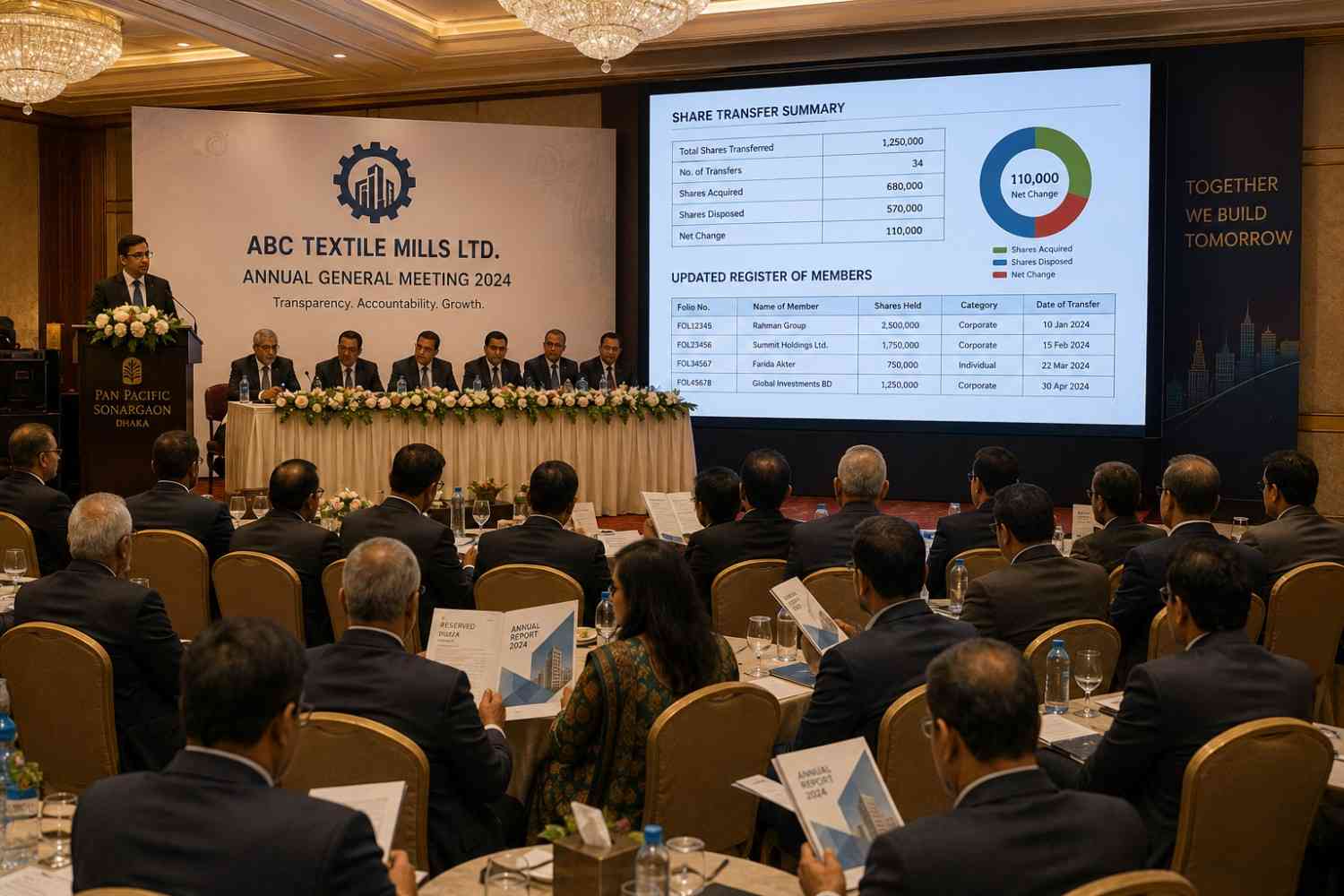
Entries in the Register of Members
The Register of Members serves as the definitive record of share ownership within your company. You are legally obligated to record the transfer details here, including the names and addresses of the new shareholders. This entry provides the necessary legal proof of ownership for the transferee.
Ensure that every detail matches the information provided in the share transfer form submitted during the application process. Any discrepancy in this register can lead to significant complications during future audits or regulatory inspections. Keeping this document current is essential for protecting the rights of your investors.
Updating the Share Transfer Register
Beyond the Register of Members, you must also maintain a dedicated Share Transfer Register. This document provides a chronological history of all share movements within your organization. It acts as a secondary layer of verification during regulatory audits.
By documenting every transfer in this register, you create a transparent audit trail for the company. This practice is highly recommended to ensure that your internal governance remains robust and organized. Use the following table to understand the primary differences between these two essential statutory records.
| Record Type | Primary Purpose | Frequency of Update | Legal Status |
|---|---|---|---|
| Register of Members | Identifies current owners | Upon every transfer | Mandatory / Statutory |
| Share Transfer Register | Tracks historical changes | After board approval | Best Practice / Internal |
| Minute Book | Records board decisions | Post-meeting | Mandatory / Statutory |
Canceling Old Certificates and Issuing New Share Certificates
After the board gives its approval, the next step is to formally cancel and issue new share certificates. This is the last administrative task in the process. It’s crucial to keep your records up to date to avoid any future disputes over ownership.
Surrendering the Original Share Certificate
The transferor must hand over the original share certificate to the company office. Before canceling, check the document against your records. It is essential to mark the certificate as “Canceled” to prevent misuse or confusion about ownership.
Recording this surrender properly helps keep the company in line with local corporate laws. After marking, store the certificate securely in your records.
Issuing the New Certificate to the Transferee
With the old certificate retired, issue a new one to the transferee. This new certificate proves their stake in the company. Make sure it’s signed by the right directors and sealed as per the company’s Articles of Association.
The share transfer form starts the process, but the new certificate seals the deal. Giving it to the new shareholder confirms their legal position in the company. Getting this right is vital for the integrity of your statutory records.
Final RJSC Filing and Compliance
After updating your internal records, the next step is to comply with the Registrar of Joint Stock Companies and Firms (RJSC). You must ensure the rjsc company share transfer Bangladesh process ends with the required filings. This step is crucial for legal transparency and protects your company’s reputation.
Filing Requirements with the Registrar of Joint Stock Companies
To finalize the process, submit the executed transfer instrument and the updated Form 117. It’s vital to confirm that the share transfer stamp duty has been fully paid. The RJSC will not accept filings without proof of stamping. Include a copy of the board resolution authorizing the transfer to complete your submission.
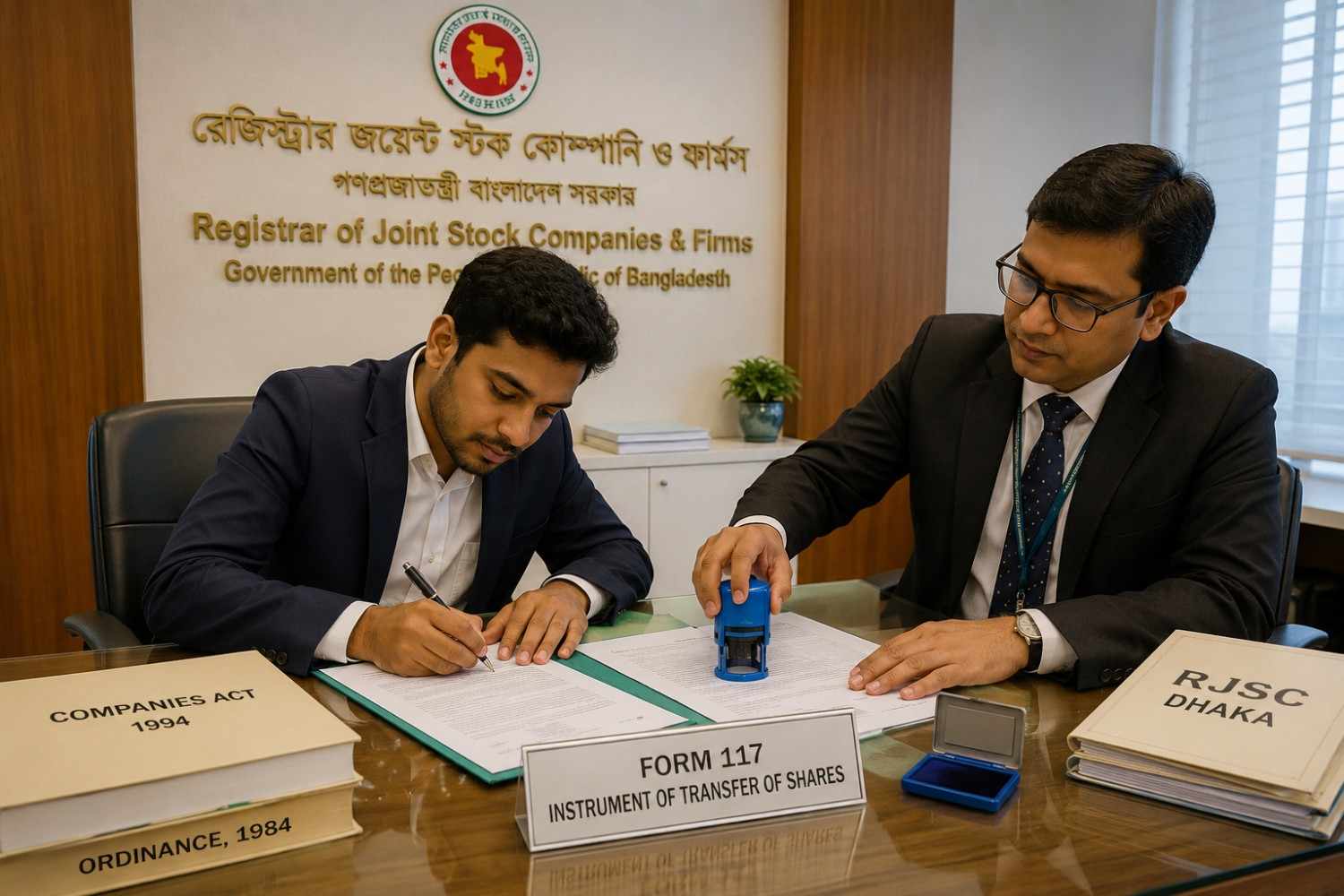

For foreign company share transfer in Bangladesh, you might need extra documents. These could include foreign exchange approvals or central bank compliance. Ensure all signatures on the forms match those in your company profile. Accurate information helps avoid delays in the review process.
Deadlines for RJSC Notifications
The Companies Act sets specific timelines for notifying authorities about shareholding changes. Filing these documents on time is crucial to avoid financial penalties and administrative issues. Missing these deadlines can cause problems during audits or when applying for certifications.
Staying proactive with these filings keeps your company in good standing. Below is a summary of the key compliance elements to track during the post-transfer phase.
| Requirement | Action Item | Importance |
|---|---|---|
| Form 117 | Submit to RJSC | High |
| Stamp Duty | Verify Payment | Critical |
| Board Resolution | Attach Copy | Mandatory |
| Statutory Deadline | Monitor Date | High |
Best Practices for Maintaining Share Transfer Records
Securing your corporate records is the final step in protecting your business interests. You should keep a dedicated archive of every transfer deed, board resolution, and consent letter for several years. This practice safeguards your company against future legal challenges while providing a clear history of ownership.
Always retain proof of your Share transfer stamp duty payments within your internal files. Accurate records allow you to demonstrate full compliance during any regulatory inspection. This level of diligence is vital for both local entities and those managing foreign investments.
A robust filing system simplifies the process for any future transaction. Consistent documentation acts as the hallmark of a well-managed organization. Reach out to legal experts if you require assistance with complex filings or specific regulatory requirements. Keeping your paperwork in order ensures long-term stability and operational success for your business.
How Long Does a Share Transfer Take?
While every case differs, most share transfers in Bangladesh follow a similar timeline: due diligence typically takes 2-4 weeks, board approval 1-2 weeks, payment and documentation about 1 week, RJSC filing and stamp duty processing 1-2 weeks, and final certificate issuance around 1 week — bringing the total process to roughly 6-9 weeks.
Disclaimer: This guide is for general informational purposes only and does not constitute legal advice. Consult a licensed lawyer or registration consultant for your specific case.
FAQ
What is the primary legal framework for a company share transfer in Bangladesh?
The share transfer process is governed by the Companies Act, 1994. To ensure a valid joint stock company share transfer procedure in Bangladesh, follow the regulations of the Registrar of Joint Stock Companies and Firms (RJSC). This includes adhering to your company’s Articles of Association and preparing all company shares transfer documents accurately.
How do I initiate the rjsc share transfer procedure in Bangladesh?
To start the share transfer procedure, review your Articles of Association for any pre-emptive rights. Then, prepare the share transfer form (Form 117), pay the share transfer stamp duty, and get board approval. Finally, file the documents with the Registrar for official recording.
What are the essential company shares transfer documents required for the RJSC?
For a successful company share transfer rjsc, submit the executed Share Transfer Deed (Form 117), original share certificates, and a board resolution. You also need a formal letter of consent from both parties. For foreign company share transfer rjsc, provide valuation evidence and inward remittance through banking Bangladesh.
How is the share transfer stamp duty calculated and paid?
The share transfer stamp duty is based on the total market value or consideration of the shares. Ensure the share transfer form is stamped according to the Bangladesh government’s rates. Not paying these share transfer fees can lead to rejection or legal issues.
What is the process for a foreign company share transfer in Bangladesh?
A foreign company share transfer in Bangladesh requires compliance with the Foreign Exchange Regulation Act. The share price must be fair, and the transaction must be reported to the Bangladesh Bank. This is crucial for joint venture company share transfer in Bangladesh involving international equity.
Can a board of directors refuse a joint stock share transfer in Bangladesh?
Yes, the board can refuse a joint stock share transfer in Bangladesh if the Articles of Association allow it or if the transfer violates share transfer rules Bangladesh. The refusal must be documented in a formal board meeting with justifiable reasons.
How do you handle a joint venture company share transfer at rjsc?
Executing a joint venture company share transfer at rjsc requires coordination between local and international partners. Ensure the documentation reflects the agreed valuation and complies with shareholder agreements. After approval, update your official records to complete the process.
What happens after the share transfer at rjsc in Bangladesh is approved?
After the share transfer at rjsc in Bangladesh is approved, update your company’s Register of Members and Share Transfer Register. Cancel the transferor’s old share certificate and issue a new one to the transferee. Maintaining these records is crucial for share transfer process compliance.
-
Foreign Company Registration in Bangladesh: Easy Guide 2026
Expanding your business into new markets offers exciting growth potential. Foreign Company Registration in Bangladesh is a straightforward process once you understand the local legal landscape. This guide provides a clear roadmap to help you navigate the legal requirements for setting up your operations effectively. We simplify the complex process of Foreign Company Incorporation Bangladesh…
-
Company Registration in Bangladesh: Easy Complete Guide
Embarking on a new venture is thrilling, yet it demands a strong base. A successful business setup in Bangladesh starts with picking the right legal form and completing the registration accurately. Quick Facts: Company Registration in Bangladesh Whether it’s a private limited company or a foreign-owned entity, the right documents are key to lasting success.…
-
Joint Venture Company Registration in Bangladesh: Complete Guide
Entering the South Asian market presents a significant opportunity for global investors. A strategic partnership allows you to merge resources and expertise. It also enables you to share operational risks effectively. Understanding Joint Venture Company Registration in Bangladesh is crucial for a smooth market entry. This guide simplifies the complex legal landscape and helps you…
-
Partnership Firm Registration in Bangladesh: Easy Steps (2026)
Starting a business with others is a wise choice for many entrepreneurs. It brings together shared resources and expertise, accelerating your venture’s growth. However, it’s crucial to handle the legal aspects correctly from the outset. Completing your partnership firm registration in Bangladesh grants your venture official status. This builds trust with clients and stakeholders. Grasping…
-
RJSC Annual Return Filing in Bangladesh | Schedule X Submission in Bangladesh Guide
Running a business demands strict adherence to local corporate laws. If you manage a company, prioritizing RJSC Annual Return Filing in Bangladesh is crucial to maintain your legal status. This ensures your entity remains transparent and trustworthy to stakeholders. Schedule X submission in Bangladesh is a vital part of your yearly obligations. Keeping your director…
-
Branch Office Registration in Bangladesh: Easy Legal Guide
Bangladesh is one of South Asia’s fastest-growing economies — with strong GDP growth and a population exceeding 160 million, it offers substantial opportunity for foreign enterprises. Establishing a local office gives your company closer control over operations and faster access to customers and partners. This guide simplifies Branch Office Registration in Bangladesh: whether you’re evaluating…
-
Liaison Office Registration in Bangladesh | Representative Office Registration in Bangladesh
Expanding your business into new territories requires a clear strategy and a solid legal foundation. Bangladesh offers a wealth of untapped potential for international firms aiming to grow their global footprint. Establishing a local presence allows you to conduct vital market research and build lasting professional relationships. Navigating the regulatory landscape can feel daunting, but…
-
Company Winding Up in Bangladesh: Complete Legal Guide (2026)
Closing a business entity requires careful navigation of local legal frameworks. Whether you manage a local firm or a foreign enterprise, you must follow the Companies Act of 1994 to ensure a smooth exit. This formal procedure protects your interests while satisfying regulatory obligations. You might wonder how to wind up a company in Bangladesh…
-
One Person Company Registration in Bangladesh: Easy Guide
One Person Company Registration in Bangladesh gives solo entrepreneurs a solid legal foundation to safeguard their assets. This modern business model allows an individual to enjoy corporate perks while retaining full operational control, making it ideal for entrepreneurs aiming to grow without the hurdles of traditional partnerships. Registering your startup with the Registrar of Joint…
-
Society Registration in Bangladesh | Complete RJSC Registration Guide
If your group works in charity, education, culture, or social welfare, registering as a society gives legal standing and public trust. This guide explains the practical steps, required documents, and fees so founders and organizers can complete the process confidently. Follow the clear steps for society registration in Bangladesh to secure name clearance, prepare your…
-
Foundation Registration in Bangladesh: Easy Guide (2026)
Setting up a non-profit in Bangladesh requires clear planning and a practical understanding of local rules. You’ll face specific administrative steps to ensure your organization operates legally and transparently. Understanding these requirements is the first step to creating lasting social impact. This guide lays out a clear, step-by-step path for Foundation Registration in Bangladesh, covering…
Starting a business with others is a wise choice for many entrepreneurs. It brings together shared resources and expertise, accelerating your venture’s growth.
However, it’s crucial to handle the legal aspects correctly from the outset. Completing your partnership firm registration in Bangladesh grants your venture official status. This builds trust with clients and stakeholders.
Grasping the partnership firm registration process in Bangladesh can prevent future complications. Knowing how to register partnership firm at rjsc in Bangladesh ensures you operate confidently. It also meets all government requirements.


This guide outlines the key steps to secure your business’s identity. Legal recognition is the cornerstone of your professional success and long-term stability.
Key Takeaways
Shared ventures require formal legal status to operate effectively.
Official documentation builds credibility with your customers and partners.
The RJSC serves as the primary authority for your business filings.
Proper compliance prevents future legal disputes and administrative fines.
Following the correct steps ensures your company remains protected under local law.
Selecting a Unique Partnership Firm Name
Choosing a unique name is the first and most crucial step in learning how to register partnership firm at rjsc in Bangladesh. A distinct name helps avoid legal issues with existing businesses and sets your brand’s professional image from the start.
Your name must be original and not infringe on other businesses’ rights. Verifying your name choice early in the partnership firm registration process in Bangladesh saves time and effort later.
Criteria for Name Availability
The Registrar of Joint Stock Companies and Firms (RJSC) has strict rules for business names. Your name cannot include prohibited words or imply government support without permission.
Avoid names too similar to existing companies. Uniqueness is key for successful registration under current laws.
| Naming Factor | Recommended Action | Common Pitfall |
|---|---|---|
| Originality | Use unique, creative terms | Copying established brands |
| Clarity | Keep it simple and memorable | Using overly complex acronyms |
| Compliance | Check against RJSC guidelines | Including restricted keywords |
| Availability | Verify via official database | Assuming a name is free |
Checking the RJSC Database
Before making a final decision, thoroughly search the RJSC portal. This tool helps you check if your name is available against the national registry of firms. If no matches are found, you’re ready to apply. Always document your search results to prove you’ve done your due diligence.
Drafting the Partnership Deed
Creating a solid legal foundation is the most critical step when you decide to register partnership firm in Bangladesh. This document serves as the primary contract between all involved parties, governing how your business functions daily. Without a formal agreement, your firm lacks the necessary structure to handle internal challenges effectively.
Essential Clauses to Include
Your deed must clearly outline the specific roles and responsibilities of every partner. By documenting these details, you minimize the risk of future misunderstandings regarding management duties. Clarity at the start prevents costly legal disputes later.
You should also include provisions for decision-making processes and conflict resolution. These clauses ensure that your business remains stable even when disagreements arise. Proper documentation is a vital component of rjsc partnership firm registration in Bangladesh, as it provides the registrar with proof of your internal governance.


Defining Profit and Loss Sharing
Defining how you distribute financial gains and losses is perhaps the most important aspect of your agreement. You must specify the exact ratio for each partner to avoid ambiguity during tax season or annual audits. Transparency in financial matters builds trust among partners and keeps the business focused on growth.
Furthermore, your deed should explicitly state the procedures for partner firm dissolution at RJSC. Having a clear exit strategy protects your personal assets and ensures that the winding-up process follows legal requirements. Planning for the end of the partnership is just as important as planning for its beginning.
Executing the Deed on Non-Judicial Stamp Paper
To make your business agreement legally binding in Bangladesh, you must sign it on the right non-judicial stamp paper. This step is crucial for partnership firm formation in Bangladesh. It turns a private agreement into a formal, legally enforceable document. Without this official step, your agreement may not be recognized by government authorities.
Determining Stamp Duty Requirements
The cost of stamp duty changes based on your business’s financial structure. You need to figure out the duty by looking at the total capital in your deed. Bangladesh’s local laws set these fees. Not paying the right amount can cause big delays.
When calculating your costs, consider these factors:
The total authorized capital of the firm.
The specific nature of the business activities.
Current government schedules for stamp duty rates.
Signing Procedures for Partners
After printing on the correct stamp paper, all partners must sign the document. They need to sign in front of witnesses to make it legally binding. This step is key for your rjsc partnership firm registration in Bangladesh. The registrar needs proof of authentic execution.
Proper execution protects everyone involved. It makes clear each partner’s rights and duties. This is crucial if you face issues like partner firm dissolution at rjsc. A clear, signed record safeguards your business’s long-term interests and keeps agreements transparent and legally valid.
Notarizing the Partnership Deed
Embarking on the partnership firm registration process in Bangladesh requires notarization for formal legitimacy. This step ensures your foundational documents meet official standards. It showcases your commitment to transparency and professionalism in business.

The Role of the Notary Public
A notary public acts as an impartial witness to your legal documents. They verify the identity of all partners involved. This prevents disputes over the authenticity of signatures on your deed.
The notary also ensures all parties sign willingly. This impartial oversight is crucial for effective partnership firm formation in Bangladesh. It confirms the deed’s execution adheres to legal standards.
Legal Significance of Notarization
Notarizing your deed adds legal authentication to your business records. It provides significant peace of mind for partners, creating a formal record of agreement execution. It acts as a strong defense against fraud or coercion claims.
Though seen as a simple task, it holds substantial weight in court. A notarized document eases interactions with government and financial institutions. It strengthens your partnership firm registration in Bangladesh and safeguards your interests.
Preparing All Required Registration Documents
A successful partnership firm registration in Bangladesh heavily depends on the quality and accuracy of your documentation. When you approach government authorities, a complete file prevents delays and rejections. This phase is the foundation of your business entity.
Required Identification and Proof of Address
Every partner must provide valid identification to verify their legal status. The Registrar of Joint Stock Companies and Firms (RJSC) requires clear, legible copies of these documents. This ensures transparency. Ensure all personal details match the partnership deed.
To meet the partnership firm registration process in Bangladesh requirements, you’ll need to gather the following for each partner:
National Identity (NID) cards or valid passports.
Recent passport-sized photographs.
Proof of residential address, such as a utility bill or bank statement.
Tax Identification Number (TIN) certificates, if applicable.
Organizing Supporting Documentation
Beyond personal identification, organize your supporting paperwork in a logical and professional manner. A well-structured file shows your commitment to compliance.
Accuracy is paramount, as minor discrepancies can cause significant setbacks.
Creating a checklist to track every document before submission is recommended. Ensure all copies are clear and signatures are present on the original deed. An orderly record protects your business interests and ensures a smoother path to official recognition.
Completing the Partnership Firm Registration Application
Entering the government portal is a crucial step in establishing your business. This digital phase is essential for the partnership firm registration process. You must interact with the official systems managed by the Registrar of Joint Stock Companies and Firms.
Navigating the Online Portal
First, access the official web portal for business entities in Bangladesh. You’ll need to create a secure user account if you haven’t already. This account is your entry point for all future filings.
After logging in, start a new application. The system will guide you through each step. However, stay alert to the specific needs for your entity type. Efficiency is key. Make sure you have all your digitized documents ready before starting.
Ensuring Accuracy in Form Data
Accuracy is crucial when filling out digital forms. Even small errors between your physical deed and online entries can cause delays or application rejection. To ensure a successful partnership firm registration at rjsc, follow these best practices:
Double-check all names: Ensure the firm name matches your deed exactly.
Verify partner details: Confirm that NID numbers and addresses are entered without typos.
Review financial data: Check that profit-sharing ratios align with your legal agreement.
Validate contact info: Use an active email address for official correspondence.
By ensuring data integrity, you simplify the partnership firm registration process in Bangladesh. Reviewing your entries before submitting is the best way to ensure a smooth partnership firm registration at rjsc.
Submitting the Application to the Registrar of Joint Stock Companies and Firms
Once your paperwork is complete, it’s time to file with the Registrar of Joint Stock Companies and Firms (RJSC). This marks the start of your business’s journey through government review. It’s crucial to submit everything accurately to avoid delays.
Submission Protocols at RJSC
During partnership firm registration at rjsc, follow the digital guidelines set by the authority. Make sure all files are clear and match your physical documents. Ignoring these rules can cause delays or application rejection.
Before uploading, confirm you’ve paid all partnership firm registration fees. Payment confirmation is a must for the system to accept your application. Here’s a checklist to ensure your submission is correct:
Double-check that all partner signatures are visible and match the provided identification.
Confirm that the scanned copies of your non-judicial stamp paper are high-resolution.
Verify that the business address matches the proof of address document exactly.
Ensure that the total amount paid covers all necessary government charges.
Tracking Your Application Status
After submitting, keep an eye on your application status through the RJSC portal. This dashboard offers updates on your partnership firm registration at rjsc status. Being informed helps you respond quickly to any requests from the registrar.
If your status doesn’t change, check your user account for notifications. Prompt communication with officials can resolve issues. By staying proactive, your firm will progress toward its registration certificate.
Paying the Prescribed Government Registration Fees
Ensuring your partnership firm registration fees are paid correctly is crucial for a smooth setup. This financial step is the last hurdle to validate your application with the Registrar of Joint Stock Companies and Firms (RJSC). Paying on time prevents unnecessary delays in your registration process.
Accepted Payment Methods
The authorities offer specific channels for collecting these mandatory charges. You’ll need to use official bank challans or approved digital payment gateways on the government portal. Always verify the current list of authorized banks before making your payment to ensure it goes to the right account.


Using the designated digital platforms often confirms your payment status quickly. Keep your transaction receipts or digital confirmation slips safe. These documents are essential proof that you’ve met your financial obligations to the state.
Understanding the Fee Structure
Understanding the total cost early helps with budgeting for your business launch. The fee structure depends on your firm’s authorized capital and the specifics of your partnership agreement. Proper financial planning ensures you’re ready for all costs during this process.
It’s wise to check the official RJSC fee schedule regularly, as rates can change. By staying informed about these partnership firm registration fees, you avoid underpayment issues that could reject your application. A proactive approach to these costs keeps your business registration journey moving forward.
Understanding the RJSC Review and Verification Process
Embarking on the RJSC verification phase is crucial for successful partnership firm registration in Bangladesh. Officials meticulously review your documents to ensure they meet the Partnership Act of 1932 standards. This thorough examination safeguards the legal standing of your business.
Common Reasons for Application Rejection
Minor errors can cause delays or rejection, even with thorough preparation. Recognizing these common pitfalls is key to a smooth partnership firm registration at RJSC. Before submitting, meticulously review your documents for the following:
Incomplete information: Missing signatures, incorrect addresses, or omitted partner details.
Deed discrepancies: Conflicts between the online form and the physical partnership deed.
Stamp duty errors: Incorrect stamp paper value for your agreement.
Illegible documents: Scanned copies that are too blurry or dark.
Communicating with RJSC Officials
If a discrepancy is found, your application may be flagged for clarification. Receiving a query is normal in the administrative process. Clear and professional communication with RJSC officials is essential for resolving issues swiftly.
Regularly check your application status on the official portal. If you’re notified for additional information or corrections, respond promptly. Proactive engagement keeps your registration on track, ensuring a smooth legal status confirmation.
Receiving the Partnership Firm Registration Certificate from RJSC
Obtaining your registration certificate is the culmination of your efforts to establish a formal business presence. This document is the official proof of your legal existence in the government’s eyes. After completing the necessary steps for registering a partnership firm, you will possess the authorization needed to run your business confidently.
Digital vs Physical Certificates
In today’s regulatory environment, you might receive your documents in various forms. Many prefer digital certificates for their convenience and accessibility. These electronic files are legally equivalent to traditional paper copies.
Yet, some partners opt for a physical copy for their records. Whether you have a digital file or a printed version, your joint stock partnership firm in Bangladesh is recognized by the authorities. It’s crucial to keep both formats secure to avoid loss or unauthorized access.
Verifying Certificate Authenticity
Confirming the genuineness and correct registration of your documents is essential. You can verify your certificate’s authenticity by visiting the official portal of the Registrar of Joint Stock Companies and Firms. This transparency ensures your business remains compliant and safeguards against fraudulent claims.
By entering your unique registration number into the system, you can check your firm’s status in real-time. This verification is key to effectively managing your joint stock partnership firm in Bangladesh. Always use official channels to validate your credentials to uphold your professional reputation.
| Feature | Digital Certificate | Physical Certificate |
|---|---|---|
| Accessibility | Instant online access | Requires physical storage |
| Verification | QR code / Portal link | Official seal / Signature |
| Durability | Permanent digital backup | Subject to wear and tear |
| Legal Status | Fully recognized | Fully recognized |
Obtaining a Trade License from the Local Authority
Starting a business in Bangladesh demands more than just registration. You must also obtain a valid trade license. This document is official permission from your local government to engage in commercial activities. It’s a crucial step for legal compliance, especially for those interested in how to register partnership firm in Bangladesh.
Applying at the City Corporation or Municipality
Submit your application to the City Corporation or Municipality office where your business is located. The local authority checks your request against zoning and safety regulations. After approval, the license confirms your firm’s authorization to operate in that area.
Required Documents for Trade Licensing
To get your license, you need specific documents from the local authorities. Accurate information is essential to avoid delays in the approval process for your joint stock partnership firm in Bangladesh. Make sure you have the following items prepared:
A certified copy of your partnership registration certificate.
Proof of business address, such as a rent agreement or utility bill.
National Identification (NID) cards of the partners.
A completed application form provided by the local office.
Recent passport-sized photographs of the authorized partners.
Applying for a Tax Identification Number (TIN)
A Tax Identification Number is crucial for your firm’s financial identity in Bangladesh. Even if you’ve filed with the rjsc, getting a TIN is essential for legal operation. It lets the government track your financial activities and keeps you in line with laws.
Registering with the National Board of Revenue
Start the registration on the National Board of Revenue (NBR) official portal. You’ll need to give precise details about your partnership, like the deed and partner info.
Accuracy is key to avoid application delays.
After submitting your data, the NBR checks it against their records. If everything checks out, you’ll get a digital TIN certificate. This is vital for your records and proves your tax status.
Importance of TIN for Partnerships
Knowing how to register a partnership firm in Bangladesh means a TIN is not just a formality. It’s a must for filing tax returns and handling corporate finances. Without it, your firm can’t meet tax obligations or bid on government contracts.
Also, banks need a valid TIN to open business accounts. It’s a critical link between your business and the financial world. Getting your TIN quickly helps avoid penalties and ensures financial stability for your firm.
Registering for VAT and BIN
Managing your tax obligations is crucial after your joint stock partnership firm registration in Bangladesh. The RJSC process sets up your legal entity. Yet, your ongoing compliance hinges on meeting the National Board of Revenue (NBR) requirements.
Determining VAT Eligibility
Review your annual turnover and specific business activities to determine VAT eligibility. The NBR outlines financial thresholds for VAT registration..


If your firm surpasses these limits, you must collect and remit VAT on sales. Staying informed about these thresholds helps avoid penalties and keeps your business compliant.
The Business Identification Number Process
Securing a Business Identification Number (BIN) is vital for tax compliance. This unique identifier facilitates interactions with the NBR system and ensures legal business operations.
The registration process requires submitting precise financial data to tax authorities. With your BIN, you show readiness to fulfill fiscal duties and contribute to the national economy.
Opening a Business Bank Account
After completing your joint stock partnership firm registration in Bangladesh, opening a corporate bank account is the next step. This move is essential to keep your personal assets separate from your business funds. It ensures accurate tracking of business transactions and enhances credibility with clients.
Selecting the Right Financial Institution
Choosing the right bank is crucial for your daily operations. Look for banks that cater to partnership firms with low fees and strong online platforms. Reliability and ease of access are vital when managing your firm’s finances.
Assess the bank’s customer service and its efficiency in handling corporate accounts. Many Bangladeshi banks offer dedicated managers for complex business needs. Ensure the branch is close to your business to make transactions easier.
Documentation Required by Banks
Banks have strict rules to verify your business’s legitimacy. You’ll need to present your registration certificate, trade license, and Tax Identification Number (TIN). These documents confirm your legal operation in the country.
The table below lists the key documents and features to focus on when opening a partnership account.
| Document / Feature | Purpose | Importance |
|---|---|---|
| Registration Certificate | Legal proof of business registration | High |
| Trade License | Operational authority | High |
| TIN Certificate | Tax compliance | High |
| Online Banking | Business efficiency | Medium |
Keep certified copies of these documents safely. Organized paperwork speeds up the account opening. Professionalism in your documentation shows the bank your firm is ready for success.
Mastering Partnership Firm Registration in Bangladesh and Maintaining Compliance
Registering your partnership firm in Bangladesh is just the beginning. It sets the stage for a successful professional journey. You now have the legal foundation to operate confidently in the local market.
Success in the long run hinges on adhering to regulatory standards. It’s crucial to renew your trade licenses on time and file tax returns with the National Board of Revenue. These steps help avoid penalties and legal issues.
Knowing how to register a partnership firm in Bangladesh is just the initial step. You must also maintain accurate financial records and keep all documentation up to date. This ensures your firm’s legal standing as it expands.


Regularly meet with your partners to review agreements and compliance. A proactive stance on administrative tasks keeps your business in line with the Registrar of Joint Stock Companies and Firms. Your commitment to these practices will enhance your reputation and support future growth.
FAQ
How can I verify if my chosen business name is available for partnership firm registration in Bangladesh?
To check if your business name is available, search the RJSC database. A unique name is crucial to avoid legal issues with existing firms. It’s the first step in registering a partnership firm in Bangladesh.
What are the essential steps for registering a partnership firm at the RJSC?
Registering a partnership firm involves several steps. First, choose a unique name. Then, draft a detailed partnership deed. This deed must be signed on non-judicial stamp paper. Next, submit your application online through the RJSC portal. Pay the required fees and wait for the Registrar to verify your documents.
Why is the partnership deed considered the foundation of partnership firm formation in Bangladesh?
The partnership deed is a legal document outlining roles, responsibilities, and profit sharing. It protects your business and provides a framework for disputes or dissolution. It’s essential for the partnership firm’s structure in Bangladesh.
How do I handle the partnership firm registration fees and payment methods?
You must pay government fees based on your firm’s capital. Payment can be made through bank challans at places like Sonali Bank or digital payment gateways on the official portal. This step is necessary for completing your registration at RJSC.
What documentation is required for a successful rjsc partnership firm registration in Bangladesh?
You’ll need several documents for registration. These include a notarized partnership deed, National ID cards or passports for partners, and proof of address. Accurate preparation of these documents is crucial for a smooth registration process.
How can I obtain a Trade License after I register partnership firm operations?
After getting your registration certificate, apply for a trade license at your local authority. This is a mandatory step for conducting business legally in Bangladesh.
Is it mandatory for a joint stock partnership firm in Bangladesh to have a TIN and VAT registration?
Yes, obtaining a Tax Identification Number (TIN) from the NBR is mandatory. If your turnover exceeds the threshold, you must also register for Value Added Tax (VAT) and get a Business Identification Number (BIN).
What is the process for opening a business bank account for a partnership firm?
To separate personal and business finances, open a dedicated account at a bank like City Bank or Mutual Trust Bank. You’ll need to provide your registration documents, including the certified deed and trade license, to meet the bank’s requirements.
How do I ensure long-term compliance for my joint stock partnership firm in Bangladesh?
To maintain compliance, renew your trade license annually and file tax returns with the NBR. Also, update the RJSC about any changes in your partnership structure. Staying proactive with these tasks ensures your firm’s legal and operational stability.
-
Foreign Company Registration in Bangladesh: Easy Guide 2026
Expanding your business into new markets offers exciting growth potential. Foreign Company Registration in Bangladesh is a straightforward process once you understand the local legal landscape. This guide provides a clear roadmap to help you navigate the legal requirements for setting up your operations effectively. We simplify the complex process of Foreign Company Incorporation Bangladesh…
-
Company Registration in Bangladesh: Easy Complete Guide
Embarking on a new venture is thrilling, yet it demands a strong base. A successful business setup in Bangladesh starts with picking the right legal form and completing the registration accurately. Quick Facts: Company Registration in Bangladesh Whether it’s a private limited company or a foreign-owned entity, the right documents are key to lasting success.…
-
Joint Venture Company Registration in Bangladesh: Complete Guide
Entering the South Asian market presents a significant opportunity for global investors. A strategic partnership allows you to merge resources and expertise. It also enables you to share operational risks effectively. Understanding Joint Venture Company Registration in Bangladesh is crucial for a smooth market entry. This guide simplifies the complex legal landscape and helps you…
-
Company Share Transfer in Bangladesh: Easy RJSC Guide (2026)
Understanding the legal intricacies of corporate ownership changes is crucial. Whether it’s for restructuring or succession, knowing the mandatory steps is essential. This knowledge ensures your actions are in line with local laws. Quick Facts: Company Share Transfer in Bangladesh Every step must comply with the Companies Act and the Registrar of Joint Stock Companies…
-
RJSC Annual Return Filing in Bangladesh | Schedule X Submission in Bangladesh Guide
Running a business demands strict adherence to local corporate laws. If you manage a company, prioritizing RJSC Annual Return Filing in Bangladesh is crucial to maintain your legal status. This ensures your entity remains transparent and trustworthy to stakeholders. Schedule X submission in Bangladesh is a vital part of your yearly obligations. Keeping your director…
-
Branch Office Registration in Bangladesh: Easy Legal Guide
Bangladesh is one of South Asia’s fastest-growing economies — with strong GDP growth and a population exceeding 160 million, it offers substantial opportunity for foreign enterprises. Establishing a local office gives your company closer control over operations and faster access to customers and partners. This guide simplifies Branch Office Registration in Bangladesh: whether you’re evaluating…
-
Liaison Office Registration in Bangladesh | Representative Office Registration in Bangladesh
Expanding your business into new territories requires a clear strategy and a solid legal foundation. Bangladesh offers a wealth of untapped potential for international firms aiming to grow their global footprint. Establishing a local presence allows you to conduct vital market research and build lasting professional relationships. Navigating the regulatory landscape can feel daunting, but…
-
Company Winding Up in Bangladesh: Complete Legal Guide (2026)
Closing a business entity requires careful navigation of local legal frameworks. Whether you manage a local firm or a foreign enterprise, you must follow the Companies Act of 1994 to ensure a smooth exit. This formal procedure protects your interests while satisfying regulatory obligations. You might wonder how to wind up a company in Bangladesh…
-
One Person Company Registration in Bangladesh: Easy Guide
One Person Company Registration in Bangladesh gives solo entrepreneurs a solid legal foundation to safeguard their assets. This modern business model allows an individual to enjoy corporate perks while retaining full operational control, making it ideal for entrepreneurs aiming to grow without the hurdles of traditional partnerships. Registering your startup with the Registrar of Joint…
-
Society Registration in Bangladesh | Complete RJSC Registration Guide
If your group works in charity, education, culture, or social welfare, registering as a society gives legal standing and public trust. This guide explains the practical steps, required documents, and fees so founders and organizers can complete the process confidently. Follow the clear steps for society registration in Bangladesh to secure name clearance, prepare your…
Entering the South Asian market presents a significant opportunity for global investors. A strategic partnership allows you to merge resources and expertise. It also enables you to share operational risks effectively.
Understanding Joint Venture Company Registration in Bangladesh is crucial for a smooth market entry. This guide simplifies the complex legal landscape and helps you navigate local requirements with confidence.
You will discover the essential steps needed to launch your operations successfully — from initial name reservation to final licensing. Following these professional insights helps you overcome administrative hurdles and establish a strong corporate presence.


Key Takeaways
- Strategic partnerships help mitigate risks while pooling capital and expertise.
- Navigating local legal frameworks is essential for long-term operational success.
- The process begins with formal name reservation and ends with full business licensing.
- Compliance with local regulations protects your investment and ensures smooth growth.
- Professional guidance helps you manage administrative challenges efficiently.
Table of Contents
Understanding the Legal Framework for Joint Venture Company Registration in Bangladesh
Securing a solid legal framework is crucial for the success of your business. It safeguards your assets and outlines the partnership’s scope from the outset. This approach prevents potential disputes and ensures your entity’s legal recognition under corporate law.
Defining the Joint Venture Model in the Bangladeshi Context
In Bangladesh, a joint venture is a strategic partnership between a foreign investor and a local partner. It merges international expertise with local market insight. This formalizes a legally binding entity under the jurisdiction of the Registrar of Joint Stock Companies and Firms (RJSC).
Selecting the Appropriate Business Structure
Choosing the right structure is vital for foreign investors entering this market. Your choice should reflect your operational goals and capital needs. Most opt for a corporate structure for its liability protection and operational flexibility.
Private Limited Company vs. Public Limited Company
Private Limited Companies are the preferred choice for joint ventures due to their manageable structure and limited share transferability. Public Limited Companies, however, are ideal for large-scale operations needing public capital. The table below outlines the key differences between the two structures:
| Feature | Private Limited | Public Limited |
|---|---|---|
| Minimum Shareholders | Two | Seven |
| Share Transfer | Restricted | Freely Transferable |
| Public Subscription | Not Allowed | Allowed |
Liability Considerations for Foreign and Local Partners
Liability is a critical aspect for both foreign and local partners to consider. In a limited liability structure, your financial risk is capped at your share capital. This protective barrier keeps personal assets separate from business debts. It’s vital for both foreign and local partners to document their equity stakes and liability limits clearly in incorporation documents for transparency.
Strategic Planning and Name Reservation with RJSC
Starting a legal entity requires the crucial step of reserving your business name through the RJSC. This initial step ensures your chosen name is unique and meets local regulations before you proceed with the registration process.
Conducting a Preliminary Name Search
Before making a formal request, you must check if your desired name is available. You can do this by searching the official website of the Registrar of Joint Stock Companies and Firms.
This search helps you avoid conflicts with existing entities. By checking early, you save time and avoid the disappointment of a later rejection.
Navigating the RJSC Name Clearance Portal
After finding a suitable name, you must submit your request through the RJSC name clearance portal. This digital platform is designed to make the company name clearance process easier for new businesses.
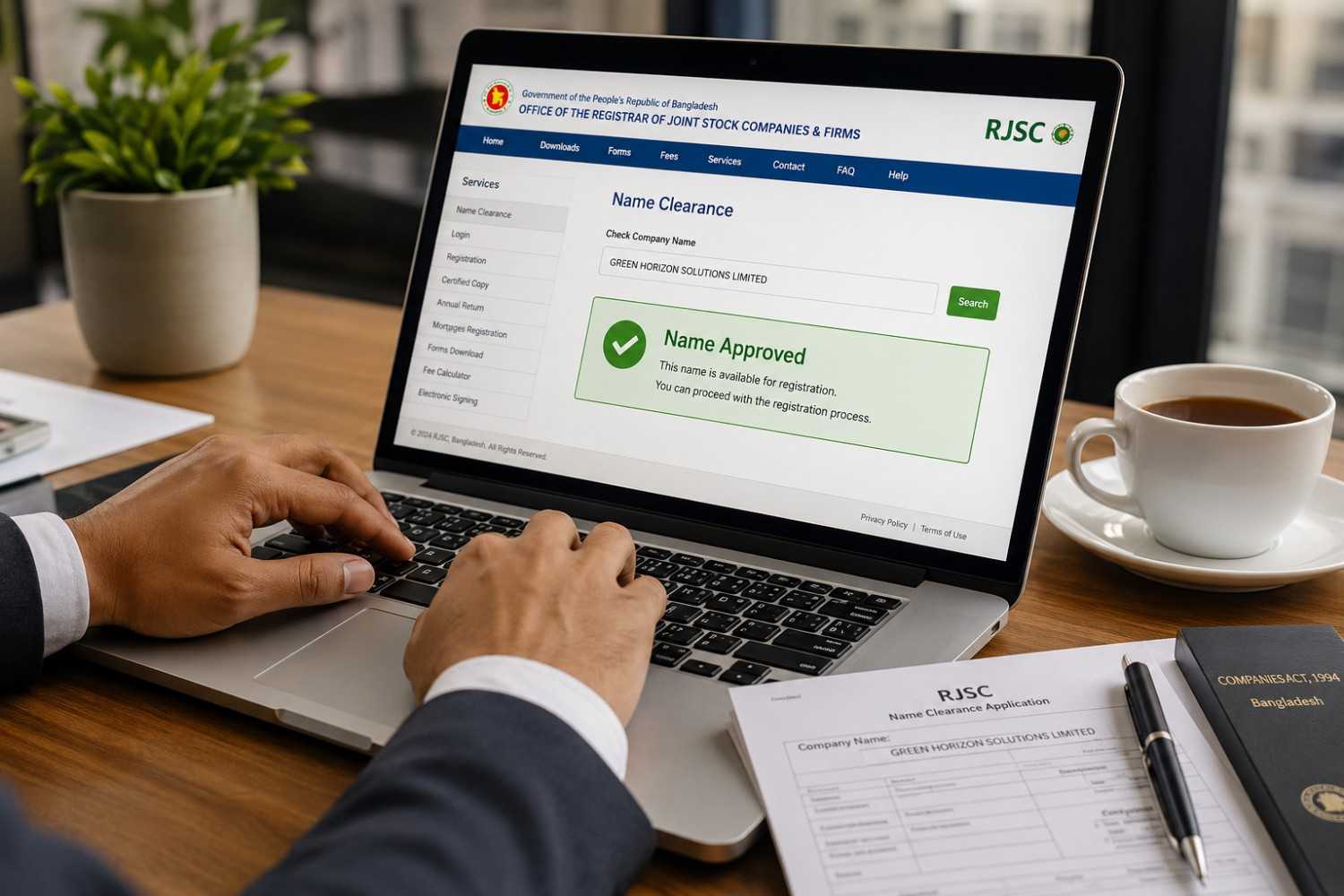

You’ll need to create an account and provide the proposed name and your contact information. The authorities will then review your request to ensure it meets legal standards. Once approved, you’ll receive a clearance certificate that’s valid for a certain period.
Criteria for Approved Business Names
The authorities have strict guidelines to ensure clarity and prevent confusion. Understanding these rules is crucial for a smooth approval process.
To increase your chances of approval, remember the following criteria:
- The name must be unique and not identical to any existing company.
- It should not contain offensive language or prohibited terms.
- The name must not imply government patronage or official status.
- You must include the appropriate suffix, such as “Limited” or “Private Limited,” to reflect your business structure.
Following these standards will greatly improve your chances of getting company name clearance on your first try. Proper preparation at this stage is key to your overall RJSC compliance strategy.
Drafting the Joint Venture Agreement
Creating a solid contract is a key part of forming a strong partnership. This document is the legal backbone of your partnership. It sets clear expectations, safeguarding your business and ensuring stability over time.
Defining Roles, Responsibilities, and Equity Stakes
It’s crucial to outline each partner’s roles and responsibilities to avoid conflicts. A detailed agreement should specify the exact equity stakes of each party. This transparency is vital for the long-term success of your venture.
Documenting decision-making authority for major corporate actions is also essential. Define who manages the board and oversees daily operations to prevent disputes.
Proper documentation at this stage can save you from legal headaches and costs later.
Dispute Resolution Mechanisms and Exit Strategies
Every partnership needs a clear plan for resolving disagreements. Include robust dispute resolution mechanisms, like mandatory mediation or arbitration, to handle conflicts outside court. This keeps your business running smoothly, even during disagreements.
Moreover, your agreement should outline exit strategies for both parties. Whether through a buy-sell agreement or a structured liquidation process, having a clear path forward is crucial. Planning for these scenarios in advance secures your exit options and protects both partners.
Governing Law and Jurisdiction Clauses
Choosing the right governing law is a critical decision for protecting your investment. Specify which country’s laws will govern your contract. This choice provides legal certainty and confidence throughout the partnership.
Also, define the jurisdiction for legal proceedings. Picking a neutral or favorable venue for dispute resolution can greatly impact enforcing the agreement. Strong jurisdiction clauses protect your capital and operational assets.
Preparing Essential Incorporation Documents
Understanding the documentation phase is a crucial part of the registration process. It’s vital to ensure all legal documents meet the standards of the Registrar of Joint Stock Companies and Firms (RJSC). Proper preparation at this stage helps avoid future administrative challenges.
Drafting the Memorandum of Association
The Memorandum of Association (MoA) is your company’s charter. It outlines the scope of your business activities and your objectives. Drafting this document with care is essential to avoid any confusion about your operational limits.
Structuring the Articles of Association
The MoA defines your external goals, while the Articles of Association (AoA) govern your internal operations. This document details how your board of directors will operate and how shareholders will exercise their rights. Structuring these bylaws correctly is crucial for maintaining harmony between local and foreign partners.
Notarization and Legalization Requirements for Foreign Documents
If your joint venture includes foreign entities, all foreign documents must be formally notarized and legalized by the relevant embassy or consulate. This step confirms the authenticity of your agreements, making them legally binding locally.
Ignoring these steps can cause significant delays in approval. Always check that your foreign partners have provided duly certified copies of their incorporation certificates and board resolutions. Following these strict protocols ensures your application is accepted without delays and keeps your foreign partnership fully compliant.
Securing BIDA Approval for Foreign Investment
Getting approval from the Bangladesh Investment Development Authority (BIDA) is crucial for entering the market. This step ensures your investment meets national economic goals and follows regulatory standards. It’s a core requirement for foreign-backed ventures and sets a solid base for your operations.
Determining When BIDA Registration is Mandatory
For many international investors, bida registration is a must before starting business. This is especially true for projects with foreign equity or needing industrial permits. Knowing the joint venture company registration process Bangladesh well helps avoid legal issues early on.


Some ventures need this clearance for profit and dividend repatriation. Without it, dealing with local banks becomes tough. Always check if your business model requires this filing.
Documentation Required for BIDA Clearance
To start your application, gather detailed documents proving your investment’s legitimacy. You’ll need your Joint Venture Agreement, board resolutions, and a project profile. These documents must be accurate and complete.
Also, provide proof of address and ID for all signatories. While RJSC handles incorporation, BIDA separately checks investment viability and sector compliance. Make sure all foreign documents are notarized and legalized for local standards.
Managing the Approval Timeline and Compliance
Managing this approval process requires a proactive approach. Approval times vary with project complexity and submission completeness. Keeping in touch with BIDA officials helps avoid delays.
Staying informed on government policies and reporting is key. Consistent compliance with BIDA rules safeguards your investment and supports growth. Strategic planning during this phase keeps your project on track and avoids regulatory hurdles.
Financial Setup and Capital Remittance
Setting up a solid financial base is a key part of this process. After planning, you must move capital into the country. This step needs careful planning to ensure funds are ready for incorporation.
Opening a Temporary Bank Account for Initial Capital
To transfer your investment, open a temporary bank account in the company’s name. This account holds your initial capital until full registration. You’ll need a name clearance certificate and a formal request letter from the promoters.
This step requires close coordination with a local bank. Banks need proof of identity for foreign partners and a detailed business plan. With the account open, you can inject capital.
Regulatory Procedures for Remitting Foreign Investment
Transferring funds must follow central bank rules. Ensure all transfers are marked as FDI to avoid errors. It’s highly recommended to get an Encashment Certificate from your bank to prove your investment.
Ensuring Compliance with Bangladesh Bank Guidelines
Transparency in remittance is crucial for success. You must report all capital inflows to the Bangladesh Bank. Not documenting these correctly can cause delays in business growth.
| Requirement | Purpose | Key Document |
|---|---|---|
| Temporary Account | Capital Holding | Name Clearance |
| FDI Remittance | Investment Proof | Encashment Certificate |
| Central Bank Filing | Regulatory Reporting | Form FC-1 |
Formal Registration with the Registrar of Joint Stock Companies and Firms (RJSC)
The last step in setting up your business is registering it with the Registrar of Joint Stock Companies and Firms. This is the most critical milestone in establishing your business in the local market. By fulfilling these requirements, you move from planning to a legally recognized entity.
Submitting the Incorporation Application
First, you need to upload your incorporation documents online. This step is crucial in the steps to register a joint venture company in Bangladesh. Make sure all documents, like the Memorandum and Articles of Association, are clear scans that match your physical copies.
The RJSC will check if your application meets local corporate laws. If there are issues, you might need to clarify or revise your documents. Accuracy at this stage is key to avoiding delays.
Payment of Registration Fees and Stamp Duty
When planning your budget, consider the joint venture company registration fees in Bangladesh. These costs depend on your company’s capital and shareholding structure. Pay these fees through the designated banking channels to ensure proper recording by the RJSC.
You also need to pay stamp duty on your documents. The duty amount changes based on your capital and business activities. Always check the current fee schedule on the government website to ensure you meet all obligations.
Receiving the Certificate of Incorporation
After approval and payment verification, the RJSC will issue your Certificate of Incorporation. This document is your company’s official birth certificate, giving it legal identity. You can then start your business operations.
Having this certificate lets you fulfill post-incorporation tasks, like opening a corporate bank account. It proves your joint venture meets the country’s regulatory standards. Keep this document safe for future legal and financial needs.
| Registration Stage | Primary Responsibility | Key Requirement |
|---|---|---|
| Document Submission | Applicant | Digital Upload to RJSC |
| Fee Processing | Financial Institution | Capital-based Payment |
| Final Approval | RJSC Authority | Certificate Issuance |
Post-Incorporation Licensing and Tax Compliance
With your incorporation certificate in hand, your business journey enters a new phase. You must now secure specific permits to operate legally. These steps are crucial to finalize your legal setup and maintain your operational status.
Applying for a Trade License from Local Authorities
To operate within any city corporation or municipality, a trade license is required. This license grants you permission to conduct business at your registered office address. You’ll need to submit your incorporation documents, rent agreement, and a filled application form to the local ward office.
The process is generally straightforward. However, ensure your business nature aligns with local zoning regulations. Timely renewal of this license is crucial to avoid penalties or operational disruptions.
Obtaining a Tax Identification Number from the NBR
Every business entity in the country must obtain a Tax Identification Number (TIN) from the National Board of Revenue (NBR). This unique number is essential for all future tax filings and financial transactions. You can apply for this through the NBR’s online portal by providing your company’s incorporation details and the particulars of your authorized signatories.
- Certificate of Incorporation
- Memorandum and Articles of Association
- Board Resolution authorizing the TIN application
- Proof of office address
Registering for VAT and Business Identification Number
If your business activities involve the sale of taxable goods or services, you must complete your company vat registration. This process grants you a Business Identification Number (BIN), which is required for issuing VAT invoices and filing monthly returns. Maintaining accurate records of your input and output VAT is critical for long-term compliance.
| Requirement | Issuing Authority | Primary Purpose |
|---|---|---|
| Trade License | Local Municipality | Legal Operation |
| TIN | NBR | Income Tax Filing |
| VAT/BIN | NBR | Indirect Tax Compliance |
By completing these registrations, you establish a solid foundation for your joint venture. Staying proactive with these regulatory filings protects your company from legal risks and fosters a professional reputation in the Bangladeshi market.


Establishing Corporate Banking and Operational Infrastructure
After completing the core registration process, your next priority is establishing a functional corporate environment. This phase is the final step before you can start daily business activities. Careful planning during this stage ensures your company remains compliant while scaling its operations.
Transitioning to a Permanent Corporate Bank Account
Once you receive your incorporation documents, you must move your initial capital from the temporary account to a permanent corporate bank account. This transition is essential for maintaining clear financial records and meeting regulatory standards. Proper banking documentation is required to prove that your paid-up capital is fully available for business use.
Setting Up the Registered Office Address
Your registered office serves as the official point of contact for government authorities and legal notices. You must ensure that this address is physically accessible and properly documented within your corporate records. Maintaining a verified office location is a mandatory requirement for every registered entity.
Compliance with Local Labor Laws and Employment Regulations
Managing your workforce requires strict adherence to the Bangladesh Labour Act. You are responsible for drafting formal employment contracts, maintaining attendance registers, and ensuring timely salary disbursements. Legal compliance in these areas protects your company from potential disputes and fosters a productive work environment.
| Operational Task | Primary Objective | Key Requirement |
|---|---|---|
| Corporate Banking | Financial Autonomy | Board Resolution |
| Office Setup | Legal Presence | Utility Bill Proof |
| Labor Compliance | Workforce Safety | Employment Contracts |
By finalizing these infrastructure steps, you successfully conclude the core registration journey. You are now prepared to launch your services and engage with the local market effectively.
Managing Share Allotment and Capital Structure
Keeping your capital structure clear and accurate is crucial for your business’s long-term success in Bangladesh. Proper equity management ensures compliance with local laws and builds trust among partners. It safeguards your legal interests and lays a solid groundwork for growth.
Procedures for Initial Share Allotment at RJSC
After getting your certificate of incorporation, you must distribute shares. The joint venture company share allotment at RJSC process requires filing specific documents. This step is essential to get your equity distribution officially recognized.
To complete this process, you generally need to prepare and submit the following:
- A formal board resolution authorizing the allotment of shares.
- The Return of Allotment form, which details the number of shares issued to each partner.
- Proof of payment for any applicable stamp duties related to the share capital.
Issuing Share Certificates to Partners
After the RJSC processes the allotment, you must issue share certificates to your partners. These documents prove ownership. Ensure each certificate is signed by authorized directors and has the company seal.
Your share certificates should clearly state the following information to remain valid:
- The name of the registered holder.
- The unique certificate number and the class of shares held.
- The amount paid or considered as paid on the shares.
Reporting Changes in Capital Structure
Your business may need to increase its authorized capital or issue new shares for growth. Any changes to your capital structure must be reported to the RJSC promptly. Not updating these records can lead to penalties and audit complications.
When altering your equity, file the necessary forms and pay fees. Keeping your statutory registers updated is essential for regulatory compliance. This ensures your joint venture remains compliant with Bangladesh’s government.
Navigating Share Transfers and Regulatory Filings
As your joint venture grows, updating ownership records becomes a necessity. Effective management of these tasks is crucial for maintaining your company’s standing with the RJSC. Proactive handling of corporate filings helps avoid legal issues and ensures smooth operations.
Legal Requirements for Joint Venture Company Share Transfer at RJSC
When partners adjust equity stakes, a joint venture company share transfer rjsc process is required. This involves submitting a formal transfer document, signed by both parties. You also need to provide the original share certificates and updated board resolutions.
After preparing the documents, they must be filed with the registrar to update records. Timely submission is key to reflect the current ownership structure accurately. Neglecting this can result in penalties and administrative delays.
Filing Schedule X for Annual Returns and Compliance
Every registered entity must follow strict reporting deadlines to stay compliant. The RJSC annual return filing is a must, providing the government with your company’s financial and operational status.
You must submit Schedule X annually. This document details your share capital, debts, and member list. Ensuring this data is accurate and filed on time is vital for your corporate governance.
Maintaining Statutory Registers and Minute Books
Keeping detailed internal records at your registered office is essential. Maintaining statutory registers, like the register of members and directors, is a non-negotiable aspect of compliance. These records are the primary proof of your company’s legal history.
Additionally, detailed minute books for all meetings are necessary. These records document decision-making processes and offer legal protection for directors and shareholders. Organized minute books prepare your business for audits or inspections.
Winding Up and Dissolution Procedures
When your joint venture’s lifecycle ends, knowing the formal dissolution process is crucial for your protection. Navigating the complexities of joint venture winding up in Bangladesh demands a well-thought-out strategy. This ensures all legal obligations are fulfilled. Proper dissolution acts as a shield, protecting partners from future financial or legal risks.
Voluntary Liquidation Processes for Joint Ventures
Deciding to close the business leads to voluntary liquidation. This starts with a formal resolution by shareholders to wind up the company. A liquidator is appointed to manage the orderly sale of assets and settle claims.
The liquidator is the key figure in this phase. They ensure this process adheres to the Companies Act guidelines. After completion, the liquidator presents a final account to shareholders and the RJSC.
Regulatory Requirements for Striking Off a Company
If a company is dormant or never started, you can apply to strike off its name. This regulatory action removes the entity from official records. You must prove the company has no operations and no liabilities to qualify.
Applying for striking off requires submitting documents to the RJSC. It’s a cost-effective option for companies that never traded. Ensure all annual returns and statutory filings are current before the registrar approves your request.
Settling Liabilities and Distributing Assets
Before dissolution, settling all debts is paramount. This includes clearing tax with the National Board of Revenue and paying creditors. Transparency is essential to avoid disputes among partners.


After debts are cleared, assets are distributed according to equity stakes and the joint venture agreement. Adhering to these steps ensures a clean exit and legal certainty for all involved.
Ensuring Long-Term Operational Success and Regulatory Adherence
Creating a sustainable business demands a strong focus on corporate governance and legal compliance. It’s crucial to stay informed about updates to the Companies Act and other laws. This ensures your venture remains resilient.
Understanding this registration process is the first step in your business journey. You now have the knowledge to manage your business from start to finish, including dissolution.
Adhering to high standards of compliance safeguards your investment and promotes growth in the competitive Bangladeshi market. Mastering this process is just the start of your journey to long-term success.
FAQ
How to register a joint venture company in Bangladesh and what is the first step?
To start the process of registering a joint venture company in Bangladesh, you first need to get a company name clearance from the Registrar of Joint Stock Companies and Firms (RJSC). This involves checking the RJSC portal to see if your name is available and meets local criteria. Once your name is cleared, you can move forward with the formal steps to form a joint venture company in Bangladesh.
What are the essential requirements for Joint venture company registration in Bangladesh?
The key requirements for registering a joint venture company in Bangladesh include a signed Joint Venture Agreement, the Memorandum of Association (MoA), and the Articles of Association (AoA). You also need to provide identification for all directors, proof of your registered office address, and evidence of capital remittance through a temporary bank account for foreign partners.
Is BIDA registration mandatory for all foreign investors in a joint venture?
Yes, BIDA registration is a must for all foreign investors in a joint venture. The Bangladesh Investment Development Authority (BIDA) oversees foreign capital inflows and provides necessary approvals for work permits and profit repatriation. It’s crucial to align your investment with BIDA and Bangladesh Bank guidelines to understand the foreign company registration process in Bangladesh.
How do you determine the joint venture company registration fees in Bangladesh?
The fees for registering a joint venture company in Bangladesh are mainly based on your company’s authorized capital. You’ll need to pay registration fees to the RJSC and stamp duty to the government. Budgeting for these costs early in your journey to avoid delays in getting your Certificate of Incorporation is essential.
What is the process for joint venture company share allotment at rjsc?
After the initial capital is remitted and the company is incorporated, you must complete the share allotment at RJSC. This involves submitting the return of allotment (Form XV) to the RJSC, which officially records the distribution of shares among partners. This step is crucial for legally finalizing your joint venture company formation in Bangladesh.
What post-incorporation licenses are required to commence business operations?
After your company is registered at RJSC, you need to obtain a trade license from the relevant local authority, such as the Dhaka South City Corporation. You must also apply for a Tax Identification Number (TIN) from the National Board of Revenue (NBR) and complete your company vat registration to receive a Business Identification Number (BIN).
How do you handle a joint venture company share transfer rjsc later in the business lifecycle?
To transfer shares in a joint venture company at RJSC, follow the procedures outlined in your Joint Venture Agreement and the Companies Act. This requires executing a transfer deed (Form 117) and filing it with the RJSC to update the company’s list of shareholders. Ensuring accuracy in this process is vital for maintaining your RJSC foreign company registration in Bangladesh status.
What are the annual compliance duties for a Joint venture company, such as rjsc annual return filling g in Bangladesh?
Your company must legally submit RJSC schedule X and other statutory documents annually. This includes filing audited financial statements and holding an Annual General Meeting (AGM). Consistent compliance ensures your Joint venture company registration in Bangladesh remains valid with regulators.
How can you legally dissolve a partnership through joint venture winding up in Bangladesh?
To close the business legally, you must follow the formal process for joint venture winding up in Bangladesh. This involves voluntary liquidation, where you appoint a liquidator to settle liabilities, distribute assets, and officially strike the company off the RJSC register. This ensures a clean exit and protects you from future legal disputes.
What is the difference in how to register foreign company in Bangladesh compared to a joint venture?
While registering a joint venture company in Bangladesh involves both local and foreign partners, registering a 100% foreign-owned subsidiary follows a similar RJSC process. Both require BIDA registration, capital remittance, and adherence to the foreign company registration procedure in Bangladesh. However, the internal governance in the Articles of Association will differ significantly.
-
Foreign Company Registration in Bangladesh: Easy Guide 2026
Expanding your business into new markets offers exciting growth potential. Foreign Company Registration in Bangladesh is a straightforward process once you understand the local legal landscape. This guide provides a clear roadmap to help you navigate the legal requirements for setting up your operations effectively. We simplify the complex process of Foreign Company Incorporation Bangladesh…
-
Company Registration in Bangladesh: Easy Complete Guide
Embarking on a new venture is thrilling, yet it demands a strong base. A successful business setup in Bangladesh starts with picking the right legal form and completing the registration accurately. Quick Facts: Company Registration in Bangladesh Whether it’s a private limited company or a foreign-owned entity, the right documents are key to lasting success.…
-
Partnership Firm Registration in Bangladesh: Easy Steps (2026)
Starting a business with others is a wise choice for many entrepreneurs. It brings together shared resources and expertise, accelerating your venture’s growth. However, it’s crucial to handle the legal aspects correctly from the outset. Completing your partnership firm registration in Bangladesh grants your venture official status. This builds trust with clients and stakeholders. Grasping…
-
Company Share Transfer in Bangladesh: Easy RJSC Guide (2026)
Understanding the legal intricacies of corporate ownership changes is crucial. Whether it’s for restructuring or succession, knowing the mandatory steps is essential. This knowledge ensures your actions are in line with local laws. Quick Facts: Company Share Transfer in Bangladesh Every step must comply with the Companies Act and the Registrar of Joint Stock Companies…
-
RJSC Annual Return Filing in Bangladesh | Schedule X Submission in Bangladesh Guide
Running a business demands strict adherence to local corporate laws. If you manage a company, prioritizing RJSC Annual Return Filing in Bangladesh is crucial to maintain your legal status. This ensures your entity remains transparent and trustworthy to stakeholders. Schedule X submission in Bangladesh is a vital part of your yearly obligations. Keeping your director…
-
Branch Office Registration in Bangladesh: Easy Legal Guide
Bangladesh is one of South Asia’s fastest-growing economies — with strong GDP growth and a population exceeding 160 million, it offers substantial opportunity for foreign enterprises. Establishing a local office gives your company closer control over operations and faster access to customers and partners. This guide simplifies Branch Office Registration in Bangladesh: whether you’re evaluating…
-
Liaison Office Registration in Bangladesh | Representative Office Registration in Bangladesh
Expanding your business into new territories requires a clear strategy and a solid legal foundation. Bangladesh offers a wealth of untapped potential for international firms aiming to grow their global footprint. Establishing a local presence allows you to conduct vital market research and build lasting professional relationships. Navigating the regulatory landscape can feel daunting, but…
-
Company Winding Up in Bangladesh: Complete Legal Guide (2026)
Closing a business entity requires careful navigation of local legal frameworks. Whether you manage a local firm or a foreign enterprise, you must follow the Companies Act of 1994 to ensure a smooth exit. This formal procedure protects your interests while satisfying regulatory obligations. You might wonder how to wind up a company in Bangladesh…
-
One Person Company Registration in Bangladesh: Easy Guide
One Person Company Registration in Bangladesh gives solo entrepreneurs a solid legal foundation to safeguard their assets. This modern business model allows an individual to enjoy corporate perks while retaining full operational control, making it ideal for entrepreneurs aiming to grow without the hurdles of traditional partnerships. Registering your startup with the Registrar of Joint…
-
Society Registration in Bangladesh | Complete RJSC Registration Guide
If your group works in charity, education, culture, or social welfare, registering as a society gives legal standing and public trust. This guide explains the practical steps, required documents, and fees so founders and organizers can complete the process confidently. Follow the clear steps for society registration in Bangladesh to secure name clearance, prepare your…
-
Foundation Registration in Bangladesh: Easy Guide (2026)
Setting up a non-profit in Bangladesh requires clear planning and a practical understanding of local rules. You’ll face specific administrative steps to ensure your organization operates legally and transparently. Understanding these requirements is the first step to creating lasting social impact. This guide lays out a clear, step-by-step path for Foundation Registration in Bangladesh, covering…
Embarking on a new venture is thrilling, yet it demands a strong base. A successful business setup in Bangladesh starts with picking the right legal form and completing the registration accurately.
Quick Facts: Company Registration in Bangladesh
- Governing Law: Companies Act, 1994
- Registering Authority: RJSC (Registrar of Joint Stock Companies and Firms)
- Minimum Shareholders (Private Limited): 2 | Maximum: 50
- Minimum Directors (Private Limited): 2
- Minimum Shareholders (Public Limited): 7 | Minimum Directors: 3
- Name Clearance Fee: around Tk. 500-600 (paid online via RJSC portal)
- Name Clearance Validity: 30 days
- Time to Get Certificate of Incorporation: usually 3-7 working days after full document submission
- Stamp Duty on MoA/AoA: starts around Tk. 18,000 for authorized capital up to Tk. 10,00,000 (increases with higher capital)
- Foreign Ownership: 100% allowed in most sectors
Whether it’s a private limited company or a foreign-owned entity, the right documents are key to lasting success. The Registrar of Joint Stock Companies and Firms, or RJSC, is the main body overseeing this process. Understanding RJSC Bangladesh’s requirements is crucial for establishing credibility and unlocking growth opportunities.
Our team of experts makes your company registration in Bangladesh smooth. We guide you from name clearance to final incorporation, ensuring your business meets all.


Key Takeaways
- Select the appropriate legal structure for your specific business goals.
- Understand the vital role of the RJSC in the incorporation process.
- Ensure full compliance to build trust with stakeholders and partners.
- Complete tax and VAT registrations to avoid future legal hurdles.
- Leverage professional guidance to streamline your market entry.
Understanding the Role of RJSC in Business Incorporation
Your journey toward establishing a formal business entity in Bangladesh starts with the Registrar of Joint Stock Companies and Firms. As the primary regulatory authority, the RJSC oversees the lifecycle of all business organizations. This includes everything from initial formation to final dissolution. Proper engagement with this office is essential for maintaining legal standing in the local market.
What the RJSC Actually Does
Operating within the legal framework of RJSC Company Registration in Bangladesh requires a clear understanding of statutory requirements. You must ensure that your business structure aligns with the Companies Act to avoid future administrative hurdles. The registrar acts as the gatekeeper, ensuring that every entity follows the rules set by the government.
When you pursue joint stock company registration in Bangladesh, you are essentially entering a formal contract with the state. This process guarantees that your business is recognized as a separate legal entity. By adhering to these regulations, you protect your personal assets and build credibility with potential investors.
Essential Documentation for Initial Name Clearance
Before you can proceed with formal registration, you must secure company name clearance. This step is critical because it prevents the use of names that are already registered or misleading. You should prepare a list of potential names to increase your chances of approval during the first attempt.

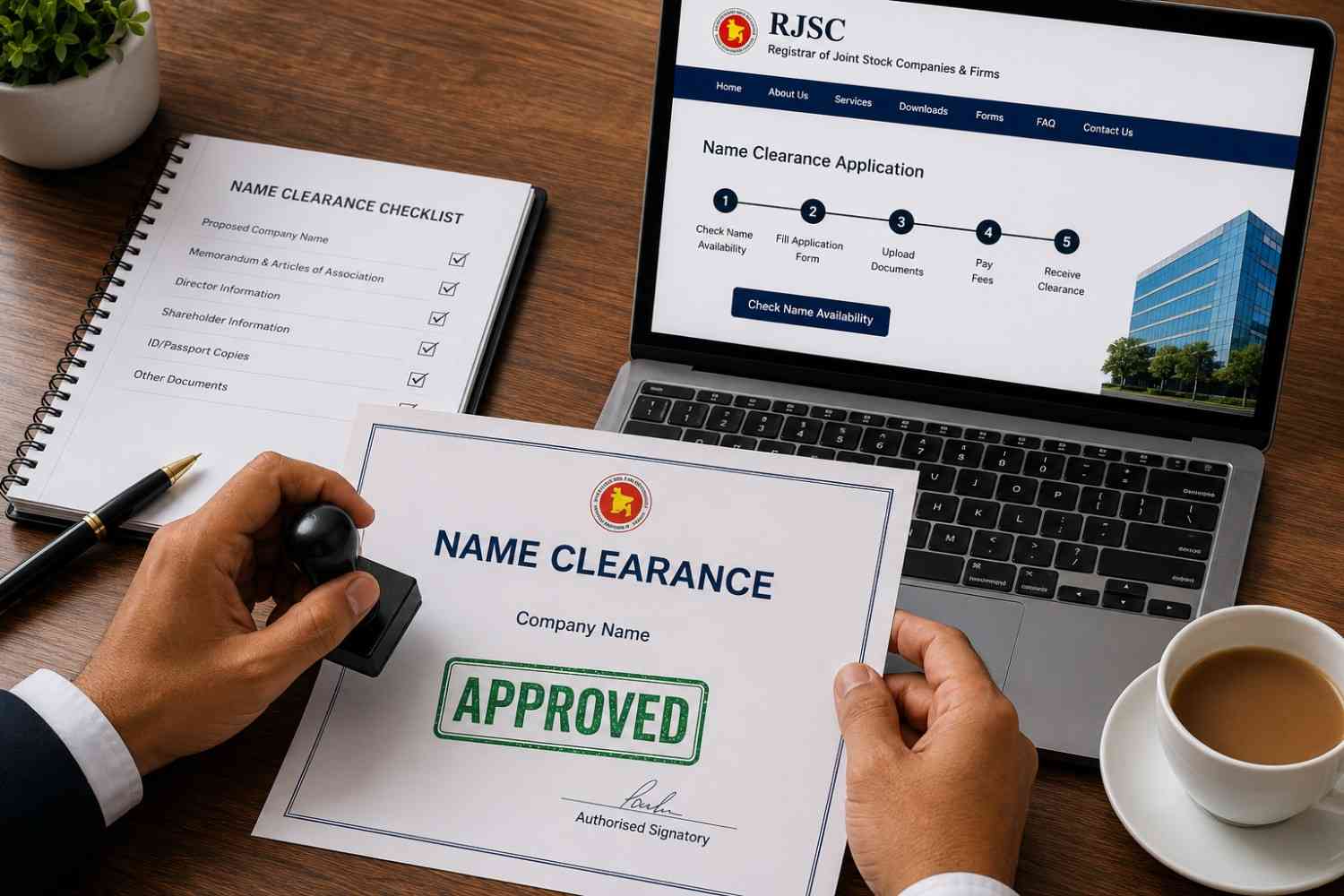
The following table outlines the key stages and requirements for your initial interaction with the authorities:
| Stage | Primary Objective | Key Requirement |
|---|---|---|
| Name Search | Verify uniqueness | Proposed business name |
| Name Clearance | Reserve the name | Clearance fee payment |
| Drafting Docs | Prepare legal papers | Memorandum of Association |
| Final Submission | Formal registration | RJSC approval certificate |
Securing your company name clearance is a foundational step in the joint stock company registration in Bangladesh. Once the name is approved, you gain the right to use it for your official documents and branding. Always ensure that your documentation is accurate to satisfy the RJSC and expedite your application process.
The RJSC name clearance fee is currently around Tk. 500-600, payable online, and once approved your name stays reserved for 30 days — giving you time to complete the remaining paperwork.
Procedures for Private and Public Limited Company Registration in Bangladesh
Choosing the right business structure is crucial for success in Bangladesh. Whether it’s a small startup or a large enterprise, knowing the company registration procedure in Bangladesh is essential. This ensures your business operates legally in the country.
Effective company incorporation in Bangladesh demands careful planning and adherence to the Companies Act. By picking the right entity type, you align your goals with regulatory needs. This foundation safeguards your interests and sets a path for growth.
Steps to Incorporate a Private Limited Company
Most entrepreneurs prefer private limited company registration in Bangladesh for its flexibility. First, you need to get name clearance from the Registrar of Joint Stock Companies and Firms (RJSC). After approval, draft the Memorandum and Articles of Association.
These documents outline your company’s goals and management rules. Next, pay stamp duties and registration fees. Then, submit your application and documents to the RJSC for your Certificate of Incorporation.
Once your documents are submitted correctly, RJSC typically issues the Certificate of Incorporation within 3-7 working days. Stamp duty on your Memorandum and Articles of Association starts at approximately Tk. 18,000 for companies with authorized capital up to Tk. 10,00,000, increasing for higher capital brackets.
Requirements for Public Limited Company Formation
For public capital rising, public limited company registration in Bangladesh is necessary. This path requires stricter compliance than private entities. You must have at least seven shareholders to start.
Additionally, a statutory meeting and a prospectus or statement is required. These steps ensure transparency for investors and creditors. Adhering strictly to these rules is key when learning how to register a limited company in Bangladesh.
| Feature | Private Limited Company | Public Limited Company |
|---|---|---|
| Minimum Shareholders | Two | Seven |
| Transfer of Shares | Restricted | Freely Transferable |
| Public Subscription | Not Allowed | Allowed |
| Minimum Directors | Two | Three |
Unlike private companies, public limited companies must also hold a statutory meeting and issue a prospectus before commencing business — a legal requirement under the Companies Act, 1994.
Knowing these differences helps you choose how to register limited company in Bangladesh wisely. Always seek legal advice to ensure your documents comply with all laws for directors and shareholders.
Establishing a One Person Company Registration with RJSC
If you’re a solo founder aiming to formalize your business, the RJSC offers a streamlined path for One person company registration in Bangladesh. This modern legal framework lets you enjoy corporate benefits while maintaining full control. It’s perfect for entrepreneurs aiming to scale their ventures without the hassle of traditional partnerships.
Eligibility Criteria for OPCs
To qualify, you must meet specific requirements set by regulatory authorities. Primarily, the entity must be formed by a single natural person who acts as the sole shareholder. It is essential to note that you must also appoint a nominee who will take over the business in the event of your death or incapacity.
- The founder must be a natural person, not another corporate entity.
- A nominee director must be appointed during the initial filing.
- The company must have a clear memorandum of association outlining its business activities.
Operational Advantages of One Person Companies
Choosing this path for your startup company registration provides significant protection for your personal assets. The business is a separate legal entity, limiting your liability to the capital invested. This separation is a crucial advantage for managing financial risks effectively.
Furthermore, the compliance burden is significantly lower compared to public limited companies. The administrative requirements are simplified, allowing you to focus more on growth and innovation. The following table highlights how this structure compares to other common business forms in Bangladesh.
| Feature | One Person Company (OPC) | Private Limited Company | Partnership |
|---|---|---|---|
| Minimum Members | 1 | 2 | 2 |
| Liability | Limited | Limited | Unlimited |
| Compliance Level | Low | Moderate | Low |
| Management | Sole Owner | Board of Directors | Partners |
By leveraging the RJSC framework, you ensure your startup company registration is handled with professional rigor. Completing your One person company registration in Bangladesh correctly sets a solid foundation for your future success. Always ensure your documentation is accurate to avoid delays in the approval process.
Foreign Company Registration and Market Entry
Expanding into Bangladesh demands a deep grasp of legal frameworks for foreign entities. You must overcome various regulatory obstacles to ensure your operations are fully compliant with local laws. A well-thought-out strategy is key to avoiding risks while capitalizing on growth opportunities in this burgeoning market.
Registering a Foreign Subsidiary in Bangladesh
The journey of foreign company registration in Bangladesh starts with securing name clearance from the Registrar of Joint Stock Companies and Firms. After confirming the name, you must draft the Memorandum and Articles of Association, customized for your business activities. These documents outline your operational scope and governance structure within the country.
Following incorporation with the Registrar, BIDA registration is imperative. It’s crucial for foreign investors to obtain work permits and ensure the repatriation of profits. Early completion of your foreign investment registration in Bangladesh ensures that your capital inflows are acknowledged by the central bank and relevant authorities.
For a company with roughly USD 100,000 in paid-up capital, government and RJSC fees typically run between USD 450-500. Foreign shareholders must also deposit their paid-up capital into a temporary bank account and obtain an Encashment Certificate before incorporation can be finalized.
Compliance Requirements for Foreign-Owned Entities
Compliance is an ongoing duty for foreign-owned entities. You must submit annual returns and audited financial statements to the Registrar to maintain your active status. Neglecting these deadlines can lead to severe penalties or the suspension of your business license.
Adherence to specific sector-based regulations is also crucial. BIDA registration in Bangladesh requires periodic updates on your investment and employment statistics. Keeping abreast of these requirements safeguards your foreign investment registration status and ensures long-term operational stability.
| Entity Type | Primary Purpose | Regulatory Focus |
|---|---|---|
| Foreign Subsidiary | Full Commercial Operations | RJSC & BIDA Compliance |
| Liaison Office | Market Research & Coordination | BIDA Approval Only |
| Branch Office | Specific Project Execution | RJSC & BIDA Oversight |
Setting Up a Joint Venture
Entering the local market through a strategic partnership requires a clear understanding of joint venture company registration in Bangladesh. This process allows foreign investors to combine resources with local entities. It leverages market knowledge and operational expertise. By forming a formal business entity, you ensure that your cross-border collaboration remains legally protected and scalable.


Structuring Agreements for Joint Ventures
A robust shareholder agreement serves as the foundation for your partnership. You must clearly define the roles, responsibilities, and equity distribution between the foreign and local partners. Precision in these documents prevents future disputes and clarifies the decision-making process for your board of directors.
Your agreement should also outline exit strategies and dividend distribution policies. By addressing these factors early, you create a stable environment for your joint venture company registration in Bangladesh. It is essential to ensure that all clauses align with the local Companies Act to maintain enforceability.
Regulatory Hurdles and Solutions
Navigating the regulatory landscape often presents challenges for international investors. You may encounter specific requirements regarding capital repatriation and local equity participation. Working with legal experts helps you address these hurdles while ensuring full compliance with the Registrar of Joint Stock Companies and Firms (RJSC).
The following table outlines key considerations for your venture structure:
| Feature | Foreign Partner Role | Local Partner Role |
|---|---|---|
| Capital Contribution | Foreign Currency Investment | Local Assets or Cash |
| Operational Oversight | Technical Expertise | Regulatory Liaison |
| Compliance Focus | BIDA Approval | RJSC Filings |
| Risk Management | Global Standards | Market Adaptation |
Proactive planning remains the best solution for overcoming administrative delays. By preparing your documentation according to RJSC guidelines, you streamline the joint venture company registration in Bangladesh. Consistent communication with regulatory bodies ensures that your business remains in good standing throughout its lifecycle.
Branch, Liaison, and Representative Offices
Deciding on the right legal structure for your foreign entity is crucial for entering the Bangladesh market. Foreign firms often seek to expand without the full incorporation complexities. By choosing the right office model, you ensure compliance with local laws and align with your business goals.
Distinguishing Between Office Types
It’s vital to understand the differences between these entities for compliance. Each serves as a market entry point but has distinct legal permissions and operational scopes.
| Office Type | Primary Function | Revenue Generation |
|---|---|---|
| Liaison Office | Communication and Market Research | Not Permitted |
| Branch Office | Commercial Activities | Permitted |
| Representative Office | Promotional Activities | Not Permitted |
A branch office registration in Bangladesh enables full commercial activities and revenue generation. In contrast, a liaison office focuses on communication between the parent company and local stakeholders. Careful selection of your office type affects your tax obligations and operational freedom.
Application Process for Foreign Liaison Office Registration in Bangladesh
The liaison office registration in Bangladesh process requires approval from the Bangladesh Investment Development Authority (BIDA). You must submit a detailed application outlining your business goals and financial support.
To secure your office status, follow these key steps:
Prepare a formal application letter signed by the authorized representative of the parent company.
Submit the Memorandum and Articles of Association of the parent firm, duly attested by the local embassy.
Provide a board resolution authorizing the opening of the office and appointing a local representative.
Include the audited financial statements of the parent company for the last two years.
After submitting your documents, BIDA reviews the proposal to ensure it aligns with national economic interests. Maintaining compliance during this period is crucial for a smooth approval process. Once approved, you must complete local trade licensing and tax registration to finalize your setup.
Partnership Firm Registration: Legal Framework
The Partnership firm registration in Bangladesh is a crucial step for entrepreneurs aiming to run a business together. This step is governed by the Partnership firm registration act. 1932,which sets the legal framework for your business. By registering your business, you ensure that the rights and liabilities of all partners are clearly defined and protected by law.
Applying the Partnership Act 1932
Understanding the legal framework is essential before starting. The Act details how partners should manage their internal and external obligations. Proper registration gives your firm the legal standing to sue or be sued in its name.
To proceed, you must learn how to register a partnership firm at RJSC. The Registrar of Joint Stock Companies and Firms (RJSC) is the primary authority for this process. Working with the RJSC partnership firm registration system ensures your business meets national standards.
Name Clearance and Deed Registration
The first step is obtaining Partnership firm name clearance. Your chosen name must be unique and not in conflict with existing entities. Securing this partnership firm name clearance is a necessary step before registering your deed.
After name approval, draft a comprehensive partnership deed. This document outlines profit sharing, capital contributions, and dispute resolution mechanisms. Submitting this deed to the RJSC completes the joint stock partnership firm registrationin Bangladesh process.
Following these steps correctly is the most reliable way to how to register a partnership firm registration at RJSC. Below is a summary of the key components involved in the registration process.
| Requirement | Description | Importance |
|---|---|---|
| Name Clearance | Verification of a Unique Business Name | Prevents Legal Conflicts |
| Partnership Deed | Legal Agreement Between Partners | Defines Rights and Duties |
| RJSC Filing | Official Submission of Documents | Grants Legal Recognition |
| Compliance | Adherence to the Companies Act, 1994 | Ensures Long-Term Stability |
Managing Company Share Allotment and Transfer
Issuing new shares or transferring existing ones requires adherence to the Registrar of Joint Stock Companies and Firms (RJSC) protocols. Keeping an accurate register of members is crucial for corporate transparency and stability. Following the legal path ensures your business remains compliant with regulatory authorities in Bangladesh.
Procedures for Share Allotment in Bangladesh
The company share allotment procedure in Bangladesh starts with a board resolution. You need to decide on the number of shares, their price, and the allottees’ identities. This step is vital for companies aiming to increase their capital base effectively.
After the board approves the allotment, filing the necessary returns with the RJSC is required. This update ensures your capital structure is reflected in the public record. Here are the key steps for a seamless process:
Pass a formal board resolution to authorize the new share issuance.
Prepare the return of allotment detailing the number and class of shares.
Pay the required government fees through the designated banking channels.
Submit the filing to the RJSC to finalize the company share allotment in Bangladesh.
Legal Requirements for Share Transfer at RJSC
Executing a Company share transfer at RJSC demands strict adherence to the Articles of Association and the Companies Act. Whether it’s a foreign company share transfer or a joint venture company share transfer RJSC, the documentation must be precise. Proper execution prevents legal disputes and ensures clear ownership records.
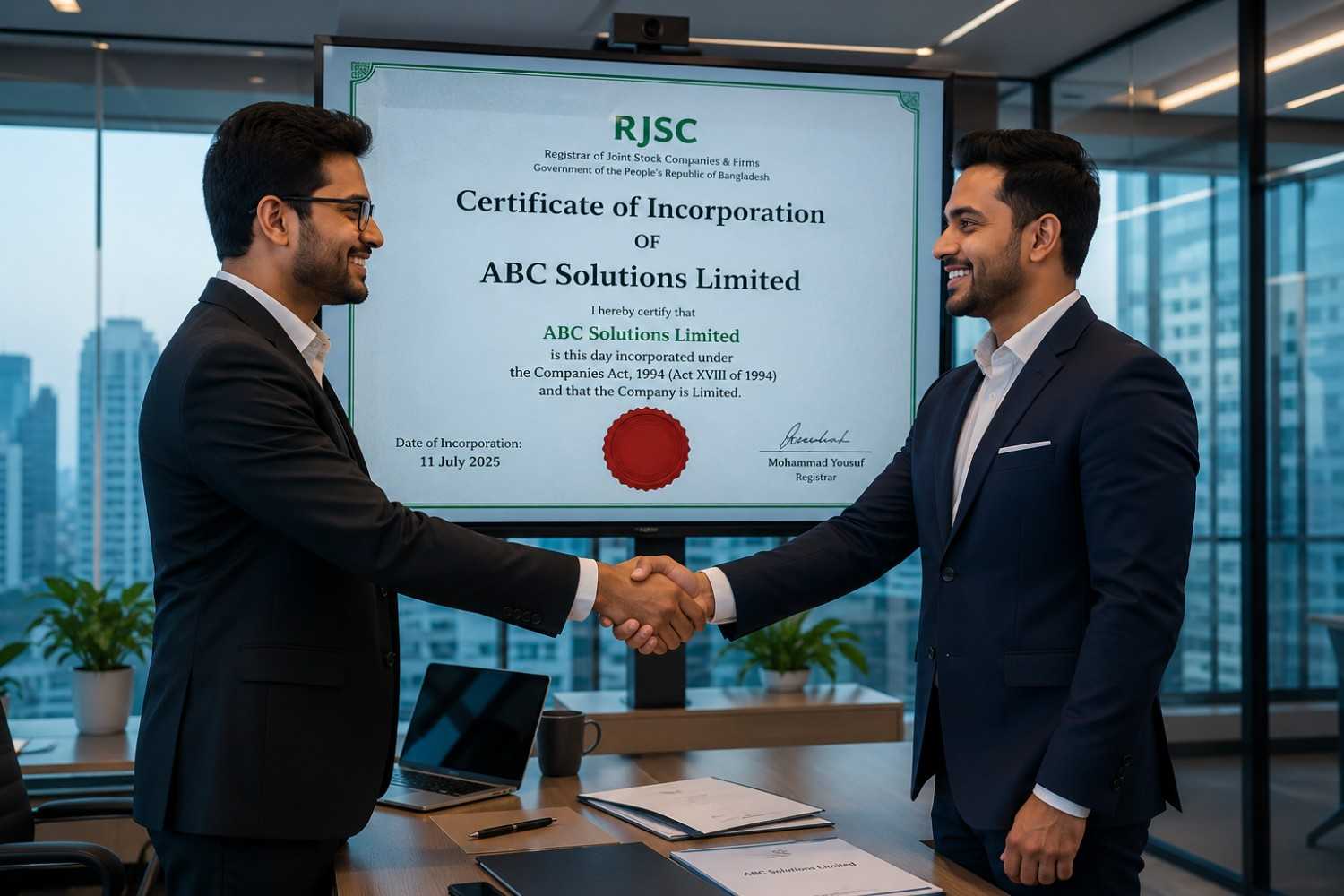

The share transfer procedure in Bangladesh involves several mandatory documents. These must be verified by the authorities. Below is a summary of the essential requirements for a successful transfer:
| Document Type | Purpose | Requirement |
|---|---|---|
| Instrument of Transfer | Legal Agreement Between Parties | Must Be Stamped |
| Share Certificate | Proof of Ownership | Original Must Be Surrendered |
| Board Resolution | Company Approval | Certified True Copy |
For a joint venture company share allotment in Bangladesh, ensure compliance with foreign investment regulations before filing. Accuracy in your filings is key to protecting your interests and maintaining a clean corporate history. Always consult with legal experts for complex cross-border transactions.
Compliance with Company Schedule X Submission in Bangladesh
The Company schedule X submission in Bangladesh is crucial for legal compliance in Bangladesh. It’s a key document that outlines your company’s financial and operational details. This ensures the Registrar of Joint Stock Companies and Firms (RJSC) has an up-to-date profile of your business.
By focusing on your RJSC schedule X submission in Bangladesh, you show transparency and integrity. This filing confirms your company operates within the legal bounds set by the government.
Importance of Schedule X in Annual Filings
Your annual compliance obligations are more than just paperwork. They are vital for maintaining your company’s good standing. The Company schedule x submission in Bangladesh gives authorities the data they need on your share capital, debt, and any structural changes. Without it, your company might struggle during audits or when seeking funding.
Keeping your records up to date through the RJSC return submission in Bangladesh process helps avoid legal issues. It ensures stakeholders and regulatory bodies have verified information about your company’s health.
Deadlines and Penalties for Non-Compliance
Meeting filing deadlines is essential for business owners. Missing these deadlines can lead to severe financial and operational consequences. Here are some risks of missing your filing dates:
Late filing fees: The RJSC charges daily penalties for delays beyond the deadline.
Legal notices: Repeated non-compliance may result in formal notices from the registrar.
Operational restrictions: Your company might face restrictions when updating trade licenses or securing loans.
Reputational damage: A history of poor compliance can harm your reputation with investors and partners.
It’s important to track your filing deadlines to protect your business. Being organized allows you to focus on growth while keeping a clean record with authorities.
RJSC Annual Return Submission in Bangladesh and General Meeting Filings
Understanding RJSC filing requirements is the first step to managing your corporate duties effectively. Keeping accurate records is crucial for the long-term health and reputation of your company in Bangladesh. Adhering to these legal procedures ensures transparency with shareholders and government bodies.
Preparing for the Annual General Meeting
The Annual General Meeting (AGM) is a cornerstone of corporate governance. It must be held within the time frame set by the Companies Act to review financials and appoint directors. Proper preparation includes creating detailed agendas and sending out notices to shareholders well in advance.
During the meeting, it’s important to document all resolutions and discussions accurately. This documentation is a must for your annual general meeting filing. Having signed and secure minutes will safeguard your company during audits or regulatory checks.
Filing Annual Returns with the Registrar
After the meeting, the next step is the formal RJSC return submission in Bangladesh. This confirms your company’s active status and compliance with regulations. You need to gather all financial statements and director reports for your RJSC annual return filing in Bangladesh promptly.
On-time submission prevents penalties and keeps your company in good standing. While handling your company annual tax return submission, ensure all data matches the AGM information. Consistency in these documents is essential for regulatory approval.
| Requirement | Deadline | Key Document |
|---|---|---|
| Annual General Meeting (AGM) | Within 18 Months of Incorporation | Minutes of Meeting |
| Annual Return Filing | Within 30 Days of AGM | Form 23B |
| Tax Return Submission | As per NBR Schedule | IT-11GA |
By linking your annual general meeting filing with your RJSC return submission in Bangladesh, you simplify your administrative tasks. Always check that your company annual tax return submission shows your business’s current financial status. Meeting these deadlines shows your dedication to professional corporate management.
Registration for Societies, Foundations, and Trusts
Planning a charitable or social impact initiative? Your first step is to navigate the registration landscape. Creating a formal entity is crucial for legal recognition and public trust in Bangladesh. Whether you aim to form a society or a trust, the process gives you the structure to operate effectively.
Legal Framework for Non-Profit Organizations
Non-profit entities in Bangladesh operate under specific laws. For example, Society Registration in Bangladesh is mainly governed by the Societies Registration Act of 1860. This act enables groups to come together for literary, scientific, or charitable goals.
Trusts, however, are covered by the Trust Act of 1882. This act is designed to manage property or assets for the benefit of others. Knowing these laws is essential for compliance and protects your organization under national law.
Registration Processes for Societies and Trusts
The process to formalize varies by entity type. For Foundation Registration at RJSC in Bangladesh, you need a detailed memorandum of association and bylaws. These documents outline your goals and ensure accountability.
For trust registration in Bangladesh, a formal trust deed is required. This deed must be registered with the relevant sub-registrar office to be legally binding. After finalizing the deed, you can file the necessary documents to empower your organization for social activities.
Compliance requires careful record-keeping and adherence to reporting standards. By following these procedures, your organization can focus on social impact goals without legal risks. Proper registration is key to a sustainable and transparent non-profit operation.
Trade Organization Registration and Licensing
Trade organization registration in Bangladesh is crucial for industry advocacy and growth. It gives your association legal authority to speak for your sector. This ensures your organization operates transparently and accountably in the Bangladeshi market.
Requirements for Chambers and Trade Bodies
To start your trade organization registration, define your entity’s scope and membership criteria. Chambers and industry associations fall under the Ministry of Commerce’s regulations. You must prepare detailed documents to prove your organization’s legitimacy and purpose.
The necessary items for your application include:
A formal application to the Director of Trade Organizations.
A certified Memorandum and Articles of Association copy.
A list of founding members and their business credentials.
Proof of office space and a valid trade license.
A detailed plan of your trade body’s objectives and activities.
Maintaining Compliance for Trade Organizations
After registering your trade organization, focus on long-term compliance. Hold annual general meetings to discuss industry challenges and governance. Accurate meeting records are crucial for annual reports.
Compliance is more than paperwork; it involves regulatory engagement. Key actions to maintain compliance include:
Submit annual audit reports on time.
Keep an updated member register and their contributions.
Notify the government of any board or bylaw changes.
Follow the legal framework for non-profit bodies.
Meeting these obligations keeps your organization a powerful and legitimate voice for your industry. Proactive management of your licensing status avoids penalties and ensures your advocacy efforts continue without interruption.
Company Winding Up and Liquidation Procedures
As your business journey comes to an end, it’s crucial to navigate the formal exit strategy for regulatory compliance. Executing a company winding up in Bangladesh demands a structured approach. This ensures all legal obligations are met before the entity ceases to exist. It protects directors from future liabilities and ensures a clean break from corporate responsibilities.
Proper documentation is key during this transition. Whether closing due to strategy changes or market conditions, following the Registrar of Joint Stock Companies and Firms (RJSC) guidelines is essential. Understanding the specifics of company winding up RJSC protocols helps avoid legal risks during dissolution.
Voluntary Winding Up of a Company
A voluntary exit allows shareholders to initiate closure when the business is solvent. First, a special resolution at a general meeting is needed to wind up the company. Then, a liquidator is appointed to oversee asset distribution and debt settlement.
After settling all affairs, the liquidator prepares a final account of winding up. This report is presented to members to confirm all obligations are cleared. Finally, necessary documents are filed with the RJSC for a formal company strike off from the register.
Court-Ordered Liquidation Processes
In some cases, the court may intervene to oversee dissolution. This happens when a company can’t pay its debts or when the judiciary deems it just and equitable.
Company liquidation in Bangladesh under court supervision protects creditors and stakeholders through a transparent legal process.
The court appoints an official liquidator to manage assets and claims. This professional evaluates liabilities and ensures assets are liquidated properly. Once the court is satisfied, it issues an order for final dissolution, effectively ending the company’s legal existence.
Partnership Firm Winding Up and Dissolution
When it’s time to dissolve your partnership, following the correct legal steps is crucial for a smooth exit. Closing a business is more than just stopping operations. It
involves a formal process to protect partners from future liability. By following the legal framework in Bangladesh, you ensure your business closure is recognized and respected.
Legal Steps to Dissolve a Partnership
The dissolution of a partnership is primarily governed by the Partnership Act of 1932. First, determine if the dissolution is voluntary or if it’s triggered by specific events like a partner’s death or insolvency. A court may also order dissolution if disputes are unmanageable.
To start the process, follow these critical steps:
Review the Partnership Deed: Check your original agreement for specific clauses regarding dissolution and asset distribution.
Draft a Dissolution Agreement: All partners should sign a formal document stating the intent to close the firm.
Public Notice: It is standard practice to publish a notice in a local newspaper to inform creditors and the public of the firm’s closure.
Settling Liabilities and Final Filings
Once the decision to close is finalized, your focus shifts to clearing all outstanding financial obligations. You must pay off all firm debts, settle tax liabilities, and distribute remaining assets among partners. Transparency during this phase is vital to prevent long-term legal disputes.
After settling your debts, notify the Registrar of Joint Stock Companies and Firms (RJSC) to update their records. Failure to complete these final filings can lead to ongoing compliance issues. Ensure you submit the necessary forms to officially remove your firm from the active register, providing a clean and legally sound conclusion to your business venture.
Essential Post-Registration Compliance and Licensing
Getting your business registered is just the start in Bangladesh. To keep your company running smoothly and legally, you need to tackle several post-incorporation tasks. These steps are crucial to prove your business’s legitimacy and let you operate freely.
Obtaining Trade Licenses and TIN/BIN
The first step is to get a trade license registration from your local city corporation or municipality. This license is your key to doing business in your area. At the same time, you must register for a TIN to handle corporate tax filings.
Also, you need to register for VAT Registration in Bangladesh to get a Business Identification Number (BIN). Keeping this status is essential, as you must regularly submit VAT returns to the tax authorities. For foreign investors, managing tasks like an E-visa extension Bangladesh is vital to maintain your legal status.
Securing IRC and ERC for Import-Export
If your business deals with international trade, securing an import registration in Bangladesh is crucial. This involves getting an IRC registration in Bangladesh to legally import goods. You also need an Export Registration Certificate in Bangladesh to export products globally.


These licenses are overseen by the Office of the Chief Controller of Imports and Exports. Having accurate documentation prevents customs delays and keeps your supply chain efficient. Here’s a quick overview of the key documents needed for your business.
| Requirement | Deadline | Key Document |
|---|---|---|
| Annual General Meeting (AGM) | Within 18 Months of Incorporation | Minutes of Meeting |
| Annual Return Filing | Within 30 Days of AGM | Form 23B |
| Tax Return Submission | As per NBR Schedule | IT-11GA |
Strategic Considerations for Long-Term Corporate Compliance
Establishing a sustainable business in Bangladesh goes beyond the initial registration. It demands ongoing operational integrity to safeguard assets and reputation. Engaging professional company compliance services is crucial for navigating the intricate regulatory landscape confidently.
Managing tax obligations is a vital aspect of your business journey. Regular tax return filing in Bangladesh helps avoid penalties and legal issues. Establish a dependable system for annual income tax submissions to keep good standing with the National Board of Revenue.
Expert corporate legal services in Bangladesh offer the necessary guidance for adapting to changing government policies. These professionals help ensure your entity remains strong against audits and regulatory shifts. Proactive legal management is key to securing your business’s future success in this competitive market.
Your dedication to transparency and timely filings fosters trust among stakeholders and partners. Consult with qualified legal experts to review your current status and pinpoint areas for enhancement. Protecting your company today lays the groundwork for its growth tomorrow.
Disclaimer: This guide is for general informational purposes only and does not constitute legal advice. Consult a licensed lawyer or registration consultant for your specific case.
FAQ
How do I initiate company registration in Bangladesh for my new business?
To start your company registration in Bangladesh, first, you need to talk to the Registrar of Joint Stock Companies and Firms (RJSC). Begin by applying for a company name clearance to ensure your name is unique. After clearance, you can formally register your company by submitting the Memorandum and Articles of Association. You also need to provide details about your directors to ensure legal compliance.
What is the primary role of the RJSC in joint stock company registration?
The RJSC is the key regulatory body for joint stock company registration in Bangladesh. They oversee the entire business lifecycle, from initial registration to strike off if needed. To navigate this process, you must get a company name clearance and provide necessary documents that meet the Registrar’s requirements for transparency and legality.
What is the standard company registration procedure in Bangladesh for private and public limited entities?
he registration process for private and public limited companies differs. Private companies need at least two shareholders and directors, while public companies require seven shareholders and three directors. Both types involve drafting a Memorandum and Articles of Association and obtaining certificates from the RJSC to finalize your registration.
Who is eligible for one person company registration rjsc and what are its benefits?
One person company registration is for solo entrepreneurs who want limited liability. To qualify, you must be a natural person. This setup is great for startups, offering advantages like simplified compliance and full control over business decisions while maintaining a separate legal identity.
How can international investors complete foreign company registration in Bangladesh?
Foreign investors must take extra steps for registration, including obtaining BIDA registration from the Bangladesh Investment Development Authority. They need to navigate foreign investment protocols and meet all RJSC filing requirements. Foreign directors might also need to extend their e-visa to maintain their status in the country.
What are the requirements for joint venture company registration in Bangladesh?
For joint venture registration, you must draft a detailed shareholder agreement between local and foreign partners. This ensures clear legal terms for share allotment and transfer. Navigating these regulations requires precise documentation to meet RJSC guidelines.
How do I choose between branch office registration and liaison office registration?
Choose branch office registration for commercial activities. For communication or market research, a liaison office is better. Both require BIDA and RJSC approvals to operate legally without full incorporation.
How to register a partnership firm at rjsc under the Partnership Act 1932?
To register a partnership firm at RJSC, follow the Partnership Act 1932. First, get name clearance, then draft and notarize a partnership deed. Finally, register with RJSC to gain legal recognition.
What is the company share allotment procedure in Bangladesh for existing firms?
For share allotment, issue new shares and file forms with RJSC. For transfers, execute a deed and record it accurately at RJSC. International entities may need tax clearances and updates.
Why is company schedule x submission mandatory for my business?
Company schedule x submission lists shareholders and their holdings. Timely submission avoids penalties and keeps your company in good standing. It provides an updated record of ownership and capital structure to the government.
What documents are required for rjsc annual return filing and annual general meeting filing?
For annual return filing, submit audited financial statements and AGM minutes. Annual general meeting filing must be done within the statutory timeframe. Proper submission ensures transparency and confirms operational compliance with RJSC.
How do I complete foundation registration rjsc or trust registration?
Non-profit entities need specific steps for registration. Foundation and society registration require RJSC clearance under the Societies Registration Act. Trust registration involves executing a trust deed. These steps empower your organization legally to receive funds and execute its mission.
What is involved in trade organization registration for industry bodies?
Trade organization registration is for chambers of commerce or industry associations. These bodies must follow Ministry of Commerce and RJSC guidelines. Compliance involves regular updates and adherence to approved bylaws.
How does company winding up in Bangladesh differ from company strike off?
Company winding up settles liabilities and distributes assets, either voluntarily or by court order. Strike off is simpler for defunct companies to be removed from RJSC. Both require thorough documentation to ensure legal obligations are met.
What are the steps for partnership firm winding up and dissolution?
Partnership firm winding up requires partners to agree on dissolution and settle debts. Notify RJSC to update the firm’s status. This ensures liabilities are finalized and the partnership is officially canceled under the Partnership Act 1932.
Which licenses are required after successful company incorporation in Bangladesh?
After registration, you need trade, TIN, and BIN licenses. Global traders require IRC and ERC registrations. Most businesses need VAT registration, followed by regular VAT returns to comply with the National Board of Revenue.
Why should my business prioritize annual tax return filing and corporate legal services?
Annual tax return filing and corporate legal services protect your business from legal disputes and audits. Using a VAT consultant and corporate legal services ensures compliance with tax returns and company laws. This secures your long-term success in the market.
Related Guides
-
Foreign Company Registration in Bangladesh: Easy Guide 2026
Expanding your business into new markets offers exciting growth potential. Foreign Company Registration in Bangladesh is a straightforward process once you understand the local legal landscape. This guide provides a clear roadmap to help you navigate the legal requirements for setting up your operations effectively. We simplify the complex process of Foreign Company Incorporation Bangladesh…
-
Joint Venture Company Registration in Bangladesh: Complete Guide
Entering the South Asian market presents a significant opportunity for global investors. A strategic partnership allows you to merge resources and expertise. It also enables you to share operational risks effectively. Understanding Joint Venture Company Registration in Bangladesh is crucial for a smooth market entry. This guide simplifies the complex legal landscape and helps you…
-
Partnership Firm Registration in Bangladesh: Easy Steps (2026)
Starting a business with others is a wise choice for many entrepreneurs. It brings together shared resources and expertise, accelerating your venture’s growth. However, it’s crucial to handle the legal aspects correctly from the outset. Completing your partnership firm registration in Bangladesh grants your venture official status. This builds trust with clients and stakeholders. Grasping…
-
Company Share Transfer in Bangladesh: Easy RJSC Guide (2026)
Understanding the legal intricacies of corporate ownership changes is crucial. Whether it’s for restructuring or succession, knowing the mandatory steps is essential. This knowledge ensures your actions are in line with local laws. Quick Facts: Company Share Transfer in Bangladesh Every step must comply with the Companies Act and the Registrar of Joint Stock Companies…
-
RJSC Annual Return Filing in Bangladesh | Schedule X Submission in Bangladesh Guide
Running a business demands strict adherence to local corporate laws. If you manage a company, prioritizing RJSC Annual Return Filing in Bangladesh is crucial to maintain your legal status. This ensures your entity remains transparent and trustworthy to stakeholders. Schedule X submission in Bangladesh is a vital part of your yearly obligations. Keeping your director…
-
Branch Office Registration in Bangladesh: Easy Legal Guide
Bangladesh is one of South Asia’s fastest-growing economies — with strong GDP growth and a population exceeding 160 million, it offers substantial opportunity for foreign enterprises. Establishing a local office gives your company closer control over operations and faster access to customers and partners. This guide simplifies Branch Office Registration in Bangladesh: whether you’re evaluating…
-
Liaison Office Registration in Bangladesh | Representative Office Registration in Bangladesh
Expanding your business into new territories requires a clear strategy and a solid legal foundation. Bangladesh offers a wealth of untapped potential for international firms aiming to grow their global footprint. Establishing a local presence allows you to conduct vital market research and build lasting professional relationships. Navigating the regulatory landscape can feel daunting, but…
-
Company Winding Up in Bangladesh: Complete Legal Guide (2026)
Closing a business entity requires careful navigation of local legal frameworks. Whether you manage a local firm or a foreign enterprise, you must follow the Companies Act of 1994 to ensure a smooth exit. This formal procedure protects your interests while satisfying regulatory obligations. You might wonder how to wind up a company in Bangladesh…
-
One Person Company Registration in Bangladesh: Easy Guide
One Person Company Registration in Bangladesh gives solo entrepreneurs a solid legal foundation to safeguard their assets. This modern business model allows an individual to enjoy corporate perks while retaining full operational control, making it ideal for entrepreneurs aiming to grow without the hurdles of traditional partnerships. Registering your startup with the Registrar of Joint…
-
Society Registration in Bangladesh | Complete RJSC Registration Guide
If your group works in charity, education, culture, or social welfare, registering as a society gives legal standing and public trust. This guide explains the practical steps, required documents, and fees so founders and organizers can complete the process confidently. Follow the clear steps for society registration in Bangladesh to secure name clearance, prepare your…
-
Foundation Registration in Bangladesh: Easy Guide (2026)
Setting up a non-profit in Bangladesh requires clear planning and a practical understanding of local rules. You’ll face specific administrative steps to ensure your organization operates legally and transparently. Understanding these requirements is the first step to creating lasting social impact. This guide lays out a clear, step-by-step path for Foundation Registration in Bangladesh, covering…
Expanding your business into new markets offers exciting growth potential. Foreign Company Registration in Bangladesh is a straightforward process once you understand the local legal landscape. This guide provides a clear roadmap to help you navigate the legal requirements for setting up your operations effectively.
We simplify the complex process of Foreign Company Incorporation Bangladesh by breaking it down into manageable phases. You will learn the exact step-by-step Company Registration in Bangladesh protocols needed to remain compliant. Our goal is to ensure you feel confident while managing your expansion objectives.
By following these professional insights, you can master how to register a foreign company in Bangladesh without unnecessary stress. We focus on providing actionable advice so you can dedicate your energy to core business goals. Let us help you streamline your Company Registration in Bangladesh today.


Key Takeaways
Understand the core legal framework for international business expansion.
Follow a clear, phased approach to ensure full regulatory compliance.
Identify the specific documentation required for a smooth setup process.
Minimize administrative delays by preparing your filings in advance.
Focus on your primary business objectives while experts handle the technicalities.
Understanding the Landscape for Foreign Investment in Bangladesh
Considering expansion into Bangladesh? The current economic climate presents unique advantages. The nation is rapidly evolving into a key player in the international commercial hub. This makes Foreign Investment in Bangladesh a compelling option for global businesses. By aligning your strategy with the local economy, you can tap into emerging opportunities effectively — and this is the first step toward successful Foreign Company Registration in Bangladesh.
Success in this market goes beyond just capital. It requires a deep understanding of the regulatory environment. Mastering compliance and local policies is crucial for long-term success. By focusing on these aspects, you lay a solid foundation for your company’s growth in the region.
The Bangladeshi government is committed to welcoming international capital. They have implemented various measures to ease entry and create a competitive business environment. Key factors defining the current market include:
Ongoing infrastructure development projects aimed at enhancing operational efficiency.
Pro-business policies that simplify the registration process for international entities.
A growing consumer base that drives demand across multiple industrial sectors.
Strategic geographical positioning that facilitates regional trade and logistics.
By staying informed about these trends, you can position your organization to benefit from the country’s economic growth. Strategic foresight is your most valuable asset as you prepare to enter this dynamic market. Embracing the local business culture while maintaining international standards will ensure your venture prospers in the long term.
Choosing the Right Business Structure for Foreign Company Registration in Bangladesh
Your choice of business entity will shape your operational freedom and tax duties in the local market. Picking the right legal framework is crucial when entering a new country. It’s essential to match your choice with your business goals for long-term success.
Private Limited Company as a Subsidiary
For full-scale commercial activities, consider forming a subsidiary. Learning how to register a limited company in Bangladesh lets you operate as a distinct legal entity. This setup offers flexibility to earn revenue, hire staff, and send profits back home, following national rules.
Establishing a Branch Office in Bangladesh
A branch office is an extension of your parent company, not a separate legal entity. The Branch Office Registration in Bangladesh process is best if you want to handle specific tasks while keeping a direct link to your global HQ. Remember, your parent company is legally responsible for all branch activities in the local market.

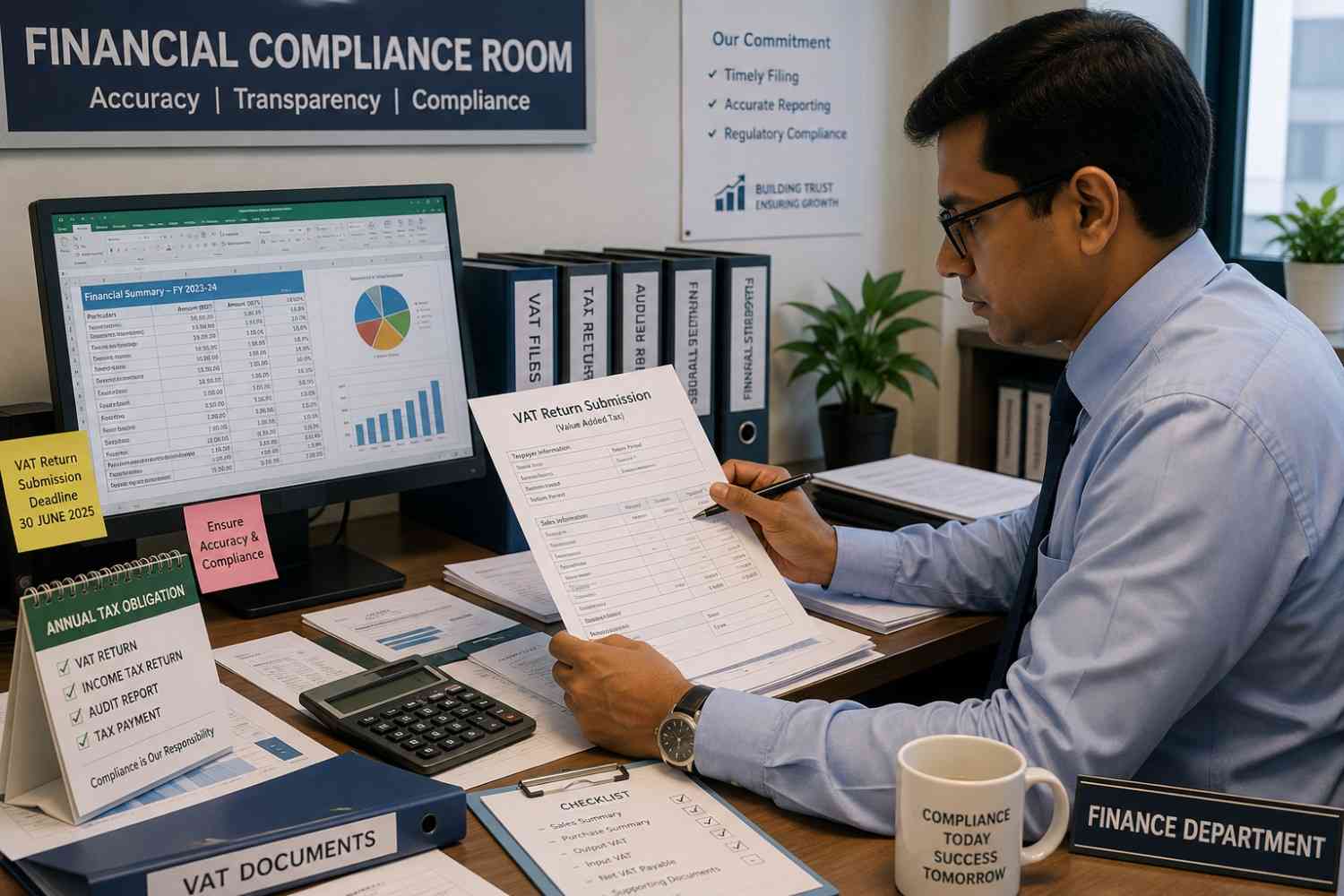
Establishing a Liaison or Representative Office in Bangladesh
For market research or communication facilitation, consider a non-commercial presence. Liaison Office Registration in Bangladesh is for promotional activities and as a communication link between your home office and local entities. Liaison Office Registration in Bangladesh also bars earning local income or direct trade.
Representative Office Registration in Bangladesh is ideal for market entry without full commercial commitment. This structure is perfect for companies not yet ready for full operations. Ensure your activities stay within your approved permit to avoid legal issues.
Evaluating Equity Options: 100% Foreign Ownership vs. Joint Ventures
Deciding on the right equity structure is crucial for investors aiming to grow their foreign investment in Bangladesh. The local regulatory environment is quite accommodating. It allows investors to choose between full control and a partnership with a local entity.
Choosing 100% foreign equity gives you full control over your business. This is perfect if you want to stick to your global policies without needing local approval.
On the other hand, a partnership could be beneficial for market entry. A joint venture combines your international assets with a local partner’s networks and cultural knowledge. When considering Joint Venture Company Registration in Bangladesh, several factors are important:
Market Access: Local partners can open doors to distribution channels and government connections.
Risk Sharing: Equity sharing means both financial and operational risks are split.
Regulatory Ease: Local partners can help with sector-specific compliance.
Cultural Integration: A local presence aids in managing human resources and understanding consumer behavior.
If you opt for a partnership, ensure your legal agreements are solid. The process for Joint Venture Company Registration at RJSC in Bangladesh demands clear documentation on shareholding and dispute resolution.
Your choice hinges on your long-term objectives and comfort with the local business scene. Whether you prefer total control or a collaborative approach, both paths can lead to success in the country.
Navigating the RJSC Name Clearance Process
Your journey to legal incorporation starts with obtaining name clearance from the RJSC. Before you can formally incorporate, you need a unique name for your entity. This essential step is the cornerstone of your Foreign Company Registration at RJSC.
The process is fully online, allowing you to submit your preferred business name for review. Your chosen name must adhere to local naming rules and not conflict with existing entities. A successful application for company name clearance is crucial for any business aiming to establish a legal presence in the country.
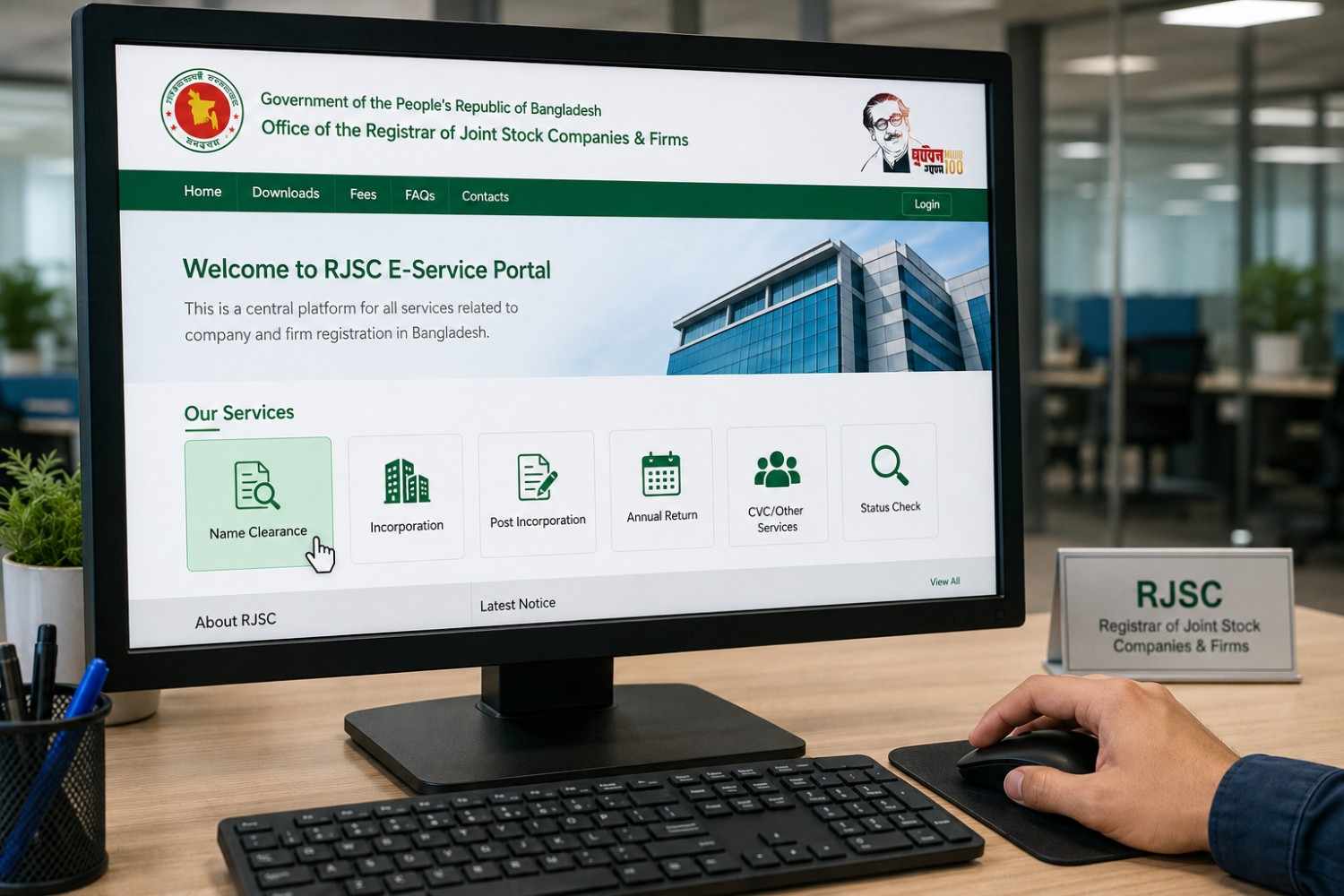
When applying, consider offering multiple name options to boost your approval chances. The RJSC assesses each request against regulatory guidelines to avoid internationally renowned trademarks. After approval, you’ll receive a Name Clearance Certificate valid for a certain period. You must use this document quickly to proceed with your RJSC Company Registration in Bangladesh. By adhering to these steps, you avoid unnecessary delays in your RJSC Company Registration process and keep your expansion plans on track.
Preparing Essential Legal Documentation
Accurate documentation is the foundation for a successful Foreign Company Registration in Bangladesh. When you prepare your files with precision, you significantly reduce the risk of administrative hurdles during the registration process. Taking the time to organize these records now will save you valuable resources later.
Drafting the Memorandum and Articles of Association
The Memorandum of Association (MoA) and Articles of Association (AoA) act as the constitution for your new entity. These documents define your company’s objectives, scope of business, and internal management rules. It is vital to ensure these drafts align perfectly with the specific regulations set by the Registrar of Joint Stock Companies and Firms (RJSC).
You should clearly outline the authorized share capital and the distribution of shares among stakeholders. Professional legal counsel is often recommended to tailor these documents to your specific operational needs. A well-drafted constitution prevents future disputes and ensures your business remains compliant with local corporate laws.
Compiling Parent Company Documents
If your Bangladeshi entity is a subsidiary, you must provide verified copies of your parent company’s legal records. This typically includes the Certificate of Incorporation, the Memorandum, and the Articles of Association from your home country. All foreign documents must be properly attested by the relevant authorities in your jurisdiction.
Additionally, you will need a formal Board Resolution from the parent company authorizing the investment in Bangladesh. If you are appointing a local representative, a notarized Power of Attorney is also required. Ensuring these documents are authenticated before submission is a non-negotiable step for international investors..
Managing Director and Shareholder Identification Requirements
Every director and shareholder must provide clear identification to satisfy local compliance standards. You are required to submit copies of valid passports for all foreign individuals involved in the venture. Clear, high-quality scans are essential to avoid rejection by the regulatory authorities.
In addition to passports, you may need to provide recent passport-sized photographs and proof of residential addresses. If a corporate entity acts as a shareholder, you must provide the board resolution and the authorized signatory’s identification. Maintaining organized records for every individual involved will streamline your application and help you secure approval faster.
Executing Board Resolutions and Power of Attorney
Creating a legal connection between your international headquarters and your Bangladeshi entity begins with two key documents. These documents are the cornerstone of your legal authorization in the country. Without them, your local representatives cannot legally act on behalf of your parent company during registration.

A Board Resolution is a formal statement by your company’s directors confirming the decision to enter Bangladesh. It must clearly state the authority given to your local agents. Precision is crucial here, as Bangladeshi authorities need specific language to validate your international corporate decisions.
The Power of Attorney is the practical tool that empowers your chosen representative to sign documents and handle filings. When drafting this, ensure it matches the mandate:
- Clear Scope: Clearly define the specific tasks your representative can perform, such as signing incorporation papers or opening bank accounts.
- Notarization: Ensure all documents are properly notarized in your home country to meet international legal standards.
- Consular Attestation: Depending on your jurisdiction, you may need to have these documents attested by the Bangladeshi embassy or consulate.
- Language Accuracy: If the original documents are not in English, provide certified translations to avoid administrative hurdles.
Proper execution of these documents prevents the need for costly and time-consuming revisions later in the process. By investing time in the drafting phase, you ensure a smooth and compliant entry into the Bangladeshi market. Taking these steps early shows your commitment to regulatory excellence and sets a professional tone for your future operations.
Opening Your Corporate Bank Account in Bangladesh
To manage your foreign investment capital, you must open a corporate bank account. This account is the main channel for your financial activities in the country. It shows a clear financial commitment to the local market.
Choosing the right bank is crucial for your business. Opt for banks with deep experience in foreign direct investment. They know the regulatory needs and can meet international standards.
After opening your account, you need to transfer your initial capital from abroad. This step is required to meet local incorporation rules. Once the funds are received, the bank will issue an encashment certificate. This certificate proves your investment.
The encashment certificate is essential for completing your registration. Without it, your registration cannot proceed. To apply for your bank account, have these documents ready:
- Certified copies of your Memorandum and Articles of Association.
- Board resolution authorizing the opening of the corporate account.
- Valid identification documents for all authorized signatories.
- Proof of address for the registered office in Bangladesh.
- Detailed information regarding the source of your investment funds.
Choosing a bank that understands international standards can save you time. They will help with the right documentation for your capital inflow. This ensures you comply with local financial rules from the start.
Transferring Foreign Investment Capital and Obtaining Encashment Certificates
Transferring your initial capital to Bangladesh is a key step for any foreign business. You must do this through authorized banking channels to meet the Bangladesh Bank’s strict rules. This method safeguards your investment and sets up a clear financial record for your new business.
After your funds reach the corporate account, you need to get an Encashment Certificate from your bank. This document proves your investment and is crucial for regulators. Your bank will need certain documents to handle these international transfers smoothly. Having these ready in advance can prevent delays in setting up your business:
- A formal letter of instruction detailing the purpose of the remittance.
- Proof of the source of funds from the parent company.
- A copy of the Board Resolution authorizing the capital transfer.
- The original copy of the RJSC incorporation certificate.
- Valid identification documents for the authorized signatories.
Keeping detailed records of these transactions is crucial for your long-term success. Proper documentation and recording of every transfer lay a strong financial foundation for your company. This approach ensures your capital is recognized by local authorities, keeping your business compliant with government regulations.
Submitting Your Application for Foreign Company Registration in Bangladesh
You are now ready to submit your application to the RJSC, marking the final stage of your Foreign Company Registration in Bangladesh journey. By adhering to the step-by-step Company Registration Bangladesh process, you ensure compliance with all regulatory standards for RJSC Foreign Company Registration in Bangladesh.
First, access the official online portal to upload your verified documents. Understanding how to register a foreign company in Bangladesh is crucial. This methodical approach to Company Registration in Bangladesh reduces the chance of delays, ensuring a smooth RJSC Company Registration in Bangladesh.
After uploading your documents, the RJSC will review your application. This is the final step in your Foreign Company Incorporation Bangladesh process. Upon approval, you receive your Certificate of Incorporation, officially recognizing your entity as legally registered in Bangladesh.
Securing Mandatory BIDA Approval for Non-Subsidiary Entities
Setting up a branch or liaison office in Bangladesh requires formal approval from the Bangladesh Investment Development Authority (BIDA). This is mandatory for any foreign entity not operating as a local subsidiary. Without this clearance, your business cannot legally operate or hire foreign staff in the country.
The process for BIDA Registration in Bangladesh demands thorough preparation of your corporate documents. You must clearly outline the scope of your activities. This will determine the terms of your approval. Whether it’s Branch Office Registration in Bangladesh or Liaison Office Registration in Bangladesh, precision in your application is crucial to avoid delays.

Understanding the specifics of Liaison Office Registration in Bangladesh is key for long-term compliance. You must show that your office will operate within the allowed guidelines. Liaison entities generally cannot engage in direct commercial activities.
After submitting your application, BIDA will assess your documentation against regulatory standards. Achieving BIDA Registration is essential for opening local bank accounts and obtaining work permits. Keeping this approval is an ongoing commitment. You must report any significant changes in your business structure or activities to the authorities without delay.
Completing Post-Registration Requirements
Your journey toward a fully functional business in Bangladesh enters a vital phase immediately following successful incorporation. The certificate from the Registrar of Joint Stock Companies and Firms (RJSC) is a major milestone. However, you must still fulfill several mandatory administrative obligations to operate legally. These steps ensure your company remains in good standing with local authorities and tax regulators.
Obtaining Your Tax Identification Number (TIN)
The first priority after incorporation is securing your Tax Identification Number. This unique identifier is essential for all your future tax filings and financial transactions within the country. You will need to submit your incorporation documents and board resolutions to the National Board of Revenue to initiate this process.
Registering for Business Identification Number (BIN)
Once you have your tax status confirmed, you must focus on your VAT Registration Certificate. Obtaining a Business Identification Number (BIN) is a critical requirement for any entity involved in the supply of goods or services. Completing your VAT Registration Certificate correctly allows you to manage your tax liabilities and input tax credits efficiently under local law.


Securing the Trade License and Local Permits
Every business must also obtain a valid Trade License from the local municipal authority where your office is located. This permit serves as your official authorization to conduct commercial activities within that specific jurisdiction. Depending on your industry, you may also need additional sector-specific clearances to ensure full compliance.
To keep your operations running smoothly, ensure you have the following items prepared for these local offices:
- Certified copies of your Memorandum and Articles of Association.
- Proof of office address, such as a rental agreement or utility bill.
- Valid identification documents for your authorized signatories.
- A formal application letter detailing your business scope.
By systematically addressing these requirements, you protect your company from potential penalties and ensure long-term operational stability. Staying proactive with these filings is the best way to maintain a healthy relationship with the Bangladeshi regulatory environment.
Managing Import Registration and Sector-Specific Licenses
If your business model relies on importing raw materials, regulatory compliance is paramount. To legally import goods into Bangladesh, securing an Import Registration Certificate (IRC) is mandatory. This document is your key to conducting international trade within the country.
The application process requires direct coordination with the Office of the Chief Controller of Imports and Exports (CCIE). You must provide detailed documentation about your business and expected import volumes. Keeping your Import Registration Certificate (IRC) active is crucial for uninterrupted and compliant supply chain operations.
Aside from standard trade permits, certain industries may require additional clearances. Depending on your goods, you might need permits from various government bodies. Here are some common requirements for operational readiness:
- Valid Trade License issued by the local City Corporation or Municipality.
- Tax Identification Number (TIN) and proof of updated tax returns.
- Membership certificate from a relevant Chamber of Commerce or Trade Association.
- Specific sector clearances from regulatory bodies like the Bangladesh Standards and Testing Institution (BSTI) or the Department of Environment.
Securing these licenses early sets a stable foundation for your operations. Always ensure your documentation is up-to-date to avoid penalties or shipment seizures during clearance.
Establishing Operational Bank Accounts and Financial Compliance
Creating a solid financial base is urgent, focusing on operational bank accounts and regulatory adherence. After your legal entity is set up, you must switch from an initial investment account to a corporate one. This account is key for handling your daily business dealings in Bangladesh.


Finding the right banking partner is critical for your success. Look for banks that offer top-notch digital services and support for international trade. Maintaining strict financial compliance from the start is vital to keep your business in good standing with local authorities.
Implementing strict accounting systems early helps avoid future financial reporting and tax audit issues. Keeping accurate records is not just a legal must; it’s a strategic advantage for audit preparation.
Here are some best practices for operational efficiency:
- Reconcile your bank statements monthly to spot discrepancies early.
- Ensure all cross-border transactions are correctly coded for regulatory reports.
- Have a qualified local accountant manage your financial documents.
- Keep up with banking policy changes that might impact your corporate accounts.
Proactive management of your financial systems saves time and resources. Consistency in reporting builds trust with stakeholders and regulatory bodies. By focusing on these tasks now, you lay a solid foundation for your business to flourish in the competitive Bangladeshi market.
Maintaining Company’s Annual Return Filing at RJSC and Tax Submissions
Keeping your company in good standing requires a series of mandatory annual filings and tax obligations. After launching your business, you must watch the deadlines set by local authorities closely. Consistent compliance is key to maintaining a reputable corporate presence in Bangladesh.
Filing Annual Returns with the RJSC
The Registrar of Joint Stock Companies and Firms (RJSC) demands specific documentation from every registered entity annually. Timely RJSC Company Annual Return Filing in Bangladesh keeps your business active and avoids late fees or legal issues.
The Company Schedule X Submission in Bangladesh is a crucial part of this process. It updates the RJSC on your share capital, directors, and registered office address. Accurate records with the RJSC safeguard your company’s legal status and operational integrity.
Managing VAT Returns and Corporate Tax Obligations
Meeting your fiscal duties to the National Board of Revenue is also essential. A professional approach to your Company Annual Tax Submission is vital for a clean financial record. Prepare your financial statements well in advance for accuracy during audits.
Moreover, regular VAT Return Submission is a must for most businesses in the country. Staying on top of these deadlines helps avoid penalties and builds a good relationship with tax regulators. Proactive financial management is crucial for long-term success in the competitive Bangladeshi market.
Handling Share Transfers and Allotments Post-Incorporation
Managing your company’s equity structure is crucial as your business grows in the Bangladeshi market. Whether it’s a Joint Venture Company Registration in Bangladesh or a wholly-owned subsidiary, your shareholding can change. It’s vital to document these changes correctly at the RJSC for legal compliance and transparency.
When shares need to be moved between stakeholders, a formal process for Foreign Company Share Transfer in Bangladesh must be followed. This involves legal filings to ensure the Company Share Transfer in Bangladesh is recognized. You’ll need to prepare transfer instruments and board resolutions for a Foreign Company Share Transfer at RJSC in Bangladesh. Proper documentation is key to a successful RJSC Company Share Transfer in Bangladesh, safeguarding your interests and those of your partners.


Issuing new shares to raise capital or attract new investors also requires careful planning. A Foreign Company Share Allotment in Bangladesh must adhere to the company’s authorized capital structure. Maintaining these records is not just a formality; it’s a strategic necessity for any Joint Venture Company Registration at RJSC in Bangladesh. An updated share register prevents disputes and simplifies audits. Always consult with legal professionals to ensure your share management practices meet the latest regulatory requirements in Bangladesh.
Why Foreign Company Registration in Bangladesh Matters for Your Business
Establishing a lasting presence in Bangladesh demands vigilance towards evolving legal frameworks. It’s crucial to remain proactive in administrative tasks to maintain operational efficiency. This includes efficiently managing your expatriate workforce through timely e-visa extension in Bangladesh procedures.
Strategic growth necessitates keeping your records current with the RJSC at all times. Accurate documentation safeguards your interests and ensures compliance with local authorities. Regular audits of your filings are essential to avoid complications during inspections.
Market dynamics can shift, prompting the need for restructuring or exit strategies. If you choose to close operations, adhering to the formal process for Company Winding up in Bangladesh is mandatory. Following the Company Winding up RJSC guidelines ensures a smooth exit.
Seeking professional advice is vital in navigating the complexities of winding up a foreign company in Bangladesh. Proper planning ensures a transparent and legally compliant departure. Consult with local experts to discuss your business objectives or for assistance with regulatory filings today.
FAQ
How can I begin the process of Foreign Company Registration in Bangladesh?
To start, follow a step-by-step Company Registration Bangladesh protocol. First, obtain company name clearance from the Registrar of Joint Stock Companies and Firms (RJSC). After reserving your name, prepare legal documents and open a temporary bank account for capital inward remittance. Finally, submit your application for RJSC Company Registration in Bangladesh.
Can international investors hold 100% equity in a local business?
Yes, 100% foreign equity investment is acceptable in Bangladesh for most industrial sectors. Many investors also choose joint venture company registration in Bangladesh to leverage local expertise. Whether you choose full ownership or a joint venture investment, your entity must be officially recorded through RJSC Foreign Company Registration in Bangladesh.
What is the difference between a subsidiary and a Liaison Office Registration in Bangladesh?
A Private Limited Company (Subsidiary) is a separate legal entity allowed to generate local income. On the other hand, Liaison Office Registration in Bangladesh or Representative Office Registration in Bangladesh is for non-commercial activities like market research and coordination. If you intend to engage in sales or contracts, Branch Office Registration in Bangladesh or incorporating a subsidiary is required. Both branch and liaison offices must also obtain mandatory BIDA Registration in Bangladesh.
What documents are required for Foreign Company Registration at RJSC?
You must prepare the Memorandum and Articles of Association, provide copies of directors’ and shareholders’ passports, and submit parent company documents. Additionally, a Board Resolution and Power of Attorney are typically required to authorize local representatives. For Foreign Company Incorporation Bangladesh, these documents must often be notarized or attested by the relevant embassy.
Why is a bank encashment certificate necessary for Company Registration in Bangladesh?
To register a limited company in Bangladesh, foreign investors must transfer the paid-up capital into a local corporate bank account. The bank then issues an encashment certificate, which serves as legal proof to the RJSC that the foreign investment in Bangladesh has been physically received through proper banking channels. This certificate is a mandatory attachment for your RJSC Company Registration in Bangladesh.
What post-registration steps must I take to ensure full legal compliance?
After receiving your certificate of incorporation, you must obtain a Tax Identification Number (TIN) and complete VAT Registration Certificate to receive a Business Identification Number (BIN). You will also need a Trade License from the local city corporation. If your business involves trading, securing an Import Registration Certificate (IRC) is essential for your supply chain operations.
How do I manage an e-visa extension in Bangladesh for my foreign staff?
Once your BIDA Registration is complete, your company can recommend expatriate employees for work permits and visa processing. Maintaining active BIDA and RJSC status is critical for a smooth e-visa extension in Bangladesh, ensuring your international team remains compliant with local immigration laws.
What are the annual filing requirements for a foreign-owned company?
You are required to perform RJSC Company Annual Return Filing in Bangladesh, which includes the Company Schedule X Submission in Bangladesh. On the tax front, you must ensure timely Company Annual Tax Submission and regular VAT Return Submission to the National Board of Revenue. Failure to meet these deadlines can lead to penalties and affect your company’s standing.
How is a Foreign Company Share Transfer or Allotment handled?
Any change in ownership requires a Foreign Company Share Transfer at RJSC in Bangladesh. This involves executing a transfer deed and obtaining RJSC approval. Similarly, if you are increasing capital, you must complete a Foreign Company Share Allotment in Bangladesh. Both RJSC Company Share Transfer in Bangladesh and RJSC Share Allotment in Bangladesh must be documented accurately to reflect the current shareholding structure.
What is the procedure for Company Winding up in Bangladesh?
If you decide to close your operations, you must follow the formal process for Company Winding up in Bangladesh. This involves appointing a liquidator, settling all liabilities, and completing the Company Winding up at RJSC filings. A Foreign Company Winding up in Bangladesh requires careful coordination with tax authorities and the central bank to ensure all foreign investment exits are handled legally and transparently.
You May Also Like
-
Company Registration in Bangladesh: Easy Complete Guide
Embarking on a new venture is thrilling, yet it demands a strong base. A successful business setup in Bangladesh starts with picking the right legal form and completing the registration accurately. Quick Facts: Company Registration in Bangladesh Whether it’s a private limited company or a foreign-owned entity, the right documents are key to lasting success.…
-
Joint Venture Company Registration in Bangladesh: Complete Guide
Entering the South Asian market presents a significant opportunity for global investors. A strategic partnership allows you to merge resources and expertise. It also enables you to share operational risks effectively. Understanding Joint Venture Company Registration in Bangladesh is crucial for a smooth market entry. This guide simplifies the complex legal landscape and helps you…
-
Partnership Firm Registration in Bangladesh: Easy Steps (2026)
Starting a business with others is a wise choice for many entrepreneurs. It brings together shared resources and expertise, accelerating your venture’s growth. However, it’s crucial to handle the legal aspects correctly from the outset. Completing your partnership firm registration in Bangladesh grants your venture official status. This builds trust with clients and stakeholders. Grasping…
-
Company Share Transfer in Bangladesh: Easy RJSC Guide (2026)
Understanding the legal intricacies of corporate ownership changes is crucial. Whether it’s for restructuring or succession, knowing the mandatory steps is essential. This knowledge ensures your actions are in line with local laws. Quick Facts: Company Share Transfer in Bangladesh Every step must comply with the Companies Act and the Registrar of Joint Stock Companies…
-
RJSC Annual Return Filing in Bangladesh | Schedule X Submission in Bangladesh Guide
Running a business demands strict adherence to local corporate laws. If you manage a company, prioritizing RJSC Annual Return Filing in Bangladesh is crucial to maintain your legal status. This ensures your entity remains transparent and trustworthy to stakeholders. Schedule X submission in Bangladesh is a vital part of your yearly obligations. Keeping your director…
-
Branch Office Registration in Bangladesh: Easy Legal Guide
Bangladesh is one of South Asia’s fastest-growing economies — with strong GDP growth and a population exceeding 160 million, it offers substantial opportunity for foreign enterprises. Establishing a local office gives your company closer control over operations and faster access to customers and partners. This guide simplifies Branch Office Registration in Bangladesh: whether you’re evaluating…
-
Liaison Office Registration in Bangladesh | Representative Office Registration in Bangladesh
Expanding your business into new territories requires a clear strategy and a solid legal foundation. Bangladesh offers a wealth of untapped potential for international firms aiming to grow their global footprint. Establishing a local presence allows you to conduct vital market research and build lasting professional relationships. Navigating the regulatory landscape can feel daunting, but…
-
Company Winding Up in Bangladesh: Complete Legal Guide (2026)
Closing a business entity requires careful navigation of local legal frameworks. Whether you manage a local firm or a foreign enterprise, you must follow the Companies Act of 1994 to ensure a smooth exit. This formal procedure protects your interests while satisfying regulatory obligations. You might wonder how to wind up a company in Bangladesh…
-
One Person Company Registration in Bangladesh: Easy Guide
One Person Company Registration in Bangladesh gives solo entrepreneurs a solid legal foundation to safeguard their assets. This modern business model allows an individual to enjoy corporate perks while retaining full operational control, making it ideal for entrepreneurs aiming to grow without the hurdles of traditional partnerships. Registering your startup with the Registrar of Joint…
-
Society Registration in Bangladesh | Complete RJSC Registration Guide
If your group works in charity, education, culture, or social welfare, registering as a society gives legal standing and public trust. This guide explains the practical steps, required documents, and fees so founders and organizers can complete the process confidently. Follow the clear steps for society registration in Bangladesh to secure name clearance, prepare your…
-
Foundation Registration in Bangladesh: Easy Guide (2026)
Setting up a non-profit in Bangladesh requires clear planning and a practical understanding of local rules. You’ll face specific administrative steps to ensure your organization operates legally and transparently. Understanding these requirements is the first step to creating lasting social impact. This guide lays out a clear, step-by-step path for Foundation Registration in Bangladesh, covering…