Setting up a non-profit in Bangladesh requires clear planning and a practical understanding of local rules. You’ll face specific administrative steps to ensure your organization operates legally and transparently. Understanding these requirements is the first step to creating lasting social impact.
This guide lays out a clear, step-by-step path for Foundation Registration in Bangladesh, covering name clearance, required documents, and filing options. Follow these practical recommendations to reduce delays and keep your registration on track.
Setting up a legal organization gives you the legal standing to open bank accounts, hire staff, enter contracts, and raise funds. We simplify the regulatory steps so you can focus on your mission. Expect the overall registration timeline to vary typically from a few weeks to a few months depending on application accuracy and any government queries.

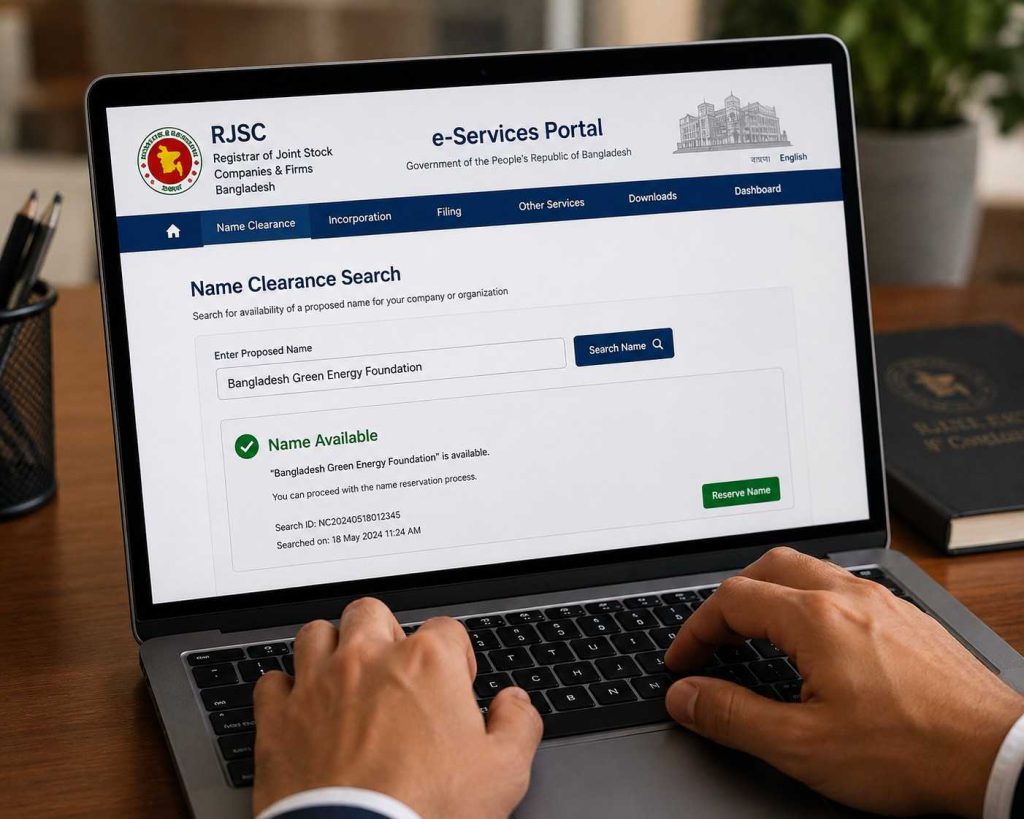
The Registrar of Joint Stock Companies and Firms (RJSC) is the only legal authority in the country for Foundation Registration in Bangladesh. The RJSC’s clear steps, you will discover how to register a Foundation Registration in Bangladesh efficiently. The proper arrangement helps you avoid common obstacles and ensures your entity achieves the status it deserves. Let us help you establish your foundation as a respected and trusted organization in the social impact sector.
Table of Contents
Key Takeaways
Define your organization’s core objectives before preparing paperwork.
Run an RJSC name search early to secure a compliant name.
Assemble accurate documents for members, office proof, and constitutional papers.
Use a structured checklist to avoid common administrative delays.
Keep originals and receipts organized for verification and future compliance.
Understanding the Legal Framework for Foundations in Bangladesh
Deciding to Register a Foundation Registration in Bangladesh, means choosing the legal form that best fits your mission and compliance needs. The country’s rules for non-profit organizations emphasize transparency and accountability in social welfare work, so selecting the right structure protects your organization from future legal and operational challenges.
When you plan to register a foundation in Bangladesh, map your activities against available legal forms. Different statutes and registration acts apply depending on whether you form a trust, society, or non-profit company — so involve your board in this pivotal decision. Common structures include:
Trusts: Typically governed by the Trust Act (1882) — suited for asset-holding, grant-making, or legacy funds.
Societies: Registered under the Societies Registration Act (1860) — ideal for member-driven organizations focused on community development, education, or cultural activities.
Companies (non-profit): Registered under the Companies Act (1994) via the Registrar of Joint Stock Companies and Firms (RJSC) appropriate for larger organizations requiring a corporate structure, clearer governance, and limited liability.
Pros and cons (quick guide):
Trusts: Pros — simple to set up, good for custodial assets; Cons — less formal governance, limited member participation.
Societies: Pros — membership-driven, suitable for grassroots work; Cons — may require more ongoing member management and reporting.
Non-profit companies (RJSC): Pros — corporate governance, limited liability, easier to contract and receive grants; Cons — stricter filing requirements and regulatory oversight.
Many organizations choose societies registration when their primary activity is community engagement or education; others prefer registration as a non-profit company with RJSC when they expect to enter contracts, own significant assets, or hire staff. Check the relevant registration act and RJSC guidance for the exact requirements and official process for each form before you file.
Strategic Planning and Selecting a Unique Foundation Name
Strategic planning creates the roadmap you need to navigate registration requirements and ongoing compliance. Define your objectives early so your organization can align governance, funding, and operational plans with the chosen legal form.


Choosing a unique name is one of the first and most important steps when you register a non-profit organization in Bangladesh. The name should reflect your mission, avoid confusion with existing entities, and comply with RJSC naming conventions. A strong name reduces the risk of rejection during the name-clearance stage and helps build credibility with donors and partners.
When researching how to register a foundation in Bangladesh, name availability is a primary hurdle. A name that is identical or deceptively similar to an existing entity will likely be denied. Use the criteria below to vet your options and improve your chance of a smooth name clearance.
| Criteria | Description | How to Check |
|---|---|---|
| Check Uniqueness | Must not match too closely to existing entities | Run an RJSC search and general web search |
| Relevance | Reflects your mission and target activities | Match name to core objectives in your MOA |
| Compliance | Avoid restricted words or terms implying government affiliation | Review RJSC naming rules or consult a registration service |
| Availability | Name is not reserved by another applicant | Check the RJSC reservation/status in the online portal |
Quick checklist — name selection steps:
- Draft 3 distinct name options that reflect your mission.
- Run an RJSC name search and a web/NGO directory check.
- Remove restricted terms and refine for clarity.
- Reserve the preferred name via the RJSC portal (if available) before drafting the MOA.
Following these steps improves your odds at the name clearance stage and sets a solid foundation for subsequent registration steps. Run the search early name issues are one of the most common causes of application delays.
Navigating the RJSC Name Clearance Process
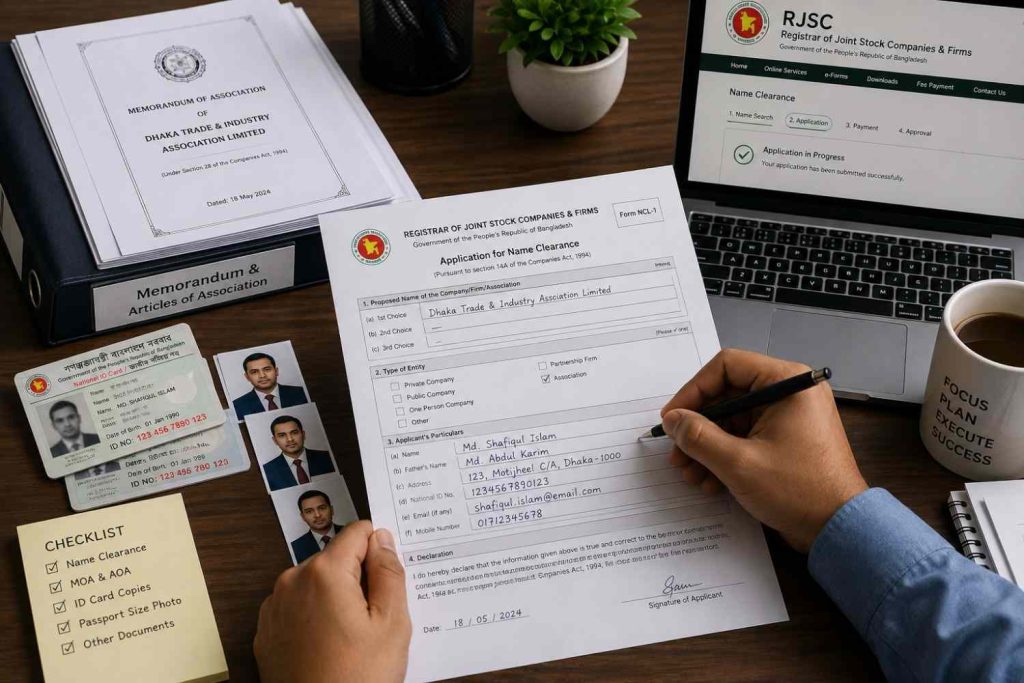
Understanding the RJSC name clearance process is essential for a smooth registration. This step is required when you learn how to register foundation with RJSC it reserves your chosen name in the national registry so you can proceed with documents and the formal registration process.
The Registrar of Joint Stock Companies and Firms (RJSC) enforces strict rules to prevent name duplication and public confusion. When you apply for foundation name clearance Bangladesh, pick a title that is distinct, professional, and consistent with your mission. Names that are identical or deceptively similar to existing entities are commonly rejected and cause delays.
Practical tips to speed approval:
Uniqueness: Submit names that are clearly different from registered entities.
Relevance: Ensure the name reflects your objectives so reviewers understand its purpose.
Compliance: Do not use restricted words or terms suggesting government affiliation without permission.
Clarity: Prefer concise, professional wording that the public easily recognizes.
Submit your name-clearance request through the RJSC e-Services portal (verify the current RJSC URL before submitting). Reserve two or three backup names in case of rejection. Typical turnaround varies — many applicants see a response in days to a few weeks, but timelines depend on RJSC workload and any required clarifications. Mastering the name clearance step early prevents one of the most common causes of delay in the overall registration process.
Drafting the Memorandum of Association for Your Foundation
When you start the non-profit foundation registration Bangladesh process, the Memorandum of Association (MOA) is the central legal document that defines who you are and what you will do. A clear, well-drafted MOA speeds the registration and review of your application and reduces the chance of queries from RJSC.
Be specific about your objectives and the scope of activities. For social welfare or charitable Foundation Registration in Bangladesh, regulators expect precise language about how funds will be used and how activities serve the public good. Vagueness in objectives is a common reason for delays.
Include clauses that demonstrate legal compliance and governance clarity — for NGO Foundation Registration in Bangladesh this typically includes asset-dissolution rules, restrictions on dividend distribution, and basic rules for fund management.
MOA template outline (essential elements and sample phrasing — verify with counsel before filing):
Name of the Foundation: The officially cleared name (use exact spelling from the name-clearance certificate).
Registered Office: The full physical office address where records are kept.
Objectives: A numbered list of activities (sample: "To provide community education programs and vocational training to underprivileged youth").
Liability Clause: "The liability of members is limited" — or the specific wording required by the Companies Act for non-profit companies.
Application of Income / No-Dividend Clause: "All income and property shall be applied solely towards promoting the objectives of the Foundation; no portion shall be paid or transferred by way of dividend to members."
Capital and Membership: How the foundation is funded, membership eligibility, and rights.
Asset Dissolution Clause: "On dissolution, remaining assets will be transferred to another charitable organization with similar objectives." Examples of objective wording (short):
Community education: "To organize formal and non-formal education programs, scholarships, and teacher training for underserved communities."
Grant-making: "To provide financial grants and technical assistance to registered NGOs engaged in health and livelihood projects."

Before submission, cross-check your MOA against the RJSC requirements for non-profit companies or the relevant registration act for societies/trusts. Use consistent names and addresses across all documents in your application to avoid common inconsistencies that trigger RJSC queries.
Establishing Rules and Regulations for Internal Governance
Strong internal governance is essential for any registered organization in Bangladesh. Formalizing your foundation rules and regulations Bangladesh creates predictable decision-making, protects beneficiary interests, and demonstrates compliance to regulators and donors.
Draft governance documents that clearly define roles, responsibilities, and procedures for your executive team and members. Transparency in these rules builds trust with stakeholders and reduces the risk of internal disputes.
Include clear voting procedures, term limits, and conflict-resolution mechanisms so the executive committee can operate efficiently. Early adoption of these rules regulations helps your foundation handle growth and protects it from governance failures.
Use the table below as a practical guide when drafting internal policies:
| Governance Component | Primary Objective | Implementation Strategy |
|---|---|---|
| Member Roles | Define accountability | Role descriptions, responsibilities, and term limits (e.g., 2-year terms) |
| Voting Procedures | Ensure fair decisions | Quorum rules (e.g., 50%+1), proxy policy, recorded minutes |
| Conflict Resolution | Maintain harmony | Stepwise resolution: mediation → arbitration; designate an independent committee |
| Ethical Standards | Promote integrity | Code of conduct, conflict-of-interest disclosures, annual declarations |
Suggested sample clauses (short):
Quorum: "No meeting of the executive committee shall be valid unless at least 50% of members are present."
Conflict resolution: "Disputes will be referred to mediation; if unresolved, a panel of three independent arbiters will decide."
Term limits: "Committee members shall serve for a maximum of two consecutive three-year terms."
Governance checklist before submission: confirm your rules align with RJSC filing requirements (if incorporated as a non-profit company), include role details for the executive committee, record conflict-of-interest policies, and set an annual governance review schedule to keep policies current. Clear, enforceable rules regulations support long-term compliance and strengthen your foundation’s credibility.
Compiling Founding Member Details and Documentation
A successful registration starts with accurate member records. Compiling complete founding-member details is a critical step in the RJSC Foundation Registration in Bangladesh and reduces the risk of queries or rejection. Verify every entry against official records before submission.
Begin by assembling a clear list of all founding members with full legal names, current addresses, occupations, and verified contact details. Precision here prevents delays in the review of your application and ensures consistency across all filing documents.
You will also collect specific proofs for each member. These documents serve as identity and residency evidence and support the integrity of your organization’s records.
The table below shows the essential items to prepare and how you can verify them. For electronic submission, save files as searchable PDFs and name them using a standard convention (e.g., MemberName_NID.pdf).
| Document Type | Purpose | Verification Method |
|---|---|---|
| National ID (NID) / Passport | Identity proof | Scan of Smart NID or passport (clear, color copy) |
| Contact Details | Communication | Verified mobile number/email; confirm active SIM or delivery test |
| Passport-size photo | Record keeping | Recent color photo (studio or digital, 300 dpi) |
| Professional bio / signed profile | Background & role justification | One-paragraph bio + signature and role declaration |
Recommended file naming: MemberName_NID.pdf, MemberName_Photo.jpg, Member Name_Bio.pdf. Organize files in folders (e.g., /Application/Members/) and keep a master spreadsheet that matches each filename to the member record. Confirm file formats (PDF/JPG), maximum upload sizes, and notarization/attestation requirements with RJSC before final upload to meet all requirements.
Structuring the Executive Committee and Governing Body
A clear leadership structure is a cornerstone of a compliant, effective organization. When forming your foundation executive committee Bangladesh, prioritize members who combine relevant professional skills with a demonstrated commitment to the mission. Well-defined roles help the team act efficiently and transparently from day one.
The foundation governing body in Bangladesh sets the strategic direction and documents each member's responsibilities, decision-making authority, and term limits. Clear role definitions promote accountability and make it easier to meet regulatory expectations during registration and future inspections.
When selecting leaders, confirm legal requirements (minimum numbers, any residency or qualification rules) and collect the disclosure details RJSC requires — full names, occupations, addresses, and signed consent. These disclosures demonstrate your organization’s integrity to regulators and partners.
Suggested core roles and short role descriptions:
Chair / President: Provides strategic leadership, chairs meetings, and represents the foundation externally.
Secretary: Manages official records, meeting minutes, and correspondence; primary point for the RJSC and other offices.
Treasurer: Oversees finances, ensures financial controls and timely reporting.
Members / Trustees: Participate in governance, serve on committees, and approve key policies.
Before filing, run basic vetting (conflict-of-interest declaration, identity verification) for each member and prepare an organizational chart showing reporting lines and the registered office. These steps shorten the registration review and strengthen governance as your foundation grows.
Securing a Registered Office Address and Required Legal Proofs
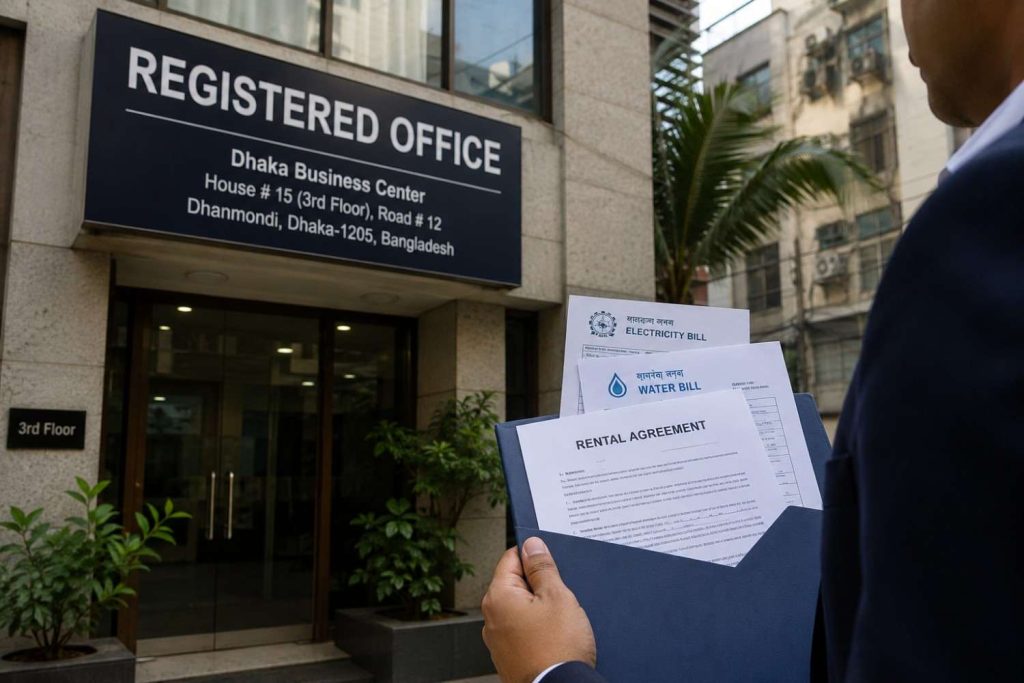
A verifiable registered office address is a non-negotiable requirement for legal Foundation Registration in Bangladesh. The RJSC and other government bodies use this address for official correspondence, inspections, and audit notices — so provide an address you can legally document and monitor.

Acceptable proofs typically include a valid rental agreement in the name of the organization or its owner, a deed of ownership, and recent utility bills (electricity, gas, or water) that show the address is active. Make sure the address on these documents matches the Registered Office listed in your Memorandum of Association and other submission documents.
Prioritized checklist of common acceptable address proofs:
Signed rental agreement / lease (with landlord contact and term dates).
Deed of ownership / sale deed (title document) if the organization owns the premises.
Recent utility bill (not older than 3 months where possible) showing the address.
Municipal tax receipt or business license (if available) linked to the premises.
Letter of consent from property owner if the office is rented in someone else’s name (accompanied by the owner’s ID).
Finally, confirm that your chosen address is located within Bangladesh and aligns with any district-level rules applicable to your organization’s activities. Proper office address documentation prevents verification failure and streamlines the overall Foundation Registration in Bangladesh process.
Completing Prescribed RJSC Forms and Statutory Declarations
The Foundation Registration Procedure in Bangladesh requires careful completion of prescribed RJSC forms and accurate statutory declarations. The Registrar of Joint Stock Companies and Firms (RJSC) expects consistency across every document — any mismatch between forms, the Memorandum, or member details can trigger queries, delays, or rejection.
Ensure every entry in your registration application matches the corresponding supporting documents. Accuracy is essential: cross-check names, addresses, occupations, and signatures against your MOA and member files before submission.
Many organizations engage professional RJSC Foundation Registration in Bangladesh services to reduce risk. Experts help identify common issues such as unsigned declarations, incorrect signatory details, or incomplete fields in statutory forms. Using an experienced reviewer or lawyer improves your odds of a smooth review and demonstrates commitment to compliance.
Common filing errors and their impacts (watch these closely):
| Document Type | Common Error | Impact |
|---|---|---|
| Application Form XII (or current RJSC form) | Mismatched member details (name/address/occupation) | Immediate rejection or formal query |
| Statutory Declaration | Unsigned or missing notarization/attestation | Processing delay until corrected |
| Memorandum / Articles | Inconsistent objectives or wording vs forms | Query issued by RJSC requesting clarification |
| Address Proof | Expired or incorrect utility bill | Verification failure — resubmission required |
Practical QA tips before submission:
Use a two-person sign-off: one prepares the package; another validates all fields against originals.
Run a consistency check: names, addresses, and dates must match across MOA, forms, and member files.
Confirm notarization requirements and attach signed statutory declarations in the correct format.
Keep a checklist of all uploaded files and retain originals for any inspection review or follow-up.
Typical timeline (illustrative): submit application → RJSC initial check (days–weeks) → query period (if any) → resubmission & verification → final approval. The application process duration depends on application accuracy and RJSC workload — thorough preparation of forms and statutory declarations helps minimize delays and ensures a stronger, faster registration outcome.
The Official Submission Process for Foundation Registration in Bangladesh | RJSC Foundation Registration
Your path to legal recognition concludes with the submission of your Foundation Registration application in Bangladesh. This moves your project from planning into the official review stage by the Registrar of Joint Stock Companies and Firms (RJSC) and other relevant government offices.
Before submission, organize all your materials to match RJSC requirements exactly. Whether you file via the RJSC e-Services portal or deliver a physical packet, precision matters: mismatched names, addresses, or signatories are common causes of delay.
The foundation registration in Bangladesh requires you to follow official government channels and submission protocols. Use the RJSC portal for e-filing where possible, and retain receipts and confirmation numbers for every step of the application.
Completing the foundation registration process Bangladesh is a pivotal milestone. After submission, your RJSC foundation registration moves to verification and may be subject to further queries or inspection. Officials will confirm that documents comply with the Companies Act and related registration rules for joint stock companies and firms.
Pre-submission QA checklist (quick): verify exact name spellings, ensure registration application fields match the MOA and member documents, confirm signatures and notarizations, attach office-proof and fee receipts, and create a folder with originals for inspection. Consider a final review by a professional familiar with RJSC filings to minimize queries and speed approval.
Managing Registration Fees and Financial Compliance
Understanding the costs of your foundation registration in Bangladesh is essential for accurate budgeting and timely registration. Financial compliance begins with paying the correct fees to the Registrar of Joint Stock Companies and Firms (RJSC) and any other relevant government authorities so your application is processed without undue delay.


Common fee types to plan for (confirm current rates on the RJSC site or with a professional):
Name clearance fee — fee to reserve or clear the proposed name.
Filing/registration fee — primary RJSC filing charge for incorporation/registration.
Stamp duty — required on statutory documents in some cases.
Treasury challans / government fees — payments to government treasuries for certain registrations or certifications.
Professional fees — optional costs for lawyers or RJSC registration services to prepare and review documents.
Practical tips for payments and record-keeping:
Verify the exact fee schedule and accepted payment methods on the RJSC portal before paying — some fees require a treasury challan or specific government payment channel.
When paying, link payments to your application (use application numbers or reference codes where possible) to avoid reconciliation issues. Keep scanned and physical copies of all receipts, treasury challans, and payment confirmations. Save them with clear filenames (e.g., Payment_RJSC_NameClearance.pdf).
Attach proof of payment to your submission if the portal or RJSC instructions require it — missing or incorrect payments are a common cause of processing delays.
Accurate payment handling and organized receipts demonstrate financial transparency and help your foundation pass any subsequent audits or inspection reviews with minimal friction.
Handling RJSC Queries and Post-Submission Corrections
Receiving queries from the RJSC after you submit your RJSC foundation registration in Bangladesh is common — treat them as part of the normal review rather than a failure. Timely, accurate responses keep your application on track and reduce the risk of prolonged delays.
When you get a notification, review what is requested, gather the exact supporting documents, and reply promptly. Aim to respond within 7–14 days where possible; faster responses help prevent escalation and further review. Use clear references to the original submission (application number, document names) in your reply.
If the query is simple (typo, missing signature, or a clarifying address), handle it in-house following your QA checklist. If the issue involves legal interpretation, complex compliance concerns, or potential checks by law enforcement agencies or national security intelligence, engage a qualified foundation registration lawyer Bangladesh immediately. Escalate only when necessary — a lawyer can draft formal responses and liaise with authorities to resolve disputes efficiently.
Obtaining Your Foundation Registration Certificate and Post-Registration Approvals
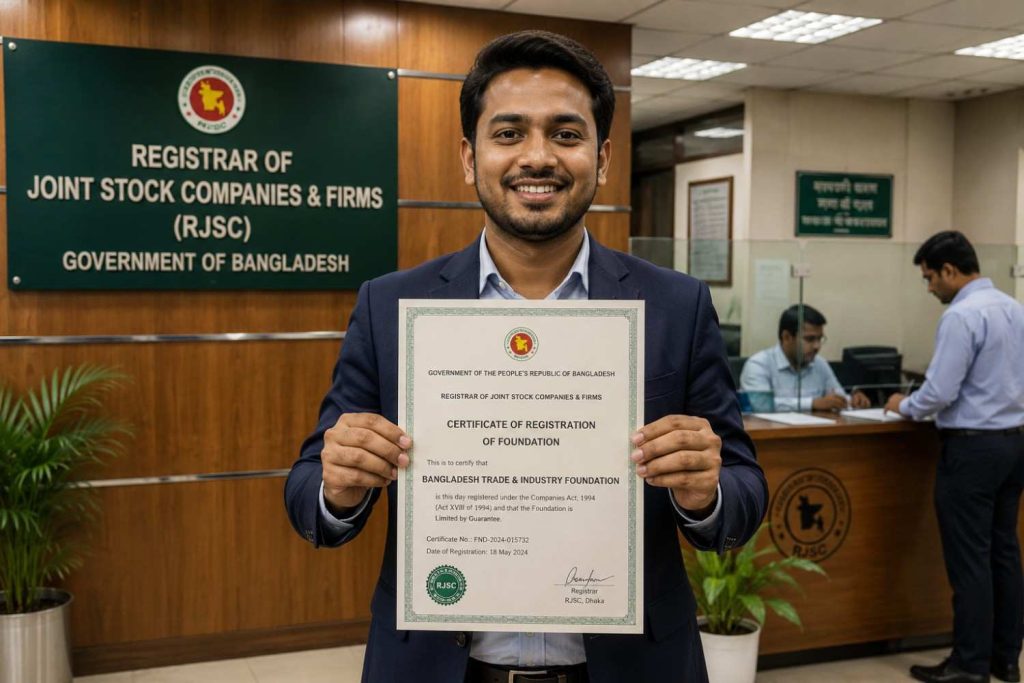
Receiving formal recognition is a pivotal milestone: successful Foundation registration in Bangladesh confirms your organization as an official legal entity and enables you to operate with confidence. The registration certificate is the core legal proof you will present to banks, donors, partners, and contractors.
Completing your foundation registration at RJSC typically leads to a verification and issuance step. Confirm approval status on the RJSC portal, then follow the RJSC instructions for collecting the foundation registration certificate Bangladesh. Requirements vary — in some cases you can download certified copies online; in others you may need to visit the RJSC office with originals.
Practical steps to finalize certificate collection:
Check approval and the certificate issuance notice via the official RJSC online portal.
Prepare originals: submission receipts, government payment evidence, and ID of the authorized representative.
If instructed, visit the designated RJSC office to present originals and collect the physical certificate and certified copies of the Memorandum and Articles. Request official certified copies or certified true copies from RJSC if you need them for bank account opening or tendering.
After you obtain the registration certificate, complete any post-registration approvals your activities require — for example, NGO Affairs Bureau registration, Department of Social Services notification, or sector-specific permits depending on your programs. Keep both physical and encrypted digital copies of your registration certificate and core documents in a secure location and maintain an indexed filing system for audits or any inspection review.
With the certificate in hand, your organization may formally commence charitable or social activities, open bank accounts, and sign contracts. Preserve the certificate and related paperwork (including your registered address proof) — they are essential for compliance and future reporting.
Maintaining Long-Term Compliance and Operational Excellence
Registration is only the beginning — long-term success depends on ongoing compliance, sound operations, and transparent governance. Prioritize routine processes that keep your foundation legally valid and operationally effective so your programs run without interruption.
A key recurring responsibility is filing your RJSC annual return submission for foundation and submitting audited financial statements where required. Missing deadlines can trigger inquiries, penalties, or even jeopardize your legal registration status. Create a compliance calendar to track all statutory filings and reporting windows.
Recommended annual compliance calendar (example — confirm exact dates with RJSC and auditors): Quarterly/Monthly bookkeeping and bank reconciliations (ongoing)
Annual audit and preparation of financial statements (start 2–3 months before filing deadline) Submit RJSC annual return and attach audited accounts (as per RJSC schedule)
Renewal or sector-specific permits and registrations (as applicable)
Good record-keeping is essential: maintain organized folders of core documents (MOA, minutes, member registers, bank statements, receipts) and keep digital encrypted backups. This makes audits and any inspection or inspection review straightforward and reduces operational risk.
Decide whether to manage compliance internally or outsource to professionals. Outsourced bookkeeping, annual audits, and a trusted registration service can save time and reduce errors — weigh the cost against the value of avoiding penalties and delays. For many organizations, hiring experienced consultants for the first 1–2 years helps establish strong processes and train in-house staff.
Keep governance active: hold regular board meetings, update your governing documents when scope or leadership changes, and ensure member records are current. Engage members in oversight — recording decisions and maintaining clear minutes improves transparency and builds donor trust.
Finally, be proactive about regulatory changes. Monitor RJSC announcements and sectorial rules (for NGOs, social welfare activities, or funded programs) and consult professional advisors when in doubt. Consistent compliance protects your reputation, preserves legal standing, and ensures your foundation can focus on delivering social impact.
FAQ
How do you begin the process of foundation registration in Bangladesh with the RJSC?
Quick steps to start your RJSC foundation registration: 1) Define your mission and choose the appropriate legal form; 2) Run an RJSC name search and reserve a compliant name; 3) Draft the Memorandum and Articles (MOA/Rules); 4) Compile founding members details and office proof; 5) Submit the registration application via the RJSC portal or physical filing. Check RJSC guidance for exact requirements.
What is the difference between a foundation and RJSC society registration?
Short answer: Societies register under the Societies Registration Act (1860) and are membership-driven (good for community groups, clubs, education). Foundations registered as non-profit companies use the Companies Act and the RJSC (suitable for grant-making, larger operations, or when limited liability is needed). Review the relevant registration act and choose based on governance, funding, and operational needs.
How can you successfully obtain foundation name clearance Bangladesh?
To secure RJSC name clearance for foundation: prepare 2–3 distinct names, avoid restricted or government-implicating words, run the RJSC search (and a web/NGO directory check), then apply through the RJSC e-Services portal. Reserve a backup name in case of rejection. Keep the name consistent across all filing documents.
What should be included in the memorandum of association for foundation?
A compliant memorandum of association should include: the cleared name; registered office address; clear, numbered objectives; liability clause; no-dividend clause (income applied to objectives only); membership/funding structure; and an asset-dissolution clause. Use precise wording and cross-check against RJSC sample templates.
What are the primary RJSC foundation registration requirements for the governing body?
You must provide details of the foundation executive committee: full names, occupations, addresses, and signed consent forms for each member. Document role descriptions, term limits, and ensure disclosure of conflicts of interest. Confirm any minimum member counts or residency rules with RJSC before filing.
How do you draft effective foundation rules and regulations Bangladesh?
Draft "Articles of Association" or internal foundation rules and regulations Bangladesh that cover membership eligibility, meeting protocols, voting/quorum rules, powers of the executive committee, financial controls, and audit procedures. Keep rules practical, enforceable, and aligned with your MOA to meet registration and compliance expectations.
What documentation is required to prove your registered office address?
Typical proof includes a signed rental/lease agreement, deed of ownership, recent utility bill (preferably within 3 months), municipal tax receipt, or owner consent plus owner ID if the lease is in a personal name. Ensure the address matches the MOA and other submitted documents.
What are the typical foundation registration fees in Bangladesh?
Fees vary by entity type and scope. Expect charges for name clearance, RJSC filing/registration fees, stamp duties, and sometimes treasury challans or other government fees. Professional RJSC registration services can help estimate totals and advise on correct payment channels to avoid delays.
How long does the RJSC foundation registration process usually take?
Timelines depend on application accuracy and RJSC workload. A well-prepared application often moves in weeks; if RJSC raises queries or requires corrections, the process can extend to months. Respond quickly to queries and consider professional help to expedite the application process.
What happens after you receive the foundation registration certificate Bangladesh?
After obtaining the registration certificate from RJSC, you become a legal entity. Next steps may include opening a bank account, registering with the NGO Affairs Bureau or Department of Social Services (if applicable), and filing your first RJSC annual return for foundation. Keep certified copies of the certificate and MOA for contracts and audits.
Why is the RJSC annual return for foundation important for compliance?
The annual return reports changes in directors/members and financial positions and usually requires audited statements. Filing on time maintains your legal standing; failure to file can trigger penalties, additional scrutiny, or affect your registration status.
Can you use a foundation registration service Bangladesh to handle the paperwork?
Yes — professional foundation registration service Bangladesh or RJSC registration services Bangladesh can manage name clearance, draft the MOA, prepare forms, and advise on payments (treasury challans or other government fees). Using a service can reduce errors and speed the registration process.