


Expanding your business into new territories requires a clear strategy and a solid legal foundation. Bangladesh offers a wealth of untapped potential for international firms aiming to grow their global footprint. Establishing a local presence through liaison office registration in Bangladesh allows you to conduct vital market research and build lasting professional relationships.
Navigating the regulatory landscape can feel daunting, but success is achievable with the right preparation. You must secure approval from the Bangladesh Investment Development Authority (BIDA) to ensure your operations remain fully compliant. This process is a critical milestone for any company looking to thrive in this dynamic economy.
Whether you are pursuing liaison office registration or seeking representative office registration in Bangladesh, understanding the legal requirements is essential to achieving your long-term objectives. This guide provides the expert insights you need to manage your setup efficiently and effectively.
Key Takeaways
- Identify the strategic benefits of establishing a local business presence.
- Understand the mandatory role of BIDA in the approval process.
- Learn the essential steps to ensure full legal compliance.
- Gain clarity on the differences between various operational structures.
- Follow a proven roadmap to streamline your administrative setup.
Understanding the Legal Framework for Foreign Entities
Before starting operations, it’s crucial to understand the legal requirements for foreign company registration in Bangladesh. Navigating the local regulatory environment is essential for any international firm. By aligning your business model with local statutes, you safeguard your company from future compliance risks.
It’s important to familiarize yourself with the specific liaison office guidelines issued by the government. These rules outline the scope of your activities and ensure your presence complies with the law. Strict adherence to these mandates is the cornerstone of a stable and productive business environment.
Operating a foreign company liaison office in Bangladesh requires a clear distinction between your office and other corporate structures. While a liaison office serves as a communication hub, other entities have different legal obligations. Understanding these boundaries is crucial for your long-term strategy.
The following table highlights the key differences between common business structures to help you choose the right path for your investment goals.
| Structure Type | Primary Purpose | Legal Status |
|---|---|---|
| Liaison Office | Communication and Market Research | Non-commercial entity |
| Branch Office | Direct business operations | Extension of parent company |
| Joint Venture | Partnership with local firms | Independent legal entity |
Deciding between a simple office setup and a joint venture company registration in Bangladesh depends on your specific operational needs. Careful planning at this stage can prevent unnecessary administrative hurdles later. Always consult with local experts to ensure your chosen structure aligns with your long-term vision for the Bangladeshi market.
Strategic Advantages of a Liaison Office in Bangladesh
Setting up a presence in Bangladesh opens doors to one of the region’s fastest-growing markets. A foreign company liaison office offers a formal base for in-depth market research. It also ensures smooth communication between your headquarters and local partners.
This setup lets you explore the market without the full complexity of commercial operations. Following liaison office guidelines keeps your entry compliant. It also helps in building crucial relationships within the local business world.
A representative office registration in Bangladesh acts as a key link for your global team. It gives you a physical space to boost brand visibility and connect with potential local partners and stakeholders. This structure offers more than just communication — it allows for effective networking and gathering real-time insights essential for long-term success. Opting for a representative office is a smart move for firms looking to establish a strong and lasting presence.
The real value lies in maintaining a controlled and professional presence. A liaison office lets you seize new opportunities while reducing initial administrative risks.
Step-by-Step Guide to Liaison Office Registration in Bangladesh
Starting a business in Bangladesh requires careful planning and foresight. Before diving in, ensure your business model fits local laws. A successful registration process demands a deep grasp of the administrative landscape to sidestep delays.
Initial Feasibility Assessment
First, conduct a thorough feasibility study. This step helps gauge if your parent company’s goals align with a liaison office’s limited scope. Analyzing the registration process early can uncover regulatory challenges ahead of time.
Ensure your activities don’t involve commercial transactions or local income. Proper due diligence at this stage keeps your application strong and in line with BIDA’s rules.
Defining the Scope of Operations
Defining your operations’ scope is key to liaison office formation in Bangladesh. Since these offices can’t earn income locally, your tasks must be limited to communication, coordination, and market research. Document these activities accurately to pass government checks.
To ensure a smooth process, follow these crucial registration steps:
- Confirm your parent company is legally set up in its home country.
- Prepare a detailed business plan detailing your non-commercial activities.
- Appoint a qualified local representative to handle the filing.
- Ensure all corporate documents are properly attested by the relevant authorities.
By following these steps, you can smoothly navigate the registration process for both liaison and representative offices. Staying focused on your non-commercial mandate will lay a strong foundation for your future success in the region.
Securing BIDA Approval for Your Foreign Office
Obtaining approval from the Bangladesh Investment Development Authority (BIDA) is crucial for entering the market. This BIDA approval marks a significant milestone in setting up a foreign office. Adhering to the official registration process ensures your business meets local regulations from the outset.
Application Submission Process
To start your registration, submit a detailed application on the BIDA online portal. This platform simplifies the permission process by allowing document uploads. It’s vital to provide accurate information to prevent delays.


After submitting your application, BIDA assesses it against national investment policies. Keeping in touch with the BIDA desk helps track your registration status. Presenting complete, verified documents can expedite the approval process.
Criteria for BIDA Evaluation
BIDA assesses applications based on the financial health and global standing of your parent company. They verify your entity’s ability to operate in Bangladesh legally and sustainably. The table below details the key factors influencing the approval decision.
| Evaluation Factor | Primary Focus | Impact on Approval |
|---|---|---|
| Financial Stability | Audited financial statements | High |
| Business Reputation | Global track record | Medium |
| Operational Scope | Clear activity definition | High |
| Compliance History | Regulatory adherence | Medium |
Meeting these criteria is vital for approval. Transparent documentation and a clear business plan enhance your chances of securing BIDA approval for your foreign company. Ensure your plan outlines your activities to meet regulatory needs.
Preparing and Submitting Essential Incorporation Documents
Getting your paperwork right is key when registering as a liaison office in Bangladesh. Detailed preparation ensures your application meets all local standards. By focusing on the documents required for registration, you avoid potential delays.
Required Corporate Documentation
For liaison or representative office formation, you need a complete set of verified corporate records. Ensure all documents are up-to-date and reflect your parent company’s legal status. These records help the government understand your operations.
The following items are typically essential for your submission:
- Certified copy of the Certificate of Incorporation from your home country.
- A formal Board Resolution authorizing the opening of a liaison office.
- Memorandum and Articles of Association of the parent company.
- Audited financial statements from the previous fiscal year.
- A detailed list of proposed activities and organizational structure.
Notarization and Attestation Requirements
To register a liaison office in Bangladesh, you must understand the legal authentication process. All foreign documents need strict notarization and attestation. This legal validation confirms your corporate identity and prevents fraud.
Work with your local embassy or consulate to attest your documents. This step is crucial for a smooth foreign company registration in Bangladesh. Once your documents are verified, you can confidently submit your application.
Navigating the RJSC Registration and Formalities
After getting your BIDA approval, you must register with the Registrar of Joint Stock Companies and Firms (RJSC). This government body is key for keeping records of all businesses in the country. Completing this step successfully is crucial to keep your business in line with local laws.
Filing Procedures with the RJSC
To register with the RJSC, you need to use their online portal. You’ll have to submit your BIDA approval letter and certified copies of your company’s documents. It’s important to pay close attention to the forms provided by the registrar.
The process requires you to pay government fees at designated banks. Once your documents are checked, the RJSC will issue a registration certificate. This certificate is your legal proof, allowing you to move forward with other business steps.
Understanding Statutory Obligations
After registration, you must follow ongoing legal duties to keep your status. You are required to file annual reports and report any changes to your office or representatives. Not doing so can lead to penalties or even suspension of your operations.
It’s vital to know the differences between a liaison office and a joint venture company registration in Bangladesh. Both need RJSC interaction, but the frequency and depth of reports vary. Being proactive with your filings helps keep your business in good standing with the authorities.
| Requirement Type | Liaison Office | Joint Venture |
|---|---|---|
| Registration Authority | RJSC & BIDA | RJSC & BIDA |
| Annual Filing | Required | Required |
| Capital Requirement | None | As per Agreement |
| Operational Scope | Non-Commercial | Commercial |
Obtaining Your TIN Certificate from the National Board of Revenue
Understanding the tax system in Bangladesh starts with getting your Taxpayer Identification Number (TIN). Every foreign company in the country must get this number from the National Board of Revenue (NBR). This is crucial for legal compliance.
Even if your office doesn’t make money locally, you still need a TIN. It’s for administrative and banking needs. This number is key for your financial dealings and reporting in Bangladesh.
Application Process for Foreign Entities
The NBR handles the application online. You’ll need to provide corporate details, like your BIDA approval and office address in Bangladesh.
Make sure your online application matches your company documents exactly. Accuracy is crucial to avoid delays. After your application is checked, you’ll receive a digital TIN certificate. Keep it safe for later use.
Tax Compliance Responsibilities
Having a TIN means you have ongoing duties. Even if your office is tax-exempt, you must file annual tax returns to report your financial status to the government.
Not following these rules can result in fines or banking issues. It’s wise to update your records and seek advice from a local tax expert to ensure you meet all NBR requirements.
| Requirement | Action | Frequency |
|---|---|---|
| TIN Registration | Online NBR Portal | One-time |
| Annual Return | Submission of Financials | Annually |
| Record Keeping | Maintain Audit Trail | Ongoing |
Acquiring a Trade License from Local Authorities
Operating a liaison office in Bangladesh demands strict adherence to local regulations. This begins with obtaining a trade license, a mandatory requirement for any foreign entity with a physical office. This license confirms your office’s presence and ensures your operations meet local standards.
Selecting the Relevant City Corporation
The first step is identifying the correct local authority based on your office’s location. Bangladesh is divided into administrative zones. Your office must register with the City Corporation or Municipality that governs your district.
Applying to the wrong office can cause administrative issues and fines. Verify your office address against municipal maps to ensure correct submission to the regulatory body. After confirming the jurisdiction, you can proceed with the application.
Documentation for Trade Licensing
To obtain your license, you must present a detailed set of paperwork to local authorities. Ensure all documents are clear, current, and properly attested. The following list outlines the standard items needed for your submission:
- A certified copy of the BIDA approval letter for your liaison office.
- The original and a copy of your office rental agreement or lease deed.
- A copy of the trade license application form, duly filled and signed by your authorized representative.
- Proof of payment for the municipal trade license fees.
- A copy of the company’s Memorandum and Articles of Association.
Consistency is key when submitting these files. Any discrepancies between your BIDA documentation and your trade license application may require further clarification. Accurate and up-to-date records ensure a smooth transition into full operational status.
Managing VAT and BIN Registration Requirements
Understanding tax compliance is crucial for foreign entities in Bangladesh. Even if your liaison office doesn’t engage in direct sales, you must assess your activities for tax law applicability. Proactive management of these requirements can prevent penalties and ensure compliance with the National Board of Revenue (NBR).
Determining Applicability for Liaison Offices
Many believe liaison offices are tax-exempt. However, certain activities, like service provision or local procurement, might require a Business Identification Number (BIN). Review your agreements and operations to identify taxable services or goods needing customs clearance.
If your office pays VAT on services or withholds tax for local vendors, registration is mandatory. Early assessment of these triggers can avoid administrative delays. Consulting a local tax expert can clarify if your business needs a BIN filing.
Registration Procedures for BIN
When registration is needed, the NBR’s online portal handles the process. You’ll need your BIDA approval, trade license, and TIN certificate to apply. Accurate business details are crucial for a BIN certificate without errors.
After applying, the VAT office might verify your premises. Organized corporate records can expedite this process. Once verified, your BIN will be activated, enabling you to meet tax obligations efficiently.
| Activity Type | VAT/BIN Requirement | Action Required |
|---|---|---|
| Pure Liaison/Communication | Generally Exempt | Maintain BIDA records |
| Local Service Procurement | Conditional | Verify withholding status |
| Importing Office Equipment | Mandatory | Register for BIN |
| Providing Taxable Services | Mandatory | Full VAT compliance |
Opening a Corporate Bank Account and Managing Foreign Funds
Starting with a secure corporate bank account in Bangladesh is key to managing your entity’s daily expenses. It’s essential to understand how to open a bank account for your representative office. You must follow the central bank’s specific mandates carefully.
Banking Regulations for Foreign Investment
Foreign entities must comply with strict rules when handling capital. You need to keep your accounts in an authorized dealer branch of a commercial bank. These banks ensure all transactions meet Bangladesh Bank’s guidelines.
Compliance is non-negotiable for foreign investors. You must present your BIDA approval letter and incorporation documents to the bank. This step is crucial for maintaining transparent and legal financial activities locally.
Transferring Funds Through Authorized Channels
All foreign investment or office funds must enter the country through official banking channels. Direct transfers from abroad are the only accepted method for funding your operations. This method ensures your capital inflow is accurately recorded and verified by authorities.
When planning your budget, remember the cost of registration includes the initial capital requirements to be remitted from your parent company. These funds cover your setup costs and initial operational needs. Below is a table outlining the typical documentation needed for your banking setup:
| Document Type | Purpose | Verification Status |
|---|---|---|
| BIDA Approval Letter | Legal Authorization | Mandatory |
| Board Resolution | Account Authorization | Required |
| Trade License | Operational Proof | Required |
Maintaining accurate records of these transfers is crucial for your annual reporting. Using authorized channels helps avoid regulatory issues. Always check with your bank to meet all requirements for foreign-owned accounts.
Cost of Liaison Office Registration in Bangladesh
One of the most common questions foreign investors ask is how much it actually costs to set up a liaison office in Bangladesh. Budgeting accurately from the start helps you avoid cash-flow surprises during the approval process.
| Cost Component | Typical Range | Notes |
|---|---|---|
| Minimum Inward Remittance | USD 50,000 | Mandatory initial capital to cover setup and operating costs |
| BIDA Application Fee | Government-set fee | Paid at application submission |
| RJSC Registration Fee | Government-set fee | Based on company documents filed |
| Document Notarization & Attestation | Varies by country | Done through embassy/consulate |
| Trade License Fee | Set by City Corporation | Renewed annually |
| Legal/Consultant Fees | Varies by firm | Optional but recommended |
Because government fees and remittance requirements can change with policy updates, it’s best to confirm current figures with BIDA or a local consultant before submitting your application.
Timeline: How Long Does Registration Take?
Foreign companies often underestimate how long the full process takes when combining BIDA approval, RJSC registration, and post-registration formalities. A realistic timeline looks like this:
- BIDA Approval — typically 4 to 6 weeks after a complete application.
- RJSC Registration — 1 to 2 weeks after BIDA approval is granted.
- TIN Certificate — usually issued within a few business days of applying.
- Trade License — 1 to 3 weeks, depending on the City Corporation.
- VAT/BIN Registration (if applicable) — 2 to 4 weeks.
- Bank Account Opening — 1 to 2 weeks once all approvals are in hand.
In total, most foreign companies complete the entire liaison or representative office registration process within 2 to 4 months, assuming documents are properly notarized and submitted without errors.
Setting Up Your Office and Appointing Authorized Representatives
Establishing your physical presence marks the end of your business setup journey. After obtaining regulatory approvals, you enter an operational phase. This step aligns your office setup with your corporate objectives and local laws.
Physical Office Requirements
Compliance demands specific requirements for your workspace. Your office must be in a commercial zone recognized for business. It’s crucial to have a documented and registered lease agreement with local authorities.
Your infrastructure should support your daily activities. This includes reliable internet, secure storage for records, and enough space for staff.
Roles and Responsibilities of Local Representatives
Choosing a qualified local representative is essential. They act as a bridge between your headquarters and local authorities. Their role is to ensure your office complies with all regulations.
Your representative will handle critical tasks to maintain smooth operations:
- Managing daily communication with government agencies like BIDA.
- Ensuring timely submission of reports and tax filings.
- Overseeing office maintenance and staff records.
- Being the legal contact for inquiries or audits.
By picking a representative familiar with local laws, you safeguard your company. Their diligent oversight keeps your office productive, supporting your global growth strategy.
Ensuring Ongoing Compliance and Reporting Obligations
Establishing your office is just the beginning. Long-term compliance and reporting are crucial. You must view regulatory adherence as an ongoing process, not a single event.
Periodic Reporting to BIDA
BIDA demands regular updates. You must submit reports detailing your operational progress and ensuring your business stays within your permit’s scope. This diligence is crucial to safeguard your BIDA approval.
Not providing these updates can risk your standing. Keeping open communication with authorities ensures your approval remains valid. Consistency is the key to a smooth relationship with regulators.
Maintaining Accurate Financial Records
Your office must maintain detailed financial records to meet local audit standards. These records prove your funding is used only for approved operational expenses. Proper documentation is the foundation of compliance and helps prevent legal issues during inspections.
Implement a strong system to track all financial transactions. Organized books show your commitment to transparency and integrity in the local market.
Handling Renewals and Regulatory Updates
Keeping your business in Bangladesh requires a proactive stance on regulatory renewals. Managing your registration means tracking expiration dates closely to avoid disruptions.
Renewal Timelines and Procedures
Securing your liaison office permission is an ongoing process. You must submit renewal applications to BIDA before your permit expires. Ignoring these deadlines can result in penalties or the closure of your operations.
To ensure a seamless renewal, follow these steps:
- Review your current BIDA approval letter for the specific expiration date.
- Prepare updated financial statements and activity reports for the preceding period.
- Submit the formal renewal application through the online BIDA portal.
- Pay the necessary government fees promptly to avoid processing delays.
Adapting to Changes in Regulatory Policy
Regulatory policies in Bangladesh can change, affecting your foreign office management. It’s crucial to stay informed about new circulars or policy shifts. A professional registration consultant can help you navigate these complex changes effectively.
Maintaining accurate records and staying updated on policy adjustments protects your company from risks. This proactive approach keeps your registration process seamless, even with legal changes.
Finalizing Your Operational Setup for Long-Term Success
Entering a new market demands a long-term commitment to compliance and growth. You’ve laid a strong base by finishing your VAT and BIN registration. You’ve also set up your physical office and chosen a local representative.
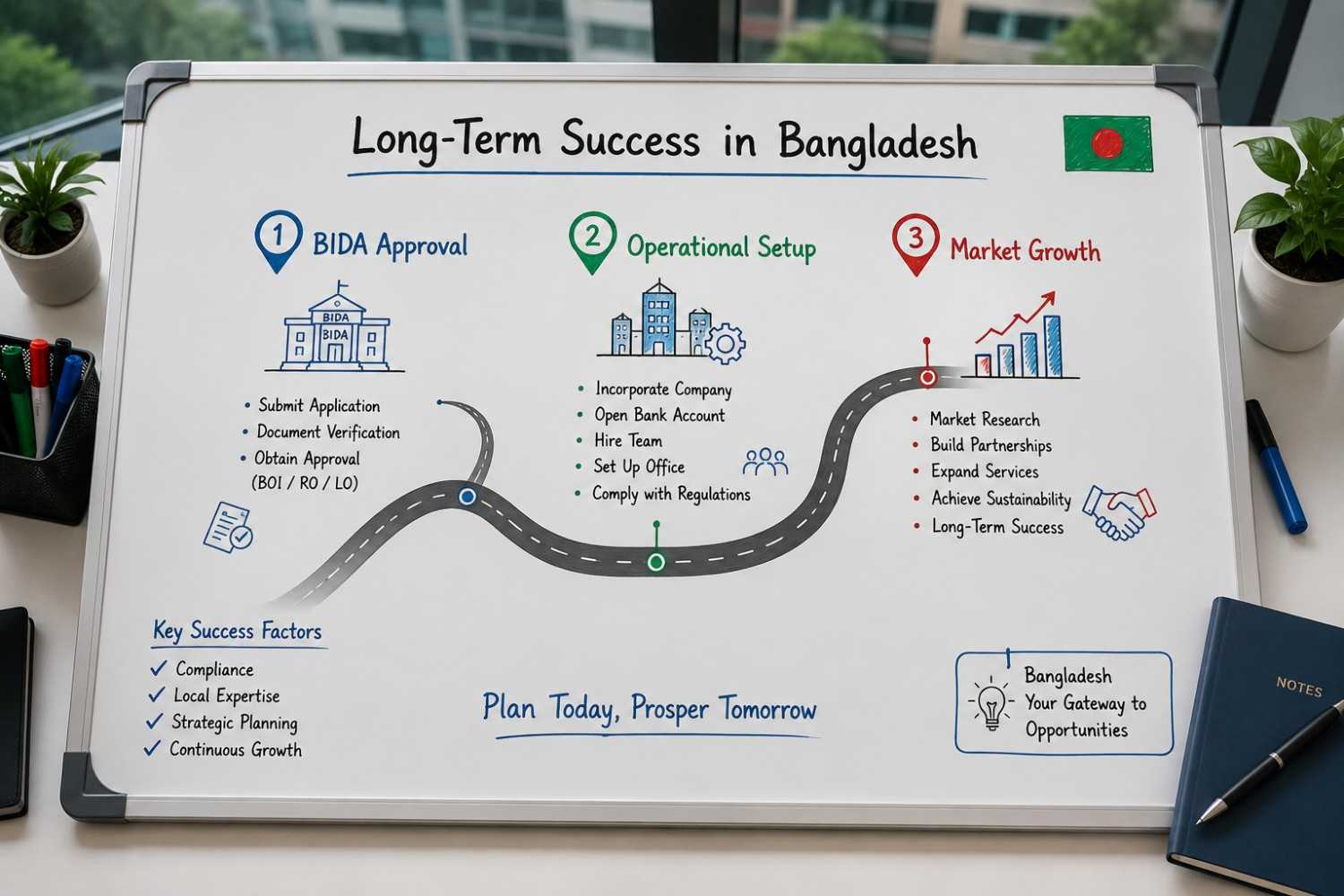

Your liaison office in Bangladesh is crucial for your global reach. It requires careful management and a proactive stance on regulatory changes. Collaborating with a registration consultant is wise — they help you manage the ongoing costs and complexities in Bangladesh.
Regular audits of your operations ensure you stay in line with local laws. This keeps your renewal process smooth and predictable. Contact our team to talk about your operational needs — we offer the support needed to keep your business successful in Bangladesh’s competitive market.
FAQ
What are the primary liaison office registration steps in Bangladesh?
To start the process, you first need BIDA approval. Next, register your office through the Registrar of Joint Stock Companies and Firms (RJSC). You must also get a TIN certificate from the National Board of Revenue (NBR). Lastly, obtain a Trade License from the City Corporation.
What are the core requirements for foreign companies?
Your liaison office cannot engage in profit-making activities. It must have a physical office, a local representative, and all costs must be covered by your parent company.
What specific documents are required for registration?
You need notarized copies of your parent company’s Certificate of Incorporation, Memorandum and Articles of Association, and a Board Resolution. These documents must be attested by the Bangladesh Embassy or High Commission.
How does BIDA approval work?
BIDA assesses your application based on your parent company’s reputation and financial health. You must submit a detailed plan for your activities. Once approved, this is your legal authorization to operate in Bangladesh.
What is the typical cost of liaison office registration in Bangladesh?
The cost includes government fees, notarization, and a mandatory inward remittance. You need to remit at least USD 50,000 to an authorized bank to cover initial expenses.
Can a foreign firm pursue a joint venture company registration in Bangladesh instead?
Yes, for commercial trading or manufacturing, a joint venture or a 100% foreign-owned subsidiary is suitable. Unlike a liaison or representative office, a joint venture can generate income and issue invoices.
How do you handle renewal?
Permission is typically granted for two to three years. To renew, submit an application to BIDA two months before your permit expires, with updated reports and remittance evidence.
Is it necessary to hire a registration consultant?
While not mandatory, hiring a consultant is advisable. They offer guidance on compliance, help with approval applications, and ensure adherence to NBR and BIDA regulations.
What are the tax and VAT obligations for a representative office?
Even without profit, you need a BIN (Business Identification Number) and a TIN. You must file tax returns and comply with VAT on local expenditures and employee salaries.
How do I open a corporate bank account for my office?
After BIDA approval and RJSC registration, open a corporate account at an authorized dealer bank. This account is essential for transferring foreign funds and managing daily operations.
Related Guides
-
Foundation Registration in Bangladesh: Easy Guide (2026)
Setting up a non-profit in Bangladesh requires clear planning and a practical understanding of local rules. You’ll face specific administrative steps to ensure your organization operates legally and transparently. Understanding these requirements is the first step to creating lasting social impact. This guide lays out a clear, step-by-step path for Foundation Registration in Bangladesh, covering…
-
One Person Company Registration in Bangladesh: Easy Guide
One Person Company Registration in Bangladesh gives solo entrepreneurs a solid legal foundation to safeguard their assets. This modern business model allows an individual to enjoy corporate perks while retaining full operational control, making it ideal for entrepreneurs aiming to grow without the hurdles of traditional partnerships. Registering your startup with the Registrar of Joint…
-
Company Winding Up in Bangladesh: Complete Legal Guide (2026)
Closing a business entity requires careful navigation of local legal frameworks. Whether you manage a local firm or a foreign enterprise, you must follow the Companies Act of 1994 to ensure a smooth exit. This formal procedure protects your interests while satisfying regulatory obligations. You might wonder how to wind up a company in Bangladesh…
-
Branch Office Registration in Bangladesh: Easy Legal Guide
Bangladesh is one of South Asia’s fastest-growing economies — with strong GDP growth and a population exceeding 160 million, it offers substantial opportunity for foreign enterprises. Establishing a local office gives your company closer control over operations and faster access to customers and partners. This guide simplifies Branch Office Registration in Bangladesh: whether you’re evaluating…
-
RJSC Annual Return Filing in Bangladesh: Easy 2026 Guide
Running a business demands strict adherence to local corporate laws. If you manage a company, prioritizing RJSC Annual Return Filing in Bangladesh is crucial to maintain your legal status. This ensures your entity remains transparent and trustworthy to stakeholders. Schedule X submission in Bangladesh is a vital part of your yearly obligations. Keeping your director…
-
Company Share Transfer in Bangladesh: Easy RJSC Guide (2026)
Understanding the legal intricacies of corporate ownership changes is crucial. Whether it’s for restructuring or succession, knowing the mandatory steps is essential. This knowledge ensures your actions are in line with local laws. Quick Facts: Company Share Transfer in Bangladesh Every step must comply with the Companies Act and the Registrar of Joint Stock Companies…
-
Partnership Firm Registration in Bangladesh: Easy Steps (2026)
Starting a business with others is a wise choice for many entrepreneurs. It brings together shared resources and expertise, accelerating your venture’s growth. However, it’s crucial to handle the legal aspects correctly from the outset. Completing your partnership firm registration in Bangladesh grants your venture official status. This builds trust with clients and stakeholders. Grasping…