


Running a business demands strict adherence to local corporate laws. If you manage a company, prioritizing RJSC Annual Return Filing in Bangladesh is crucial to maintain your legal status. This ensures your entity remains transparent and trustworthy to stakeholders.
Schedule X submission in Bangladesh is a vital part of your yearly obligations. Keeping your director and shareholder data current shields your firm from unnecessary fines. Understanding the process empowers you to navigate these regulatory hurdles confidently.
This guide offers a clear roadmap for your compliance journey. We detail every step to ensure your organization remains in good standing with authorities.
Quick Facts: RJSC Annual Return Filing in Bangladesh
- Governing Law: Companies Act, 1994
- Regulating Authority: RJSC (Registrar of Joint Stock Companies and Firms)
- Filing Document: Schedule X (Annual Return)
- Filing Deadline: Within 30 days of the Annual General Meeting (AGM)
- AGM Frequency: Must be held within 15 months of the previous AGM
- Shareholder Notice Period: Minimum 14 days before the AGM
- Director/Shareholder Change Form: Form XII
- Auditor Requirement: Must be a professional registered with the Institute of Chartered Accountants of Bangladesh (ICAB)
- Non-Compliance Risk: Late fees, “defaulting” status, blocked trade license renewal, or company strike-off
Key Takeaways
Compliance is mandatory for all registered companies to avoid legal penalties.
Timely updates to shareholder and director records build corporate credibility.
Schedule X is a critical document for maintaining accurate statutory information.
Proper documentation prevents potential complications with government regulators.
Following the correct procedures ensures your business remains in good standing.
Understanding the Legal Necessity of RJSC Annual Return Filing in Bangladesh
Keeping your business status up to date is crucial. The RJSC Annual Return Filing in Bangladesh is more than a formality. It’s essential for your company’s standing with the government. By keeping up with these filings, you safeguard your business’s reputation and ability to operate.
The Role of the Registrar of Joint Stock Companies and Firms
The Registrar of Joint Stock Companies and Firms (RJSC) is key in regulating businesses. They ensure companies follow the law and maintain transparency. Through this annual submission process, the registrar keeps a precise record of active businesses in the country.
Legal Consequences of Non-Compliance in Bangladesh
Ignoring your legal duties can severely harm your business. Missing deadlines leads to significant financial penalties and late fees. In severe cases, your company could be deregistered, ending your business rights.
Non-compliance also hinders your ability to get bank loans or bid on government contracts. Prioritizing this filing is vital to avoid these risks. Keeping your records up to date ensures your business remains flexible and ready for growth.
Identifying Your Company’s Specific Filing Obligations
Every company type has its own set of compliance needs. Whether you’re a private or public company, your annual return documents will differ. It’s important to review your records thoroughly to ensure all necessary filings are complete.
Understanding these obligations helps avoid common mistakes that can lead to RJSC rejection. Regularly checking your filing schedule is key to maintaining compliance. By staying organized, your company will be seen as reliable and stable in the Bangladeshi market.
Preparing for the Annual General Meeting
Embarking on this process requires meticulous planning for the Annual General Meeting (AGM). This pivotal event serves as the primary platform for shareholders to assess your company’s performance and governance. Proper preparation is crucial to guarantee that your filings are legally acknowledged by the authorities.
Setting the Date and Venue for the AGM
Adhering to the Companies Act of Bangladesh’s stipulated timelines is imperative for scheduling your AGM. Choosing a venue that is accessible to all shareholders is equally critical to foster participation. Consistency in scheduling is vital for maintaining transparency with stakeholders.


Issuing Formal Notices to Shareholders
For those exploring how to file an annual return with RJSC, the formal notification process is paramount. It is obligatory to dispatch a written notice to every shareholder at least 14 days prior to the meeting. The notice must explicitly outline the meeting’s details, including time, date, and agenda, to be deemed valid.
Ensuring Quorum Requirements are Met
A quorum, the minimum number of members required, must be present for the meeting to proceed. Verify your company’s Articles of Association to ascertain the specific quorum requirements. Failing to meet these standards will invalidate the meeting’s proceedings and any resolutions adopted.
| Requirement | Legal Standard | Action Required |
|---|---|---|
| Notice Period | Minimum 14 Days | Send written notice to all members |
| Meeting Venue | Registered Office or City | Confirm location availability |
| Quorum | As per Articles of Association | Verify attendance before starting |
| Agenda | Statutory Business | Prepare detailed meeting items |
By adhering strictly to these logistical steps, you lay a solid groundwork for your compliance journey. Grasping this process effectively hinges on these foundational governance practices. Adherence to these guidelines ensures a seamless and error-free submission.
Approving Audited Financial Statements for Compliance
Your company’s financial health must be clearly documented to satisfy the Registrar of Joint Stock Companies and Firms. Audited financial statements are a key part of your annual filing package. They provide the necessary transparency to regulators and stakeholders. Getting this right starts with ensuring these documents accurately reflect your financial position.
Selecting a Qualified Auditor
You must engage a professional who is registered with the Institute of Chartered Accountants of Bangladesh (ICAB). A qualified auditor has the expertise to verify your balance sheets and profit-loss accounts. Choosing the right professional ensures your financial data meets the high standards expected by authorities.
Presenting Financial Reports to the Board
After the audit, you must present the findings to your Board of Directors. This internal review allows the leadership team to scrutinize the figures and address any discrepancies before public filing. Clear communication during this stage prevents errors that could lead to rejection of your submission.
Finalizing Statements for Shareholder Approval
The final step involves presenting these statements to shareholders during your Annual General Meeting. By obtaining formal approval, you meet the core requirements for corporate transparency. This process confirms that the owners of the company have reviewed and accepted the financial performance of the business.
| Audit Stage | Primary Responsibility | Key Outcome |
|---|---|---|
| Selection | Board of Directors | Appointment of ICAB Auditor |
| Review | Audit Committee | Verification of Financial Data |
| Approval | Shareholders | Formal Adoption of Reports |
Drafting AGM Minutes and Formal Resolutions
Accurate documentation of your Annual General Meeting is crucial for corporate compliance in Bangladesh. Keeping detailed records shows your organization follows strict regulatory standards. These documents prove your company’s commitment to good governance.
Documenting Key Decisions Made During the Meeting
Every important decision made during your meeting must be documented accurately. You should note the specific motions proposed, the results of shareholder votes, and any critical discussions that influenced the outcome. Transparency in these records safeguards your company during audits or regulatory inquiries.
Formatting Minutes According to RJSC Standards
When preparing your minutes, adhere to the official RJSC guidelines to ensure acceptance. Your document should include the date, time, and venue of the meeting, along with a list of attendees. A structured, professional format helps verify that your meeting was legally and effectively conducted.
Obtaining Necessary Board Approval for Minutes
After completing the draft, it must undergo a formal review by your board of directors. The board must confirm that the minutes accurately reflect the meeting’s proceedings before granting official approval. Once the directors sign off, the document becomes a finalized record for your regulatory filings.
Updating Shareholder and Director Information
Keeping your corporate records up to date is crucial for annual compliance in Bangladesh. Adhering to these submission guidelines ensures your business remains compliant. It’s essential to update shareholder and director information to reflect any changes during the fiscal year to avoid penalties.
Reporting Changes in Directorship
When a director joins or leaves, you must notify the Registrar of Joint Stock Companies and Firms. This is a key part of your annual compliance duties. Prepare the necessary board resolutions and Form XII to document these changes effectively.
Timely reporting is crucial to avoid discrepancies in your official company profile. Make sure to record all appointment or resignation dates accurately in your internal minutes before filing with the regulator.
Managing Shareholder Register Updates
Your company must maintain a precise register of members that reflects the current ownership structure. Any transfer of shares or issuance of new equity requires an immediate update to this internal document. Keeping this register current is essential for verifying the accuracy of your filing during the audit process.
If your company has undergone significant ownership changes, ensure that all share transfer deeds are properly stamped and executed. Transparency in your shareholding structure builds trust with stakeholders and simplifies the verification process during your annual filing.
Notifying RJSC of Changes in Registered Office Address
Your registered office address is the official point of contact for all legal correspondence. If your business has relocated, you must inform the RJSC promptly to ensure your filing contains the most current contact details. Failure to update this information can lead to missed notices and administrative complications.
You will typically need to file a formal notice regarding the change of address within the stipulated timeframe. Always verify that the new location is properly documented in your board meeting minutes before submitting the update to the authorities.
Verifying Share Capital and Company Details
Accurate company records are crucial for a successful submission. Any discrepancies in financial data can lead to rejection by regulatory bodies. This can severely hinder your business operations. It’s essential to meticulously review all capital-related information before finalizing your documents.
Reconciling Authorized and Paid-up Capital
Distinguishing between authorized and paid-up capital is critical. Authorized capital is the maximum amount your company can raise. Paid-up capital, on the other hand, is the actual funds received from shareholders. Consistency in these figures is vital to avoid queries from the Registrar of Joint Stock Companies and Firms.
When preparing your forms, ensure that these figures align with your latest audited financial statements. Any discrepancies will raise red flags during the review process. Always verify that your ledger accurately reflects the amounts reported in previous filings.
Validating Share Allotment Records
Tracking changes in share ownership is a key compliance duty. Document every share allotment or transfer during the reporting period. Maintaining an updated register of members ensures accurate and transparent data.
If your company issued new shares, confirm that board resolutions and filings are complete. Incomplete documentation for allotments can cause administrative challenges. Keeping records organized simplifies verification for auditors and regulators.
Cross-Referencing Data with Previous Filings
Comparing current data with historical records is wise. Look for consistency in shareholding patterns and capital structures over multiple years. This thorough review process helps identify errors before they become compliance issues.
| Capital Category | Definition | Verification Source |
|---|---|---|
| Authorized Capital | Maximum limit defined in MOA | Memorandum of Association |
| Paid-up Capital | Actual capital contributed | Audited Financial Statements |
| Share Allotments | New shares issued during year | Board Meeting Minutes |
Mastering the Schedule X Preparation Process in Bangladesh
Mastering the Schedule X preparation process ensures your business remains compliant with Bangladeshi corporate laws. This document serves as the formal annual return for your entity. Getting this filing right demands extreme precision to avoid administrative hurdles.
Accessing the Official Schedule X Form
To begin, you must obtain the correct version of the form directly from the Registrar of Joint Stock Companies and Firms (RJSC). You can find the latest forms on the official government portal. Always ensure you are using the most recent template to prevent compatibility issues during your submission.
Inputting Company Particulars Accurately
Once you have the form, you must enter your company details with absolute care. Even minor discrepancies between your internal records and the submitted data can lead to immediate rejection. Follow these guidelines to maintain data integrity:
- Verify that the registered office address matches your current records.
- Ensure the list of directors and shareholders is updated to reflect the latest changes.
- Double-check the share capital figures against your previous filings.
Common Mistakes to Avoid During Data Entry
Many businesses face delays because of avoidable errors during this filing. Understanding the common pitfalls will help you streamline your workflow and avoid unnecessary rejections. Keep these points in mind:
- Inconsistent Dates: Ensure the AGM date matches the supporting board resolutions.
- Calculation Errors: Double-check your math regarding paid-up capital and share allotments.
- Payment Mismatches: Always verify the correct filing fees before finalizing your payment transaction.
By maintaining a meticulous approach to data entry, you protect your company from regulatory scrutiny. Taking the time to review every field before submission is the best way to ensure a smooth and successful filing experience.
Gathering Essential Supporting Documentation
A successful filing experience heavily relies on the quality of your supporting documentation. When preparing your Schedule X package, it’s crucial that every claim in your form is supported by verified records. This approach helps prevent delays and keeps your company compliant with authorities.
Compiling Certified Copies of Financial Statements
Your audited financial statements are the foundation of your annual compliance. You must provide certified copies that accurately reflect your business’s financial health. These documents should be signed by authorized auditors and approved by the board before you begin the submission process.
Preparing Attendance Sheets and AGM Reports
The Annual General Meeting (AGM) is a critical event that necessitates formal documentation. You need to compile accurate attendance sheets listing all participating shareholders and directors. These reports serve as essential evidence that your company adhered to legal procedures for corporate governance.
Organizing Proof of Share Transfers or Allotments
If your company has experienced changes in its capital structure, you must provide clear proof of these actions. This includes documentation for any new share allotments or transfers during the fiscal year. Keeping these records organized ensures a swift response to any regulatory inquiries about your share capital.
| Document Type | Purpose of Submission | Verification Status |
|---|---|---|
| Audited Financials | Verify fiscal performance | Certified Required |
| AGM Attendance | Confirm meeting quorum | Signed by Secretary |
| Share Allotment Proof | Validate capital changes | Board Approved |
| Director Resolutions | Authorize filing data | Certified True Copy |
Reviewing Documents for Accuracy and Regulatory Completeness
Accuracy is crucial for a successful regulatory filing in Bangladesh. Before starting, a thorough review of all materials is essential. This proactive verification ensures your submission meets strict authority standards.
Conducting an Internal Compliance Audit
An internal audit is key to a smooth filing. Reviewing records helps spot errors before they reach the Registrar. This step protects your company from delays or administrative issues.
Checking for Discrepancies in Dates and Figures
It’s important to double-check all dates and financial figures. Even small mistakes in your submission can cause issues. Make sure your Annual General Meeting dates match your financial reports.
Ensuring All Mandatory Fields are Populated
Missing information often leads to filing rejections. Verify that all required fields in your forms are filled correctly. A meticulous approach to data entry is crucial for a smooth filing. Confirming all attachments are included will also help keep your submission on track.
Obtaining Authorized Signatures from Directors
Your company’s compliance status heavily relies on the accuracy and validity of signatures on filing documents. This process demands strict adherence to formal signing protocols. This ensures all declarations are legally binding. Without the correct signatures, your submission may face rejection or delays during verification.
Identifying Authorized Signatories
Before finalizing your paperwork, confirm which directors have the authority to sign on behalf of the company. This authority is usually granted through a formal board resolution or the company’s Articles of Association.
Verify the following details before proceeding:
- Confirm the current list of directors registered with the RJSC.
- Ensure that the signatories are active and hold valid Director Identification Numbers.
- Check if the board has passed a specific resolution authorizing these individuals to sign the filing.
Managing Remote Signatures for Multi-Location Boards
Modern business operations often involve directors spread across different locations. Coordinating signatures can be challenging when board members are not in the same city.
To manage this effectively, consider these strategies:
- Utilize secure courier services to circulate physical documents between locations.
- Ensure that each director signs the exact same version of the document to maintain consistency.
- Maintain a clear log of when documents were sent and received to track your filing’s progress.
Ensuring Seal and Stamp Requirements are Met
Beyond signatures, the physical presence of the company seal is often a mandatory requirement for official filings. You must ensure that the seal is applied clearly on all relevant pages where indicated.
Follow these best practices to avoid common errors:
- Verify that the company seal is legible and contains the correct registered name.
- Ensure that the official company stamp is used alongside the director’s signature if required by your internal bylaws.
- Double-check that the ink used for stamps is dry and does not smudge, as this can obscure critical information during the scanning process.
Submitting Schedule X and Supporting Documents to RJSC
Mastering the electronic submission process is crucial for maintaining your company’s good standing in Bangladesh. Modern corporate compliance demands a shift from paper-based methods to digital infrastructure. By following a structured approach, you ensure your filing is processed efficiently.
Navigating the Online Submission Portal
To start, access the official RJSC web portal with your authorized credentials. This begins with a secure login to your company dashboard. This portal is the central hub for all your annual return activities, offering a clear view of your filing history.
Uploading Digital Copies of Required Documents
After logging in, you’ll need to upload your prepared files. It’s crucial to ensure all documents, including audited financial statements and board resolutions, are in the correct digital format. Verify each file for clarity and completeness before uploading.
Finalizing the Submission Workflow
The final stage requires a detailed review of the data entered into the system. You must confirm that all figures align with your internal records to avoid rejection. After verifying the information, proceed to the payment gateway to complete the transaction, marking the end of the filing process.
| Submission Phase | Primary Action | Compliance Goal |
|---|---|---|
| Portal Access | Login to RJSC site | Secure entry for company return submission |
| Data Upload | Attach Schedule X | Ensure digital accuracy of records |
| Final Review | Verify all entries | Prevent filing errors and penalties |
| Payment | Process filing fees | Trigger official processing status |
Managing Government Filing Fees and Payment Procedures
Handling the financial side of your regulatory filings is crucial. Paying government fees on time is essential for the smooth processing of your annual return. Not paying on time can cause delays or penalties for your company.
Calculating Applicable Filing Fees
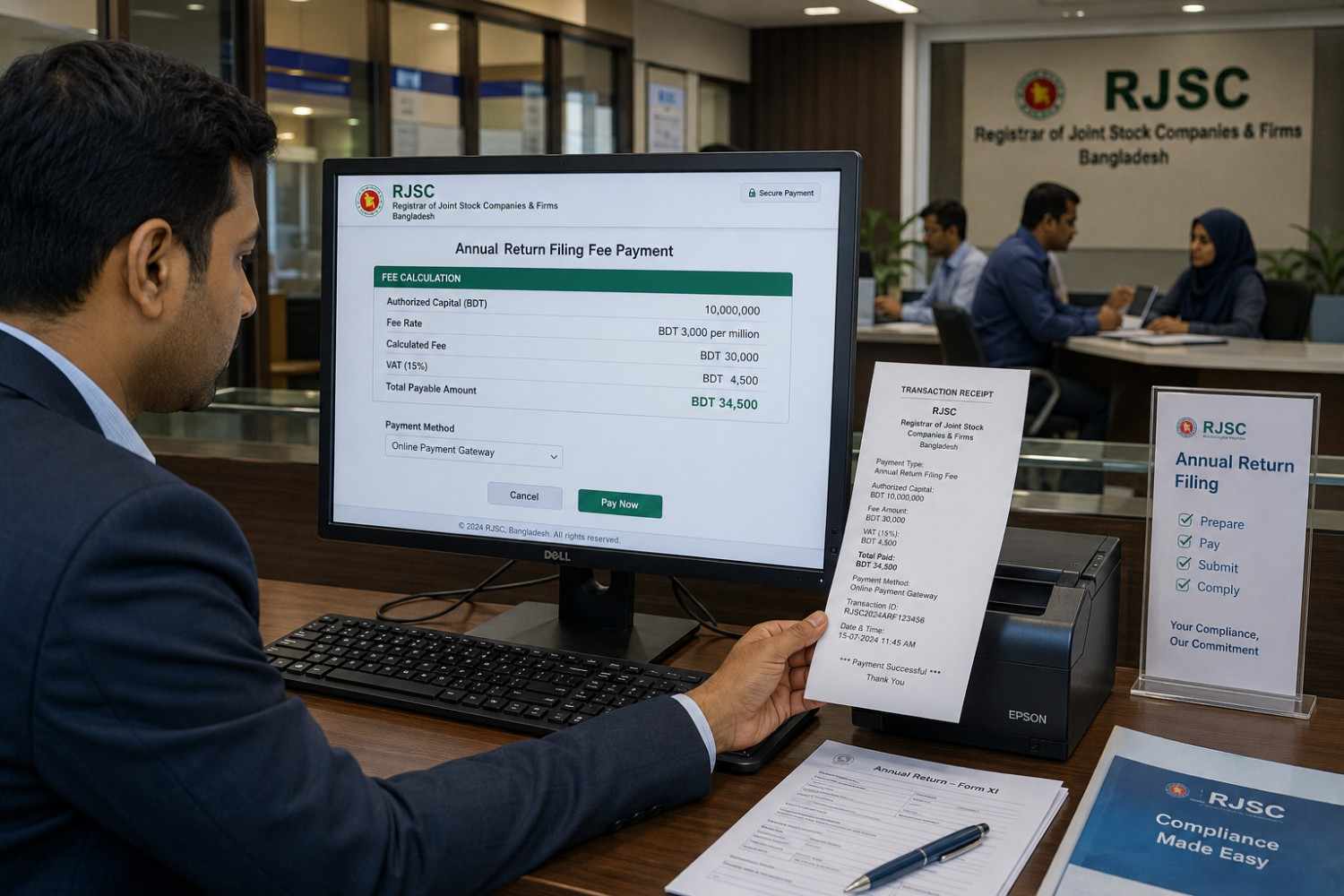
The cost of filing depends on your company’s capital structure. You need to know your authorized and paid-up capital to figure out the applicable fees. Check the official fee schedule from the Registrar of Joint Stock Companies and Firms to make sure you’re following the rules.
Utilizing Authorized Payment Gateways
When you’re ready to make your payment, use the official online payment portals. These secure sites are part of the RJSC platform for easy transactions. Don’t use third-party services, as only payments through authorized channels are accepted.
Retaining Payment Receipts and Transaction IDs
After making your payment, save all digital receipts and transaction IDs. These serve as essential proof of your filing. Keeping these records will help you deal with any issues during the verification process.
| Fee Category | Description | Payment Status |
|---|---|---|
| Annual Return Filing | Standard Schedule X fee | Mandatory |
| Late Filing Penalty | Applied after deadline | Conditional |
| Document Processing | Service charge for portal | Required |
Handling RJSC Queries and Correction Requests
Managing the post-submission phase is a critical part of the filing process. Even with the most careful preparation, you might occasionally face inquiries from the Registrar of Joint Stock Companies and Firms (RJSC) regarding your filings.
Receiving a query does not necessarily mean your filing has failed. Instead, it is a standard part of the regulatory process to ensure all data remains accurate and compliant with local laws.
Monitoring the Status of Your Filing
You should regularly log into the official RJSC portal to check the progress of your submission. The system provides real-time updates on whether your application is under review, approved, or flagged for corrections.
Consistency is key when tracking your submission status. By checking the portal weekly, you ensure that you do not miss any time-sensitive notifications that could delay your compliance timeline.
Responding Promptly to Deficiency Notices
If the RJSC identifies an error, you will receive a formal deficiency notice. You must address these requests immediately to maintain the integrity of your filing.
Failure to respond within the stipulated timeframe may lead to penalties or the rejection of your annual return. Always keep a copy of the notice and prepare your response with the necessary supporting evidence to resolve the issue quickly.
Resubmitting Corrected Documentation
Once you understand the required changes, you must prepare the updated documents carefully. If you are unsure how to proceed after a correction request, review the original guidelines to ensure your new submission meets all technical standards.
After uploading the corrected files, verify that the system has successfully registered the update. Maintaining a clear audit trail of all correspondence and resubmissions is essential for your company records.
| Query Type | Common Cause | Resolution Action |
|---|---|---|
| Data Mismatch | Figures differ from audit report | Reconcile and re-upload |
| Missing Signature | Director signature omitted | Obtain and scan document |
| Payment Discrepancy | Incorrect fee calculation | Pay balance via portal |
| Expired Documents | Outdated financial statements | Provide current certified copies |
Securing Filing Confirmation and Maintaining Records
Getting your official filing confirmation is key to proving your company’s compliance for the year. This document is the ultimate proof that your business has met all statutory requirements for the year. Without it, your compliance cycle is not complete, putting your company at risk of regulatory scrutiny.
Downloading the Official Filing Confirmation
After the Registrar of Joint Stock Companies and Firms (RJSC) processes your submission, log back into the online portal to check your status. You’ll find a downloadable certificate or a stamped receipt once your update is approved. It’s crucial to download this file right away to have a verified copy of your submission.
Organizing Physical and Digital Filing Archives
Keeping a strong archive of your corporate filings is vital for good governance. Store digital backups on secure cloud servers and physical copies in a fireproof cabinet. This two-tier approach ensures you can show proof of compliance quickly during audits or bank inquiries.
| Storage Method | Primary Benefit | Accessibility |
|---|---|---|
| Digital Cloud | Instant retrieval | High |
| Physical Binder | Legal verification | Medium |
| External Drive | Offline redundancy | Low |
Sharing Compliance Proof with Stakeholders
Transparency is crucial for building trust with investors, board members, and financial institutions. By sharing proof of your successful filing, you show your company operates with integrity. This makes future credit applications smoother and boosts your professional reputation in the local market.
Ensuring Long-Term Compliance and Monitoring Future Deadlines
Maintaining your corporate status demands a proactive stance on regulatory governance. It’s crucial to stay on top of the next filing deadline to keep your business compliant. Regular monitoring helps avoid late fees or legal penalties that can hinder your operations.
Creating a recurring internal schedule aids in managing your obligations effectively. By tracking every update, you safeguard your company from oversight. This consistent practice ensures your records are up-to-date and your board is well-informed.

Set calendar reminders for your filing needs well before the due date. Consult with your legal team or company secretary to stay updated on corporate law changes. Your dedication to transparency fosters trust among shareholders and government bodies.
Take charge of your regulatory path by auditing your internal filing processes. A well-organized archive is the cornerstone for future growth and stability. Remain vigilant to ensure your firm prospers within Bangladesh’s legal framework.
Disclaimer: This guide is for general informational purposes only and does not constitute legal advice. Consult a licensed lawyer or registration consultant for your specific case.
FAQ
What is the official RJSC annual return deadline for companies in Bangladesh?
You must file your RJSC annual return in Bangladesh within 30 days after your Annual General Meeting (AGM). The AGM should occur within 15 months of the last meeting, as per the Companies Act. Missing this deadline can lead to hefty fines. It may also threaten your company’s legal status with the Registrar of Joint Stock Companies and Firms.
What is Schedule X and why is it required for my business?
Schedule X is the annual return form detailing your company’s share capital, shareholders, and directors. This submission is a yearly must for the RJSC. It ensures your corporate structure is accurately documented.
How do I file an annual return with RJSC using the online portal?
The process is now online. Log into the RJSC portal, input your company details, and upload Schedule X, audited financial statements, and AGM minutes. Following this process ensures your documents are reviewed efficiently.
What are the primary documentation requirements for RJSC annual return submission?
To successfully complete your filing, gather essential documents. These include audited financial statements, AGM minutes and resolutions, updated director lists, and share transfer proofs. Adhering to these guidelines avoids common filing issues.
How are the RJSC annual return fees calculated?
RJSC annual return fees are based on your company’s authorized share capital. Use the RJSC online calculator to determine the cost. Pay these fees through authorized gateways or banks during your filing.
What happens if I need to update my Schedule X filing due to changes in directorship?
If your company has new directors or resignations, update your Schedule X filing. Reflect these changes in the form to keep the Registrar of Joint Stock Companies and Firms informed.
How do I resubmit at RJSC if there are errors in my initial filing?
If you get a deficiency notice, respond to RJSC queries or correction requests promptly. Review your documents, make digital corrections, and resubmit your package. Timely responses are crucial for final filing confirmation.
Is holding an AGM mandatory for the Schedule X submission process in Bangladesh?
Yes, an Annual General Meeting (AGM) is required before you can file. Shareholders must approve audited financial statements and AGM minutes at the AGM. Without a valid AGM, you cannot legally submit your annual return, as the RJSC needs the meeting date on the forms.
Why is it important to maintain copies of all filed documents for future compliance?
After getting filing confirmation from RJSC, keep both physical and digital archives of your submission. These records are vital for future filings. They help verify data and prove compliance to various stakeholders.
What are the legal consequences of failing to complete the annual return submission at RJSC?
Neglecting this annual filing obligation can lead to your company being marked as “defaulting.” This status can incur heavy fines, prevent trade license renewals, and even lead to your company’s dissolution or striking off by the Registrar of Joint Stock Companies and Firms (RJSC).
-
Foundation Registration in Bangladesh: Easy Guide (2026)
Setting up a non-profit in Bangladesh requires clear planning and a practical understanding of local rules. You’ll face specific administrative steps to ensure your organization operates legally and transparently. Understanding these requirements is the first step to creating lasting social impact. This guide lays out a clear, step-by-step path for Foundation Registration in Bangladesh, covering…
-
One Person Company Registration in Bangladesh: Easy Guide
One Person Company Registration in Bangladesh gives solo entrepreneurs a solid legal foundation to safeguard their assets. This modern business model allows an individual to enjoy corporate perks while retaining full operational control, making it ideal for entrepreneurs aiming to grow without the hurdles of traditional partnerships. Registering your startup with the Registrar of Joint…
-
Company Winding Up in Bangladesh: Complete Legal Guide (2026)
Closing a business entity requires careful navigation of local legal frameworks. Whether you manage a local firm or a foreign enterprise, you must follow the Companies Act of 1994 to ensure a smooth exit. This formal procedure protects your interests while satisfying regulatory obligations. You might wonder how to wind up a company in Bangladesh…
-
Liaison Office Registration in Bangladesh
Expanding your business into new territories requires a clear strategy and a solid legal foundation. Bangladesh offers a wealth of untapped potential for international firms aiming to grow their global footprint. Establishing a local presence through liaison office registration in Bangladesh allows you to conduct vital market research and build lasting professional relationships. Navigating the…
-
Branch Office Registration in Bangladesh: Easy Legal Guide
Bangladesh is one of South Asia’s fastest-growing economies — with strong GDP growth and a population exceeding 160 million, it offers substantial opportunity for foreign enterprises. Establishing a local office gives your company closer control over operations and faster access to customers and partners. This guide simplifies Branch Office Registration in Bangladesh: whether you’re evaluating…